Director of Diplomacy, Representative to UN Geneva & UNESCO, World Jewish Congress
Marking the 10th Anniversary of IHRA’s Antisemitism Definition
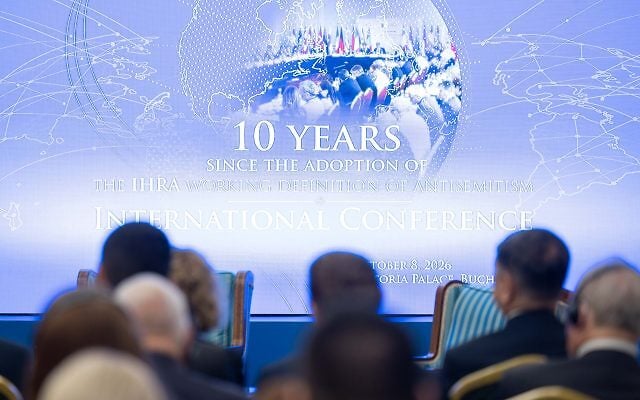
Last week, I had the great honor and pleasure of visiting Bucharest, the capital of Romania, for an international conference to mark ten years since the adoption of the International Holocaust Remembrance Alliance’s (IHRA) Working Definition of Antisemitism. Amid the current explosion of antisemitism globally, this gathering could not have been more timely.
Drafted by several renowned experts and adopted by IHRA, an intergovernmental organization counting today 35 member states, the definition along with its associated examples of antisemitism has become the gold standard for identifying antisemitism and has been adopted by dozens of countries and numerous institutions, including the United Nations and the European Commission. It helps clarify what antisemitism is and how it manifests itself, allowing for the development of effective measures to counter it. The World Jewish Congress is a proponent of the definition, and I personally use it as a reference point in my daily work.
Romania’s government is especially proud of their role in developing the definition, particularly as it was formally adopted in 2016 during the country’s term as IHRA Chair. In Bucharest, the conference paid special homage to late Ambassador Mihnea Constantinescu, thanks to whose vision, leadership and hard work, the adoption of the definition by IHRA by consensus was made possible.
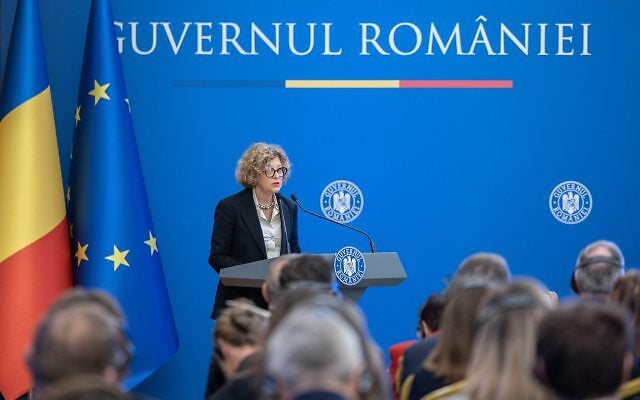
Romania has formally integrated the definition in its national legislation, while other countries are following a similar path. Several governments has published handbooks for its practical use, such as the European Commission and the governments of Australia and Canada.
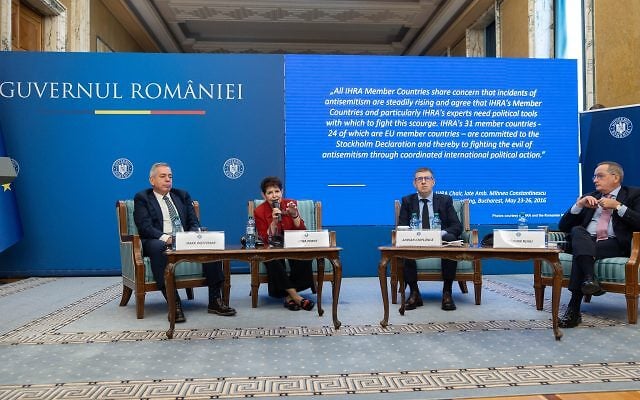
In my intervention, I remarked that the definition has become a victim of its own success. It has been attacked from different sides because it works and it exposes the haters. I stressed the importance of the definition as a cornerstone and critical tool for all international and domestic efforts to counter the scourge of antisemitism. But to have an impact on the ground, the definition needs to be applied more vigorously and be accompanied by political will.
One of its innovations— and a focus of much discussion — are its eleven illustrative examples that constitute an integral part of the definition and provide insight into how antisemitism manifests today in a variety of settings. Crucially, this specificity enables educators, law enforcement, and sporting institutions, among others, to recognize and react to real-life scenarios with practical solutions that tackle the root of the problem.
Some of its examples detail how antisemitism can be masked as criticism of the policies of the State of Israel. While criticism of the State of Israel, like any other state, is completely legitimate, some expressions carry antisemitic tropes and cross several red lines. These elements are identified by the definition in a very clear manner.

Jews and Jewish communities around the world ought to be able to live freely and openly, without fear for the physical security or having to hide their identity. Jews can feel when something is antisemitic and the definition helps codify and explain it to the authorities and the wider society. This is why the World Jewish Congress stands firmly behind it, as it offers a solid foundation to our 103 affiliated communities around the world to advocate against antisemitic hatred.
Related Topics
Related Posts