


Stephen J Stern PhD
Martin Buber Goes To A Grateful Dead Show: The Ethics of Jewish Jam
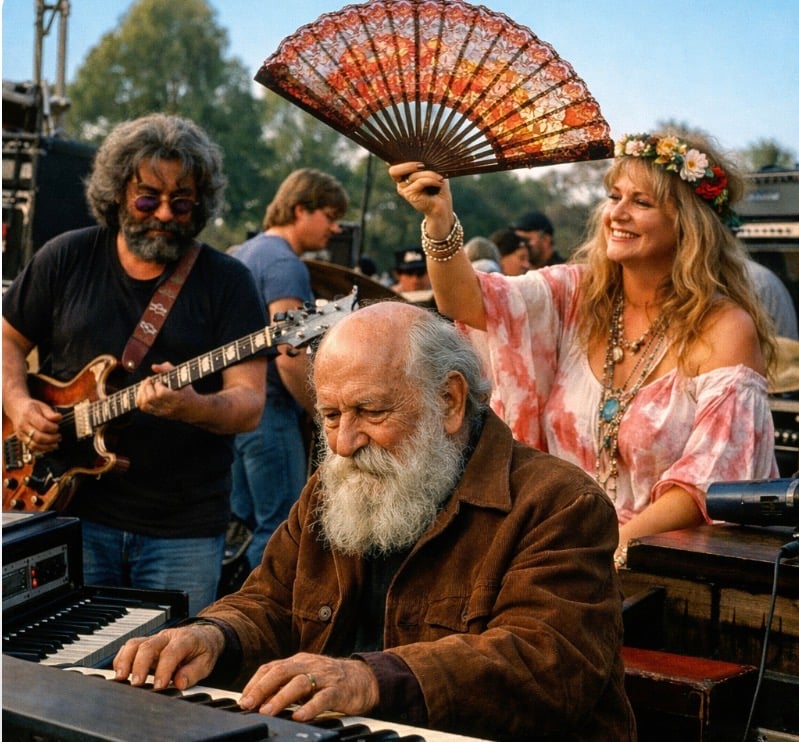
Martin Buber playing with the Grateful Dead. AI image created by author.
The Lady With a Fan
What might Martin Buber and postmodern Jewish thought have to do with a Grateful Dead concert? At first glance, not much. One belongs to the world of ethical reflection shaped by centuries of Jewish understanding, the other to American improvisational rock. Yet both circle around the same human question: how people respond to one another in the unfolding present. Listening to The Lady With a Fan through the lens of Jewish philosophy reveals an unexpected resonance between Buber’s ethics of encounter and the communal improvisation of a Grateful Dead show.
The Lady with the Fan is a famous painting by Gustav Klimt. No one knows who she is. Klimt often painted Jewish women, and some have wondered whether she herself may have been Jewish. If so, the Grateful Dead intersect with Judaism in a way no one planned. If not, they get there anyway. Let’s look.
“Let my inspiration flow in token rhyme.” The opening line of the song seems modest, almost disarming. It asks only that an inner movement take shape in language. Yet embedded in that request is a philosophical assumption: meaning originates within the self. If inspiration moves, expression follows. If expression coheres into rhyme, meaning has arrived.
Several postmodern Jewish philosophers challenged this assumption. Dialogic philosophers Franz Rosenzweig and Martin Buber argued that meaning begins not within the isolated self but with an address that comes from beyond it. Martin Buber insisted that the self becomes real only in an encounter with another. Phenomenologist and Talmudist Emmanuel Levinas went further, suggesting that responsibility for the other precedes freedom itself. Hélène Cixous, writing from the layered memories of exile and colonial displacement in Algeria, reminds us that even the most personal voice emerges from inheritance and relation. Across these thinkers, the human being does not originate meaning. One is first addressed and only then responds.
This reversal reshapes ethics. Much modern moral reasoning justifies action by outcome. Jewish philosophical thought resists that logic. Responsibility to the other does not depend upon success. The ethical act remains binding, even when its outcome is uncertain or invisible. Levinas expressed this when he argued that the face of the other interrupts the self before calculation begins. One helps not because it will solve the situation, but because the other has already placed a claim upon one’s existence.
These philosophical insights echo patterns already present in Jewish tradition. The Hebrew Bible presents command before comprehension. Abraham is called before he understands where he is going. At Sinai, the Israelites respond to divine command with the striking phrase, “We will do and we will hear.” Action precedes understanding. Ethical life, in this view, is organized around responsiveness. One acts because I have addressed one.
History forced Jewish thought to test this conviction under catastrophic conditions. When the Second Temple was destroyed by Rome in 70 CE, the center of Jewish ritual life disappeared. Yet Jewish life did not vanish with it. The reason is instructive: the center of Jewish existence had never been success or political control but covenantal obligation. The Rabbinic response to catastrophe was therefore not only survival but also a reimagining of sacred space.
With the Temple gone, holiness was no longer tied to a single geographic site. The Talmud became, in a sense, a third temple—not built of stone but of argument, memory, and study. Wherever Jews gathered to learn and debate its pages, they reassembled the sacred in conversation. Shared study replaced pilgrimage, and the page became the meeting place where a dispersed people continued to encounter one another and God.
Within this framework, inspiration still matters. The Lady with the fan awakens movement. Jewish thought does not deny needing awakening, yet awakening alone cannot sustain ethical life. The wind may begin the journey, but responsibility determines whether the traveler continues walking.

Sung in the storytelling voice of Jerry Garcia, the song unfolds like a wandering parable in which three figures appear: a sailor, a soldier, and a gambler. Each represents a different way of inhabiting uncertainty.
The sailor navigates wind and tide without controlling either. His craft lies in responsiveness. He trims the sail and reads the movement of the sea. Navigation depends not on mastery but on attentiveness. In this sense, the sailor resembles the ethical subject described by Levinas and Buber: one moves through the world not by commanding circumstances but by responding to what appears.
The soldier represents another orientation: obedience. Yet within Jewish tradition, obedience rarely means silent submission. Commandment must be studied, interpreted, debated. Responsibility remains binding even when victory is uncertain, because the act itself responds to a claim placed upon the self.
The gambler embodies the opposite temptation. The gambler entrusts the future to chance. Jewish ethics resists this posture. I cannot leave responsibility to luck. One answers the call of the other not because success is likely, but because the other stands before us.
The horizon of the song is Terrapin. It appears less than a destination than as a distant promise. The characters move toward it without certainty of arrival. In this sense, Terrapin resembles the structure of hope within Jewish thought. Redemption is anticipated but never guaranteed. One walks toward it nonetheless.
Seen in this light, one can imagine Martin Buber at a Grateful Dead show. The music unfolds in the immediacy of the present moment. Songs stretch and wander. Improvisation replaces rigid structure. Listening to the Dead often feels less like following a path toward a fixed destination than like inhabiting a shared unfolding in which musicians and audience respond to one another in real time.
Every song arrives somewhere, but the arrival is not a conquest or resolution. It is recognition. Musicians hear one another. Listeners answer with movement and applause. A community forms within the unfolding sound.
The music mirrors the ethical structure described by Jewish philosophers. Meaning does not lie in reaching a predetermined end, but in responsiveness within the unfolding moment. Each note answers another. Each person responds to another.
The Lady with the fan invites inspiration to move. Jewish thought invites the self to respond. The Dead invite something simpler still: people dancing together in the present moment. In that dancing—before certainty, before outcome, before philosophical explanation—one glimpses what Buber described. Meaning arises not from solitary inspiration but from the encounter between people who continue to respond to one another in making meaningful life.
Inspiration may open the air, but covenant builds the house that keeps life within that air. Sometimes, when that house fills with music, the response required is not theory but joy, the joy of dancing in the streets like the Rainbow Girls: https://youtu.be/kezfbRkOVYw?si=_WfLlRSTYfJLU8Sx
This is a summary of a chapter written for a forthcoming book edited by Steve Gimbel, PhD, to be published by Duke University Press Series on The Grateful Dead.