
Matot-Masei: Wrestling With Tough Questions
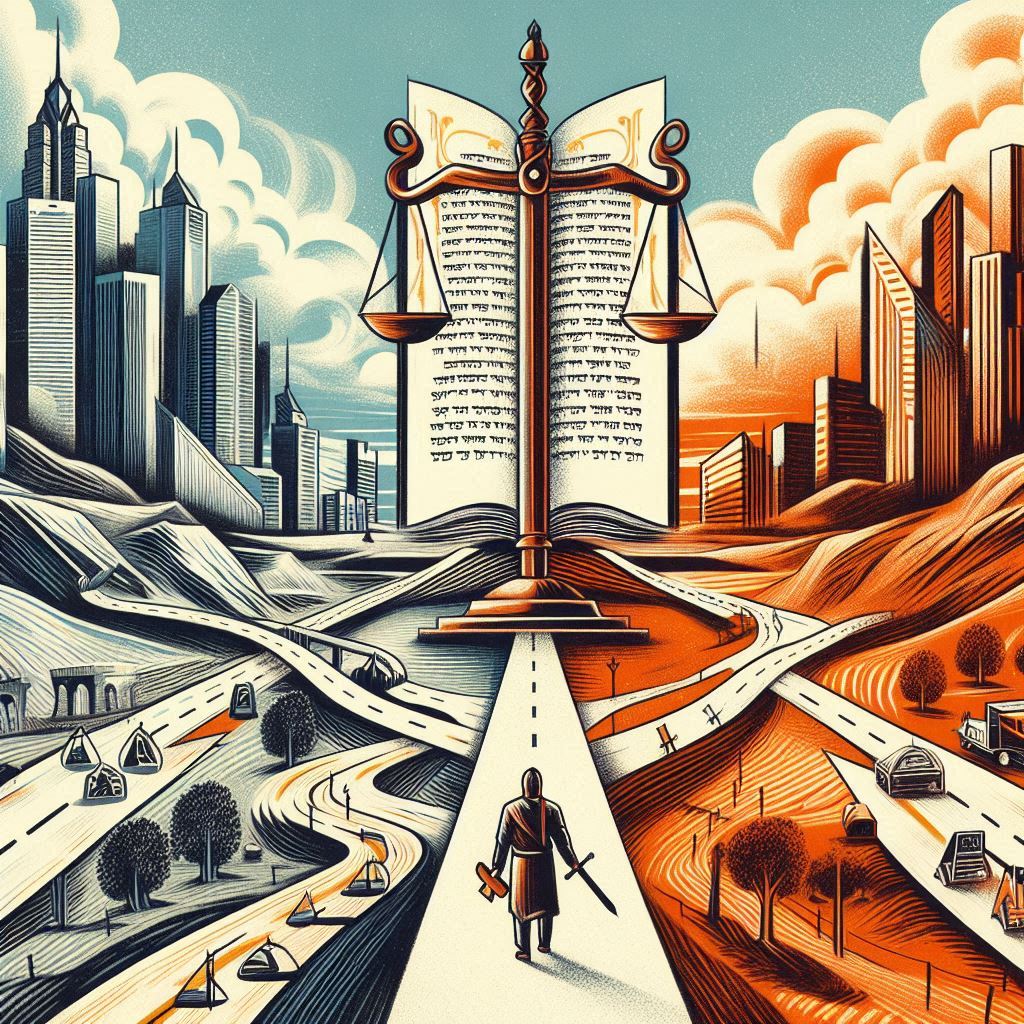
The Torah in this week’s double portion contains some of the concepts many of us find very challenging. As Rabbi Sacks taught, “The Torah’s greatness is that it trusts us with the hard questions, inviting us to wrestle with its laws to refine our moral vision and grow as ethical beings.”
Let’s wrestle!
As a parent, and as a person of faith, I sometimes wish religion were clean and uncomplicated—black and white, always palatable to the modern world we live in. But it isn’t. And life isn’t either. G-d doesn’t ask us to live in simplicity—He asks us to live in truth. He challenges us, because challenge is the foundation of growth. Free will is the very basis of this world: for every impulse to do good, there is a voice pulling us the other way. We therefore have to learn to fight these impulses and that at some level requires us to grapple with tough stuff.
It is of course easier to write about uplifting values and moral teaching that slot into today’s environment perfectly, but when the Torah presents us with laws—on war, vows, gender roles, and justice—that we find hard to understand in our modern context, we must not look away. We must wrestle with them. That’s what it means to be in covenant with G-d.
The Torah doesn’t pretend life is simple. It gives us a framework to navigate complexity. In a world of volatility, it is a constant—a moral anchor that helps us hold steady when everything else shifts.
In this context we also have to consider that society’s view of what is acceptable is constantly changing as I illustrate below, against which we have a very strong anchor.
An Example of Shifting Ground: Sheffield, 1997
An example of the shifting of the ground in a matter of years is something I experienced personally. I remember my first day of work in Sheffield, England, in 1997. A new, female, colleague asked, “Is it okay to wear a trouser suit to work?” The answer—“It’s at the discretion of each partner”—seemed normal then. Today, the very need to ask such a question would seem absurd and the answer completely inappropriate.
That moment has stayed with me. It reminds me that what we call “modern values” are constantly shifting. What’s progressive today may be regressive tomorrow. So when we say the Torah is outdated, we must ask: compared to which moment in time?
The Torah doesn’t chase trends. It offers something deeper—a moral anchor. Its laws, even the difficult ones, challenge us to think beyond the moment and ask what justice, dignity, and accountability truly mean.
Justice and Intent: The Cities of Refuge
There are so many concepts in this week’s Parshah I had to focus on one.
One of the most morally sophisticated ideas in the parshah is the institution of the Arei Miklat—Cities of Refuge. Someone who kills unintentionally must flee immediately without haste to one of these cities and remain there until the death of the High Priest (Numbers 35:9–34). Why exile someone who didn’t mean to kill?
Because the Torah recognizes that intent matters, but so does impact. Even accidental death demands accountability. The Torah’s legal system distinguishes between premeditated murder and manslaughter—long before modern legal systems developed categories like first-degree murder, second-degree murder, and negligent homicide.
Today, society has moved beyond the concept of Cities of Refuge to a system of incarceration. But while the structures have changed, I don’t think many would argue that we’ve significantly advanced in the quality of the solution. Prisons often fail to rehabilitate, and justice systems around the world struggle with fairness, overcrowding, and recidivism.
The Torah, by contrast, presents a blueprint that balances justice with compassion. The City of Refuge is not a prison. It’s a space for reflection, for spiritual growth, and for the community to grapple with the value of life and the cost of its loss. It’s a model that holds people accountable while still preserving their dignity and potential for change. It is a principle from which to draw practical solutions fit for today.
A Law That Rarely Happened—But Still Matters
Interestingly like seems to be the case with the Cities of Refuge, the Torah devotes significant space to laws that may have rarely, if ever, been applied. The rebellious son. Capital punishment for Shabbat violation and others such as the Sotah. The Mishnah (Makkot 1:10) famously says that a Sanhedrin that executed once in seven (and some opinions say seventy) years was considered destructive.
We were never a society that practiced mass punishments – so these examples are an absolute exception – So why include these laws at all?
Because the Torah is not just a legal code—it’s a moral blueprint. These laws teach us what society should value: life, intent, accountability, and compassion. Even if rarely enacted, they shape our ethical imagination.
Context Matters: War, Women, and Moral Complexity
This parshah doesn’t shy away from complexity in other areas as well. It addresses a wide range of morally and halachically challenging topics—from the laws of warfare to the role of women in shaping halacha.
One of the most difficult passages is the command to attack Midian. It raises profound ethical questions, especially regarding the treatment of non-combatants. But the Torah presents this as a specific response to a specific threat at a specific time. These are not open-ended permissions for violence, but reflections of a morally complex moment in our national history. They are recorded not to be repeated, but to be wrestled with. That we have it enables us to have a discussion about what is required at a moment when G-d is not personally involved (as is the case with the Firstborn of Egypt) and from that has sprung moral codes which are followed to this day, in direct opposition to these rules.
We also encounter one of the Torah’s most inspiring legal transformations as related to women’s right: the story of the daughters of Tzelofchad. These five women stood before Moses and demanded justice. G-d affirmed their claim, and the law changed. This wasn’t just a legal ruling—it was a moment of halachic evolution, driven by moral clarity and courage. It reminds us that the Torah doesn’t just tolerate questions—it grows through them.
Conclusion: Wrestling Is Faith
We live in a world where values shift rapidly. What’s considered ethical or enlightened today may be questioned tomorrow. But the Torah offers something deeper: a framework for moral clarity that transcends time.
Parshat Matot-Masei reminds us that the Torah’s relevance isn’t in how easy it is to read—but in how deeply it challenges us to think, to feel, and to live with integrity.
The Torah doesn’t ask us to retreat from the world. It asks us to engage with it. To challenge injustice. To elevate the human spirit. To wrestle with hard truths—and emerge stronger.