NAnews - Nikk.Agency Israel News
May 14: Ukraine Remembers Famous and Unknown Rescuers of Jews
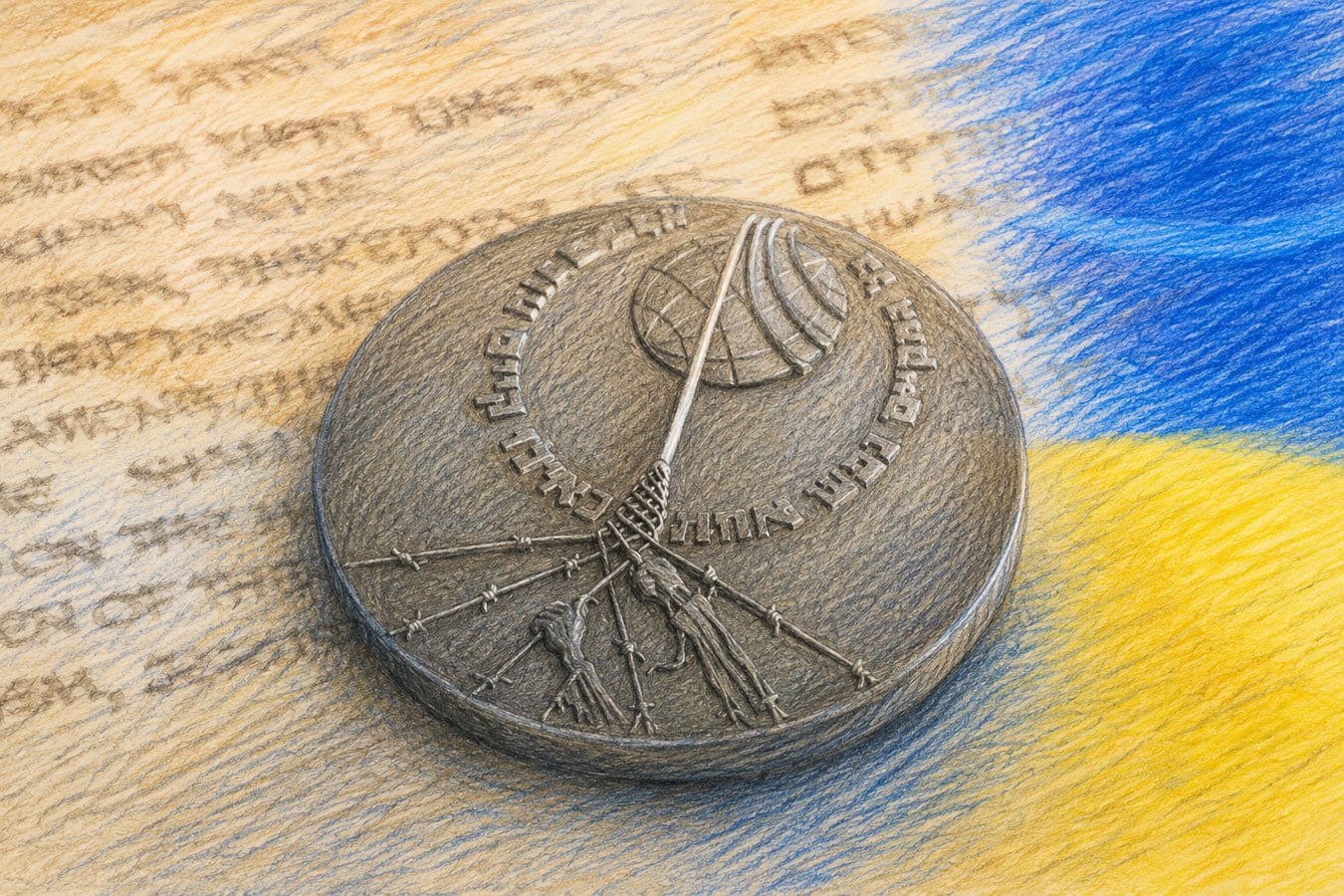
Memory cannot be stored in lists: May 14th is Remembrance Day in Ukraine for those who saved Jews. Illustration created with AI.
Ukraine’s Day of Remembrance for those who rescued Jews during the Holocaust is not only about those officially recognized. It is also about the names that disappeared, the stories still being restored, and the lives that continued because someone opened a door.
On May 14, Ukraine marks the Day of Remembrance for Ukrainians who rescued Jews during the Second World War.
It would be easy to begin with the number of Ukrainians recognized by Yad Vashem as Righteous Among the Nations. That number matters. It is part of Israel’s official memory, part of the historical record, part of the long moral archive of the Holocaust.
But this day asks for something more.
It is not only about those whose names entered official lists. It is also about those whose names were lost, whose documents were never preserved, whose stories never reached an international recognition process, yet whose actions allowed another human life to continue.
That is the real nerve of May 14.
The Ukrainian Institute of National Remembrance has emphasized that this date honors not only the officially recognized Righteous Among the Nations, but all Ukrainians who rescued Jews during the Holocaust — known and unknown. The day was established by the Verkhovna Rada of Ukraine in 2021, under a resolution honoring the memory of Ukrainians who saved Jews during the Second World War.
Ukraine first officially marked it on May 14, 2021.
The date itself carries two meanings.
For Israelis, May 14 immediately evokes the declaration of independence of the State of Israel in 1948. That gives the Ukrainian day of remembrance a powerful symbolic layer: the birthday of the modern Jewish state has also become, in Ukraine, a day of gratitude to those who helped Jews survive long enough for that future to exist.
But there is also a tragic Ukrainian connection.
On May 14, 1942, in Nazi-occupied Rivne, the Sukhoverky family was executed for hiding a Jewish girl. Their “crime” was that they refused to surrender a child to the machinery of death. This is why the date cannot be treated as an abstract memorial day. It is tied to the price of saving one human life.
And sometimes one saved life is not one life.
Sometimes it is a family.
Sometimes it is children and grandchildren.
Sometimes it is an entire world that did not end.
During the Nazi occupation of Ukraine, helping Jews often meant a death sentence not only for the rescuer, but for the rescuer’s family. A hidden child, a forged document, a bowl of food, a warning before a raid, silence at the right moment — any of these could become fatal.
Still, there were people who opened the door.
This is why memory cannot be held by statistics alone.
One of the most important Ukrainian efforts in this field is the “Bank of Portraits” project of the National Museum of the History of Ukraine in the Second World War. It is not just a database. It is an attempt to restore human faces to names that could otherwise remain lines in a table. The project publishes research on Ukrainians recognized as Righteous Among the Nations, collecting biographical essays, video testimonies, photographs, documents and other sources for each person. According to the article published by NAnews – Nikk.Agency Israel News, the database currently includes 441 portraits.
Four hundred and forty-one portraits.
That means 441 lives seen not as entries in an archive, but as human beings who made a choice under terror.
General information about rescuers is available through Yad Vashem in Jerusalem and through the Ukrainian Institute for Holocaust Studies “Tkuma.” But Ukrainian museum initiatives are trying to do something broader: to make the story of each rescuer fuller, clearer and known beyond a narrow circle of historians.
This matters because many stories survived only in fragments.
A family remembered that a grandmother once hid someone.
A village remembered that a Jewish child had been saved there.
A document appeared decades later.
A testimony arrived too late to reconstruct everything.
Memory often returns in pieces.
There are also Ukrainian Jewish forms of recognition beyond the international title of Righteous Among the Nations. The Jewish Council of Ukraine has honored rescuers with the titles of Righteous of Ukraine and Righteous of Babyn Yar. These forms of recognition matter because not every act of rescue can pass through the formal international procedure. That does not make the act less real.
Among the Ukrainian Righteous, Maria Babych occupies a special place.
She was the first Ukrainian to receive the title of Righteous Among the Nations. In occupied Rivne, she saved the Jewish girl Irit Osipova. After the war, the story did not end. Babych became part of the Osipov family and moved with them to Israel. She was recognized as Righteous Among the Nations on May 1, 1962.
There is something deeply moving in that arc.
Rivne. A Jewish child. A Ukrainian woman. A family that survived. A journey to Israel.
Not diplomacy.
Not slogans.
A human act that physically connected Ukraine and Israel through the life of a saved child.
This is why May 14 should not become a formal commemoration. Its meaning is too intimate for that.
In 2026, Israeli Ambassador to Ukraine Michael Brodsky marked the date by recalling that during the Nazi occupation of Ukraine, the Jewish population was subjected to mass destruction, while Ukrainians who risked their own lives and expected no reward helped Jews escape death. He also noted that Ukraine ranks fourth in the world by the number of those recognized as Righteous Among the Nations, after Poland, the Netherlands and France.
The Chief Rabbi of Ukraine also referred to the day after taking part in a memorial event at Babyn Yar. That location gives any words about Holocaust memory a different weight. Babyn Yar is not a place where one can speak lightly. Every mention of rescue there stands beside the abyss of destruction. The rabbi reminded Ukrainians and Jews that behind every number stand thousands of saved Jewish lives.
Jewish communities across Ukraine used different words, but the same moral language: gratitude.
Some spoke of a debt that can never fully be repaid. Others recalled the teaching that whoever saves one life saves an entire world. The Federation of Jewish Communities of Ukraine wrote that the rescuers chose humanity instead of fear, life instead of silence — without glory, without awards, simply with a heart.
That sentence may be the simplest way to understand the day.
Without glory.
Without awards.
Simply with a heart.
The General Staff of the Armed Forces of Ukraine also marked May 14, connecting the memory of those who saved Jews during the Second World War with the struggle against antisemitism, racism and all forms of intolerance today. Its message used the Hebrew phrase “Never Again” and placed Holocaust memory within the wider moral responsibility to resist hatred and punish war criminals.
For an Israeli audience, this is not an abstract connection.
In Israel, “Never Again” is not only about mourning the past. It is also about recognizing evil in the present. It is about understanding that memory loses its force if it becomes a ritual without moral consequences.
Ukraine’s May 14 day of remembrance is therefore not only Ukrainian.
It belongs also to Jewish memory.
It belongs to Israeli memory.
It belongs to every family whose existence may trace back to one person who decided not to look away.
The rescuers could not stop the Nazi machine.
They could not end the occupation.
They could not guarantee that the people they hid would survive the next day.
But they could hide one child.
They could pass food.
They could warn.
They could keep silent.
They could say: stay here.
And sometimes that was enough for an entire world to continue.
May 14 reminds Ukraine and Israel that memory is not only grief. It is gratitude. It is also the obligation to name, study and preserve the lives of those who did not betray the human being inside themselves when the world around them was collapsing.
Because memory cannot be kept in lists alone.
It needs names.
It needs faces.
It needs stories.
And it needs the courage to say that even in the darkest time, one human choice could still keep the future alive.
Related Topics
Related Posts