

Recovered Antisemite
May I Speak to My Chosen People?
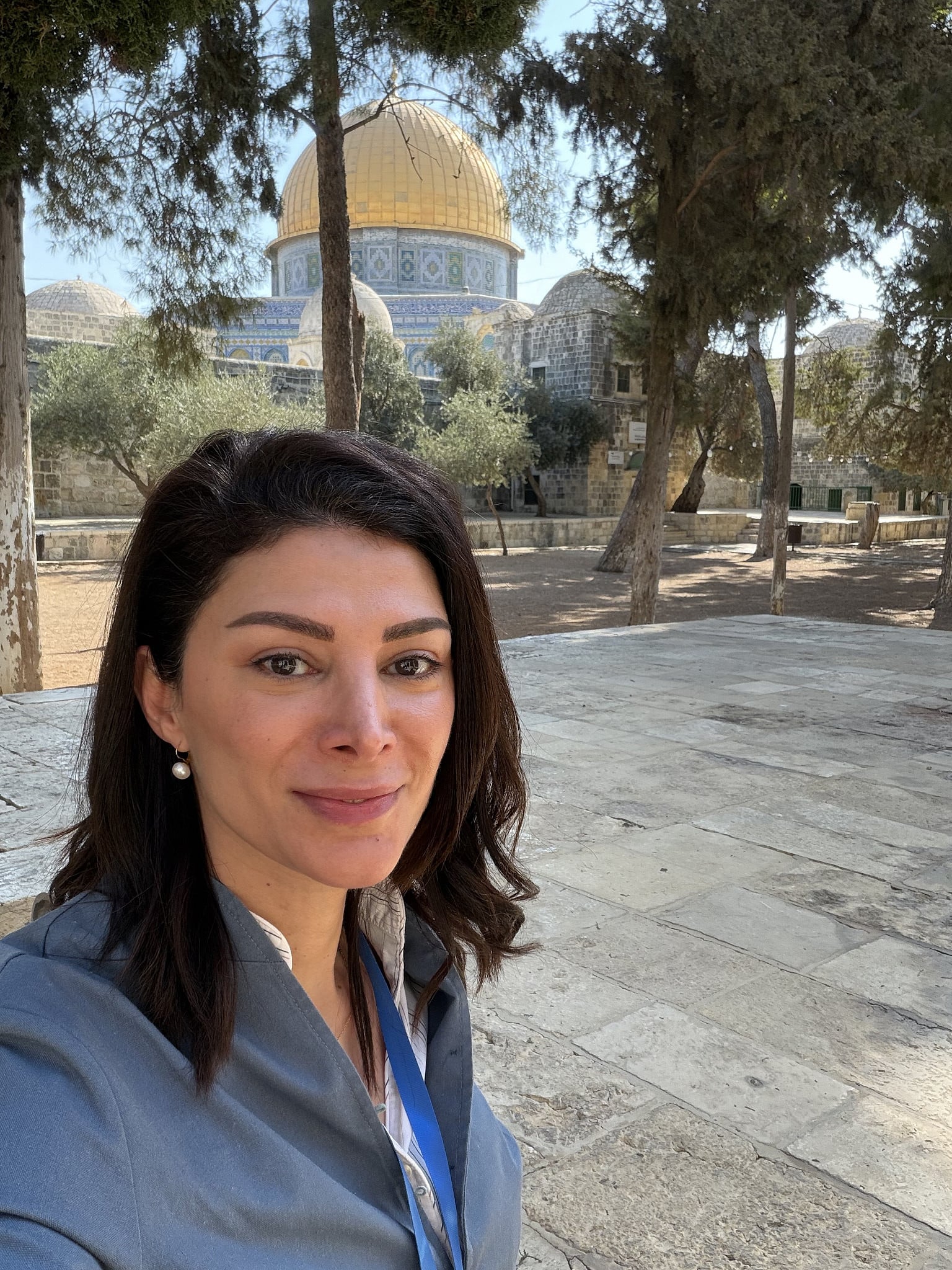
Selfie on the Temple Mount -- First visit, October 2025.
I speak as an outsider.
A wandering Jewess.
One who belongs everywhere and nowhere at once.
One who did not grow up wrapped in certainty, but in questions.
And yet — Jeremiah lives in my bones.
So I ask, humbly but unapologetically:
May I speak to my chosen people?
And may I dare call the State of Israel the Third Temple?
Before some jump at my throat, bear with me.
In classical Jewish theology, the Third Temple is clearly defined:
a physical Beit HaMikdash,
built on Har HaBayit,
with renewed sacrificial service,
and bound to messianic redemption.
By that definition — and I say this plainly — the State of Israel is not the Third Temple.
But Judaism has never been a faith of stone alone.
When the First Temple fell, we did not disappear.
When the Second Temple burned, we did not dissolve into history.
We adapted — not by abandoning holiness, but by carrying it.
At Yavneh, Torah became a portable sanctuary.
The Jewish home became a mikdash me’at, a small temple.
Jerusalem remained our spiritual axis — even when it stood in ruins.
Judaism learned how to survive without walls, without altars, without sacrifice —
but never without responsibility.
So when I say that Israel is the Third Temple, I am not making a halakhic claim.
I am making a civilizational, moral, and historical one.
What Was the Temple, Really?
The Temple was not merely architecture.
It was the center of Jewish sovereignty, accountability, and unity.
It was where Jewish fate converged.
It was the place where holiness and power were forced to meet.
And when that meeting failed — when ritual replaced ethics, when faction replaced fraternity — the Temple fell.
The Talmud does not blame Rome alone.
It does not hide behind geopolitics.
It names the sin with surgical precision: sin’at chinam — baseless hatred.
The Second Temple was destroyed not because Jews were weak,
but because they were divided.
Today, Jewish fate once again converges in Jerusalem.
Jewish power once again exists.
Jewish sovereignty, for the first time in two thousand years, is real.
And the world watches — not just Israel, but all Jews — through that prism.
If that is not Temple-like responsibility, what is?
Sacrifice Without Closeness
The Hebrew word for sacrifice, korban, comes from kirvah — closeness.
Sacrifice was never meant to glorify death.
It was meant to bring people closer — to God, to one another, to moral truth.
And yet today, the sacrifices are unbearably real:
young soldiers, murdered civilians, shattered families, broken trust, hostages waiting in darkness.
If sacrifice no longer leads to closeness,
if blood no longer binds us but tears us apart,
then the warning Jeremiah screamed into the streets echoes again.
Not destruction by enemy hands —
but erosion from within.
Hanukkah Knows This Story
Hanukkah is not only a holiday of light.
It is a holiday of fragility.
A Temple once stood defiled.
Not destroyed — but hollowed out.
Power existed, but holiness had been compromised.
And the miracle was not that a mighty army prevailed.
It was that a small flame was protected.
That someone cared enough to preserve purity, continuity, meaning.
One cruse. One flame. One refusal to surrender the soul.
Hanukkah reminds us that temples are not lost only through fire —
they are lost when people stop guarding what makes them sacred.
A Temple Can Fall Without Burning
If the First Temple was destroyed by corruption,
and the Second by hatred,
then the Third — whatever form it takes — will not be destroyed by enemies alone.
It will fall if Jews forget that unity is not sentiment but survival.
That disagreement without responsibility becomes fracture.
That power without humility becomes idolatry.
I do not call Israel the Third Temple to sanctify politics.
I call it the Third Temple to warn us.
Because temples do not announce their collapse in advance.
They fall while people insist everything is fine.
A Plea, Not a Verdict
I do not stand above my people.
I stand among them — bruised, loving, afraid, hopeful.
I speak not as a prophet, but as one haunted by prophecy.
Not as a judge, but as a witness.
If this is our Third Temple in responsibility —
then it can still stand.
But only if we remember what destroyed the ones before it.
This Hanukkah, as we light candles against the dark,
may we remember that the greatest threat was never the Greeks, the Romans, or the world.
It was always what we allowed to grow between us.
And may we choose, this time, to guard the flame.