Courtyards and Characters: Wandering Through Jerusalem’s Living Stories
Maybe We All Should Have Some Jerusalem Syndrome
Reflections on how Jerusalem disrupts, overwhelms, and sometimes awakens the people who come here
I’ve spent enough time sitting in cafés in the Old City, watching tourists from all religions and nationalities wander through the labyrinth of these ancient alleyways, to realize that Jerusalem affects people differently than probably any other place on earth.
This city compresses religion, nationalism, history, longing, violence, memory, and holiness into an impossibly small amount of space. For some people, especially those already struggling with pre-existing mental health conditions, the intensity can become overwhelming.
That phenomenon has a name: Jerusalem Syndrome.
The Acute Version
We usually talk about the extreme cases, the classic Jerusalem Syndrome stories. The accountant from Ohio who suddenly decides he’s the Prophet Isaiah, wraps himself in a bedsheet he lifted from the Sheraton, and starts preaching near Jaffa Gate. The tourists who become convinced they’ve been chosen to announce the apocalypse. The guy who tried to pry stones out of the Western Wall because he believed he was Samson (true story). Oh, and my personal favorite, the woman who showed up at a Jerusalem hospital insisting she was about to give birth to the savior, despite not actually being pregnant.
These stories are all real, and psychiatrists at Jerusalem hospitals have been dealing with this for decades. Every year, a certain number of tourists arrive in the city and completely lose touch with reality. Some become convinced they’re biblical figures. Others begin delivering sermons or speaking in tongues outside cafés or in hotel lobbies. Some even start wandering the desert barefoot, sporting a loincloth, or worse, the modern-day equivalent: a Speedo.
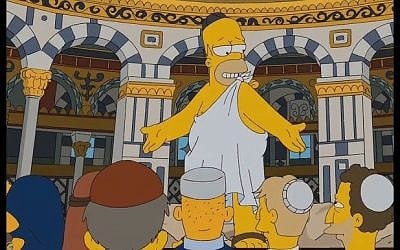
Even this guy came down with the syndrome when he came here:
I’ve had firsthand experience with it. About 35 years ago, when I was a young yeshiva student in the Old City, a close friend and fellow student suddenly became convinced he was the Kohen Gadol, the High Priest, and that he was destined to help restore animal sacrifice on the Temple Mount. What I didn’t know at the time was that he had stopped taking his medication for bipolar disorder.
His parents called from abroad and begged me not to let him out of my sight until they could get on a plane and bring him home. I spent the next day and a half following him through Jerusalem as he moved through an intensely heightened psychological and spiritual state.
That experience stayed with me for years, partly because it raised an obvious question:
Why here?
Nobody talks about Tokyo Syndrome or Rome Syndrome. Tourists don’t generally land in Athens and suddenly begin identifying as Zeus or Achilles. So what is it about Jerusalem that affects people this way?
Our Internal Jerusalem Movie
Part of the answer, I think, is that people do not arrive here emotionally neutral.
Long before they ever board a plane, Jerusalem already exists in their imagination. They have prayed toward it, read about it, sung about it, dreamed about it, argued over it, and built entire identities around it. Then suddenly they are physically standing inside the place itself.
And the experience can be intense.
I see versions of this constantly as a guide.
You can see it at the Tomb of the Patriarchs in Hebron or the Western Wall in Jerusalem, watching a completely secular guy from Chicago place his hand on the stones and unexpectedly start crying like he’s just lost a best friend.
Or you’re on the Via Dolorosa watching evangelical tourists reenact the Passion of Christ, bearing wooden crosses through the alleyways and wearing crowns of thorns under the scorching Jerusalem sun.
After a while, you realize that people do not really come to Jerusalem as tourists. They arrive with an entire internal movie about what this city means.
For Jews, it’s the address of two thousand years of longing followed by prophetic return.
For Christians, it’s the setting of the final week of the life of their Savior, where he conducted the Last Supper before being crucified and resurrected.
For Muslims, it’s the place where the Prophet Muhammad made his mystical Night Journey.
For everyone, it’s where heaven and earth feel slightly closer together.
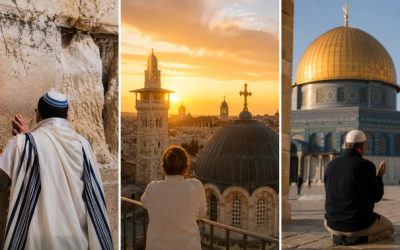
Then they arrive here and encounter the actual city: the church bells, the muezzins, the soldiers, the incense, the prayers, the arguments, the holiness, the politics, the tension, and the astonishing reality that dozens of groups all believe God gave them spiritual title deeds to the same few square miles.
At a certain point, you begin to understand why this city affects people so deeply.
The Softer Version
But I actually think there’s an even softer version of it that hits almost everyone who comes here. And maybe that’s the real Jerusalem Syndrome.
Not the tourists in bedsheets screaming scripture outside the Damascus Gate, and not the occasional pilgrim heralding the end of days.
But maybe the softer version of Jerusalem Syndrome is not really about delusion at all.
Maybe the real Jerusalem Syndrome is what happens when people suddenly begin asking larger questions than they were asking before they came here.
Because Jerusalem has a way of disrupting ordinary priorities.
People arrive focused on careers, distractions, entertainment, money, status, and routines. Then they spend a few days in a city where human beings have spent thousands of years arguing about God, truth, redemption, sacrifice, identity, and eternity.
And something inside them shifts.
Maybe the real Jerusalem Syndrome is what happens when people suddenly realize there may actually be things in life more important than comfort, success, entertainment, money, or whatever else they spent the last 20 years chasing.
Jerusalem has a strange way of recalibrating priorities and reordering our internal value systems.
The city doesn’t only overwhelm people. Sometimes it awakens them. Somehow, Jerusalem has a way of forcing people to confront the bigger questions than they were planning to ask.
You can feel it late at night near the Old City walls when Jerusalem suddenly grows quiet for a few brief moments. Or standing on a rooftop hearing church bells, Shabbat songs, and the call to prayer echo together through the cold night air.
There are probably psychological explanations for all of this: sleep deprivation, emotional overload, pilgrimage psychology, and the collision between imagination and reality.
But I also suspect there is something else happening here that is harder to explain.
Jerusalem makes people feel that life matters. That history matters. That human existence may contain meaning deeper than comfort, consumption, distraction, or success.
And honestly, in an age where so much of modern life feels shallow and disposable, maybe a little Jerusalem Syndrome is not the worst thing in the world.
Related Topics
Related Posts