
Media Participation in War: Bias Against Israel
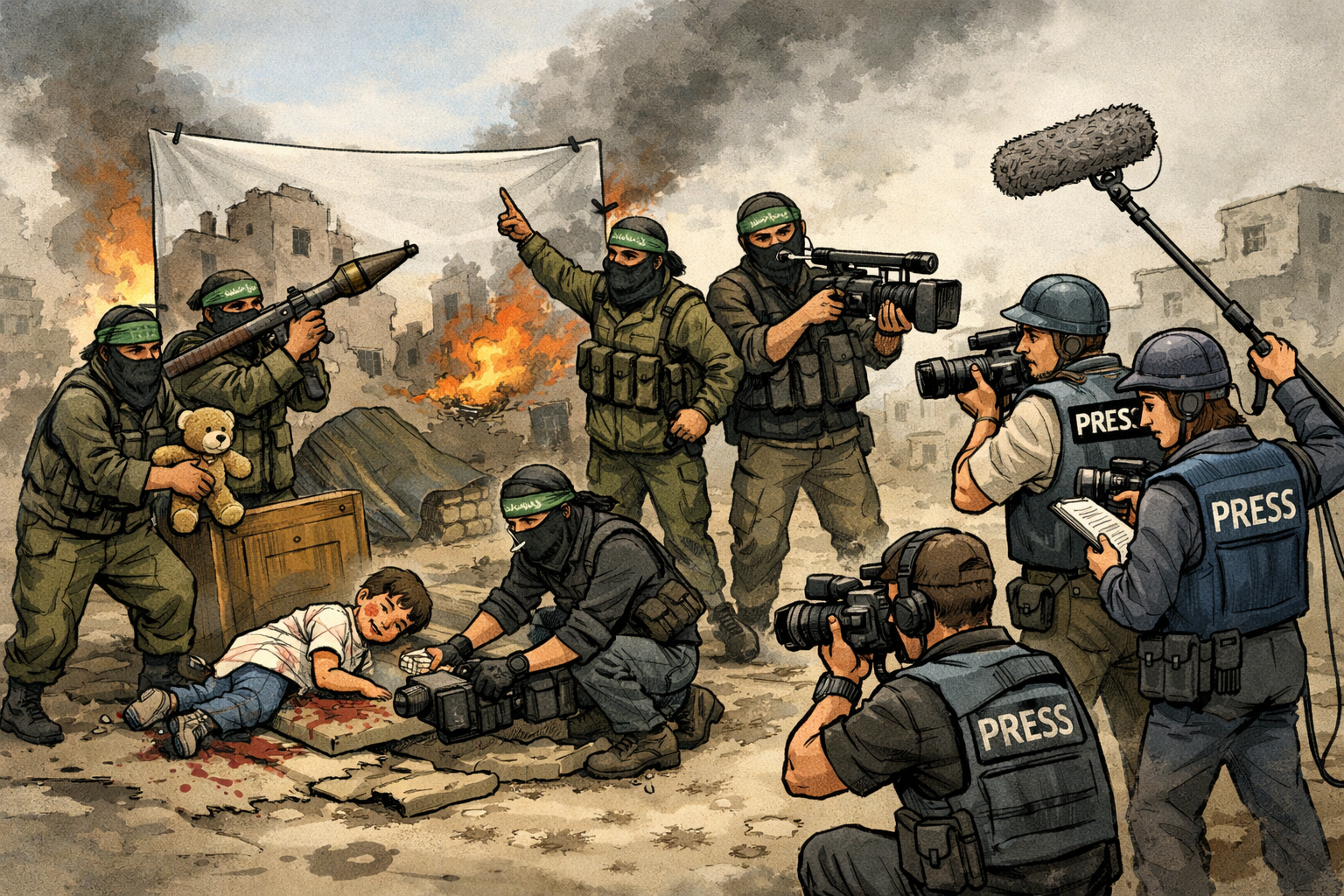
When accusations of genocide and ethnic cleansing are treated as settled facts before investigations begin, journalism has crossed an important line.
In coverage of Israel, that line is increasingly blurred. Headlines often assume intent, amplify partisan claims, and preserve moral conclusions even when facts later change. What emerges is not simply biased reporting, but a new role for the media itself.
Increasingly, major outlets no longer operate as observers of the Arab–Israeli conflict. They operate as participants in shaping its moral narrative. This transformation renders contemporary media bias against Israel not merely unfair, but structurally dangerous.
The Moment the Pattern Became Visible
One moment made this shift unusually clear. On September 1, more than 250 media outlets across over 70 countries displayed the same black banner accusing Israel of waging a “war on journalists.” The campaign’s organizers described it as a “world first.” The messaging was synchronized, the framing uniform, and the conclusion predetermined.
This mattered not because criticism of Israel is rare. It is not. It mattered because the coordination revealed something deeper. Major media institutions no longer operate independently on this issue. They increasingly move in lockstep, adopting shared moral frames supplied by advocacy organizations and repeating them as settled truth.
Journalists have been killed in other conflicts, and those deaths have rightly drawn condemnation from press organizations. Yet no comparable synchronized global media blackout followed wars in Syria, Yemen, Ukraine, or China’s repression of the Uyghurs. The asymmetry was not explained. It was simply assumed.
From Reporting to Participation
Journalism, at its best, describes events, distinguishes allegation from fact, and allows uncertainty to remain unresolved until evidence warrants clarity. Participation, by contrast, sustains a moral narrative regardless of changing facts.
In coverage of Israel, that line has blurred. Claims originating with partisan actors or NGOs are frequently repeated verbatim. Headlines often assume intent before investigation. Corrections, when issued, rarely alter the underlying frame. The conclusion, that Israel acts with unique malice, remains intact even when individual allegations collapse.
The pattern was visible after the Al-Ahli hospital explosion in October 2023, when early headlines blamed Israel before evidence emerged pointing elsewhere. While some outlets later corrected their reporting, the original framing persisted long after the facts changed.
This is not about isolated errors. It is about the consistent application of standards to Israel that are not applied elsewhere. These include standards of presumed intent, proportionality, access, and moral guilt. When one country must repeatedly prove its innocence while others are presumed tragic but understandable, bias ceases to be incidental. It becomes structural.
Why the Narrative Persists
Once a narrative is repeated often enough, it no longer needs to be proven. Familiarity creates plausibility. Plausibility creates belief persistence. Decades of symbolic, institutional, and political framing made extreme accusations against Israel imaginable. Continuous media repetition keeps them cognitively active.
This is why the same claims reappear after every round of fighting, often within hours, before investigations have begun. The narrative does not respond to events. Events are fitted to the narrative.
The Structural Accelerator
What has changed in recent years is not only editorial behavior, but infrastructure.
The Qatar-funded network Al Jazeera operates within a purpose-built ecosystem, Qatar Media City, designed explicitly to project influence outward. Its reporting is widely cited by global media, NGOs, and international institutions, and is frequently treated as a primary source.
More significantly, modern media bias is now technologically reinforced. Western technology platforms increasingly provide the cloud and AI infrastructure that powers content production and global distribution for major broadcasters. Content generated at scale is scraped, indexed, algorithmically promoted, and recycled across platforms, feeds, and even automated knowledge systems.
When a state-funded outlet becomes both a narrative source and a technologically amplified distribution engine, bias is no longer confined to editorial judgment. It becomes infrastructural.
Why This Matters for Policy and Legitimacy
This is where media bias moves from unfairness to danger. Public opinion hardens around assumptions rather than evidence. Policymakers absorb moral framings before facts are evaluated. Diplomatic pressure mounts not in response to verified findings, but to narratives that feel settled because they are familiar.
Israel does not merely face criticism. It faces the erosion of legitimacy in advance of inquiry. In such an environment, even restraint is interpreted as guilt, and self-defense as proof of criminal intent.
A media ecosystem that participates in a conflict rather than reporting on it does more than misinform. It reshapes reality, influencing public belief, institutional behavior, and international policy in ways that outlast any single headline.
A Choice the Media Must Make
None of this requires uniform sympathy for Israel, nor immunity from scrutiny. It requires something far simpler. Consistent standards, intellectual humility, and a refusal to confuse moral certainty with truth.
The coordinated blackout, the persistent double standards, and the technological amplification of partisan narratives are not isolated phenomena. Together, they form a system.
And systems, once established, do not correct themselves without deliberate effort.