Financial Advisor, Writer, Zionist, American Patriot and Conservative
Meet Alex Witkoff, a fellow visionary leading the fight for the Jewish People
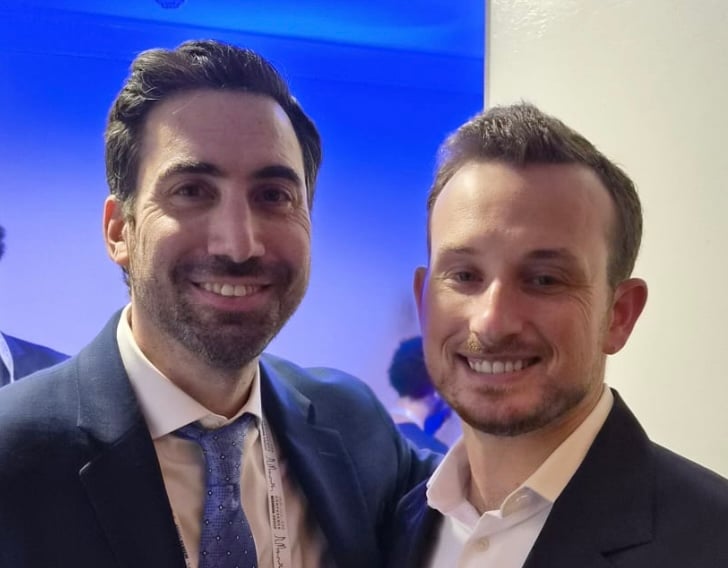
The writer Joseph Scutts with Alex Witkoff in NYC (photo courtesy of the writer)
I recently had the opportunity to meet Alex Witkoff at the Jerusalem Conference that I helped facilitate and host in NYC. Alex Witkoff is an American real estate executive and businessman who serves as the Chief Executive Officer (CEO) of The Witkoff Group, a prominent private real estate development and investment firm. He took over full leadership of the family-founded firm after his billionaire father, Steve Witkoff, joined the Trump administration as a Special Presidential Envoy. After graduating with a Bachelor of Science in Economics from the Wharton School at the University of Pennsylvania and working briefly as a real estate investing analyst at Morgan Stanley, Witkoff joined the family firm in 2015.
Known for being highly analytical and detail-oriented, he has overseen several multi-billion-dollar landmark properties. In addition, he ed the successful completion and rebranding of this massive West Chelsea luxury residential complex, surpassing $1 billion in sales, managed the high-profile redevelopment of the historic Shore Club, guiding it through complex local preservation and Spearheaded a major condo and hotel transformation project that launched with over $200 million in presales. Along with his brother Zach Witkoff, Donald Trump Jr., and Eric Trump, he is a co-founder of World Liberty Financial, a prominent cryptocurrency platform heavily associated with the Trump family. Additionally, he is a co-owner of The Executive Branch, an invitation-only private members’ club located in Georgetown, Washington DC. But what impressed me the most about Alex is his determination to help fight the good fight against antisemitism.
We have seen a massive rise in antisemitism since October 7th, the day on which the Jewish people lost more innocent lives than on any single day since the Holocaust.
In a normal world, wouldn’t you have expected the opposite?
In a normal world, wouldn’t you have expected the opposite?
The numbers tell a grim story. According to a Tel Aviv University study, 2025 was the deadliest year for antisemitic violence in over three decades, with 20 Jews killed in antisemitic attacks around the world. That is the highest toll since 1994, the year a Jewish community center was bombed in Buenos Aires. On the first night of Hanukkah, gunmen opened fire on families at Bondi Beach in Sydney, murdering fifteen people as they gathered to light candles. It was the deadliest mass shooting Australia had seen in nearly thirty years. People can hold all kinds of views about events in the Middle East. That is a complicated and painful subject, and reasonable people disagree. But there is nothing complicated about a family being gunned down at a Hanukkah celebration, or worshippers being targeted outside a synagogue. Whatever someone believes about a conflict thousands of miles away, it can never be a license to attack Jewish children, Jewish families, and Jewish communities here at home. That line should be obvious to every decent person, and the fact that it has been blurred is exactly what alarms me. I won’t end in despair, though. I have had the honor of serving on the U.S. Holocaust Memorial Council, and if our history teaches us anything, it is that the Jewish people have outlasted every power that ever tried to break us. We will outlast this too. The answer to darkness has never been to dim our own light. It is to shine it brighter.
Why do you think reprehensible behavior such as rioting near synagogues, harassing Jewish people, and chanting pro-terror slogans like “from the river to the sea” has become the norm and almost socially acceptable?
Because too many people in positions of influence looked away, or worse, gave hatred a pass. Think back to when the presidents of some of our most elite universities were asked, under oath before Congress, whether calling for the genocide of Jews violated their codes of conduct. Their answer was that it “depends on the context.” When the leaders of our greatest institutions cannot give a straight answer to that question, is it any wonder that students felt emboldened to march, to harass, and to intimidate? When a mob can gather outside a synagogue, when Jewish students are targeted simply for being Jewish, when a slogan like “from the river to the sea,” which is a call for the elimination of the Jewish state and its people, gets chanted in the streets and waved through as ordinary political speech, none of that happened by accident. It happened because the guardrails came down one at a time and not enough good people objected. Hatred becomes acceptable the moment it stops carrying a social cost. We allowed the ugliest ideas to be laundered as activism and let intimidation be rebranded as protest. The way to reverse it is the same way it took hold, incrementally and out loud. Decent people of every faith and background have to be willing to say plainly that this is antisemitism, and it has no place here.
In today’s climate, many Jewish people are weighing the risks of openly displaying their identity, such as wearing a Star of David, a kippah, or putting up a mezuzah. How would you describe the psychological impact of this reality on Jewish individuals right now, and what is the best way to fight back?
It is profoundly sad to me that we live in a world where anyone feels they have to hide their faith or their identity to feel safe, whether that is a Star of David tucked under a shirt, a kippah, or a mezuzah by the door. That fear takes a real psychological toll. It teaches a child that who they are is something to be concealed. It asks people to make themselves smaller just to be left alone. No one should ever have to live that way. Let me tell you where I stand. I wear a Magen David around my neck every single day, and there is a mezuzah on the doorpost of my home. Not as a provocation, but as a simple statement of who I am and where I come from, and I will not apologize for it. That is how you fight back. Antisemitism should not make us shrink. It should make us stand taller. Every Jew who refuses to hide is a living answer to everyone who wishes we would. And this is bigger than any one person. No human being, of any faith, any race, or any background, should ever be made to feel afraid of who they are. The day we defend that principle for everyone is the day hatred begins to lose.
Related Topics
Related Posts