


Memes on Social Media Can Inform, Spotlight, Mislead, or Erase the Truth
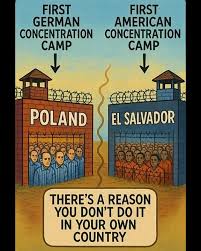
Several memes circulating on social media sites can provide insightful information and spotlight the truth, or they can promote false or misleading information while erasing the truth.
In the latter case, either intentionally promoting lies for the purpose of propagandizing or the less sinister reason of ignorance of the facts, these memes can cause great harm and must be challenged until either corrected or taken down from cyberspace.
To emphasize these points, I highlight one example.
The meme in question depicts two apparent prisons positioned vertically side-by-side with prisoners standing behind fences and barbed wire.
On the left structure is written: “POLAND” and above with an arrow pointing downward is: “THE FIRST GERMAN CONCENTRATION CAMP.”
On the right structure is written: “EL SALVADOR” and above with an arrow pointing downward is: “FIRST AMERICAN CONCENTRATION CAMP.”
Below both structures the meme’s creator wrote: “THERE’S A REASON YOU DON’T DO IT IN YOUR OWN COUNTRY.”
Though I believe the creator of the meme was well intentioned by alerting viewers to connections in two points in history where authoritarian regimes denied civil rights protections to its residents without due process of law, the meme, nonetheless, by stating inaccuracies engages in historical revisionism and erases other important events.
Concentration Camp: “a camp in which people are imprisoned or confined, commonly in large groups, without trial….Usually, those people belong to groups the government does not like.”
Throughout the collective history of concentration campus, we can identity some general conditions including brutal working conditions, insufficient supplies of food, clean water, sanitation, rampant disease, inadequate medical services and medications, lack of freedom of movement outside the limits imposed by occupying forces, rescinded human and civil rights, and in many instances, military incursions, armaments, bombardments, and death.
When the topic of concentration camps arises, most people think of the series of armed encampments constructed and maintained under the Nazi regime in Germany and throughout its conquered territories during the 1930s until the end of World War II in 1945.
Some were designated as forced hard labor encampments, while others the Nazis constructed as massive death factories for the murder of those the regime considered undesirable.
In fact, the first of these was camp Dachau set up in March 1933 soon following Hitler’s ascension to power. Here, the Nazi authorities and military personnel searched for, arrested, and imprisoned individuals and groups the regime regarded as “enemies of the state” and as antithetical to the goals of Nazism such as communists, socialists, and Jehovah’s Witnesses, and those it defined as racially impure, non-Aryan, subhuman, including Jews, male homosexuals, Roma and Sinti, people with disabilities, and others.
Dachau was the first of the more than 44,000 camps and other incarceration sites, which included city and town ghettos, established under the German Nazi regime.
Located in an abandoned munitions factory about 10 miles northwest of Munich in southern Germany, Dachau became a “model” for other concentration camps that would follow. It served also as a training site for SS concentration camp guards. Dachau was the oldest and longest operating of all the camps.
The estimated number of prisoners incarcerated in Dachau between 1933 and 1945 exceeded 200,000, and at least 40,000 prisoners died there.
While these are arguably the most widely known, the history of concentration camps is much more extensive than we might think. Governments set up encampments in differing forms and configurations and called them different names, for example, “reeducation camps,” “internment camps,” “ghettos,” “prison campus,” “work camps,” “death camps,” “relocation camps,” “gulags,” and many others.
The expansion of the United States republic and movement west was, in part, justified by overriding philosophical underpinnings since the American Revolution. Called “Manifest Destiny,” it was based on the belief that God intended the United States to extend its holdings and its power across the wide continent of North America over indigenous peoples and colonial powers from east coast to west. The doctrine of “manifest destiny” embraced a belief in American Anglo-Saxon superiority.
When he inhabited the White House, Andrew Jackson argued that white settlers (a pleasant term for “land thieves”) had a “right” to confiscate Indian land. Though he proposed a combination of treaties and an exchange or trade of land, he maintained that white people had a right to claim any Indian lands that were not under cultivation. Jackson recognized as the only legitimate claims for Indian lands those on which they grew crops or made other “improvements.”
The Indian Removal Act of May 28, 1830, authorized President Jackson to confiscate Indian land east of the Mississippi River, “relocate” its former inhabitants, and exchange their former land with territory west of the river. The infamous “Trail of Tears” during Jackson’s presidency attests to the forced evacuation and redeployment of entire indigenous nations in which many died of cholera, exposure to the elements, contaminated food, and other environmental hazards.
The Naturalization Act of 1790, excluded Native American Indians from citizenship, considering them, paradoxically, as “domestic foreigners.” They were not accorded rights of citizenship until 1924, when Congress passed the Indian Citizenship Act, though Asians continued to be denied naturalized citizenship status.
In 1838, the army searched out and arrested members of Cherokee tribes in the southeast and drove them into prison camps before “relocating” them to Oklahoma. Many indigenous peoples died in these so-called “emigration depots” due to the swift spread of diseases in poor sanitary conditions.
The plantation system and enslavement of Africans could as well be termed a form of concentration camps, from kidnapping from their native lands, transport across vast distances, dumping onto unknown territories, enslavement among harsh working conditions, meager housing, food, and medical services, suspension of all human and civil rights, rape by whites in power, separation from children and other family members, torture, and murder.
Following U.S. entry into World War II at the end of 1942, reflecting the tenuous status of Japanese Americans, some born in the United States, military officials uprooted and transported approximately 110,000 Japanese Americans to internment (concentration) camps within several interior states far from the shores.
In Korematsu v. United States, 323 U.S. 214 (1944), the landmark United States Supreme Court decision ruled 6-3 that Executive Order 9066 was constitutional “as a matter of military urgency,” ordering Japanese Americans into internment camps during World War II regardless of citizenship status.
Not until Ronald Reagan’s administration did the U.S. officially apologize to Japanese Americans and paid reparations amounting to $20,000 to each survivor as part of the 1988 Civil Liberties Act.
So, I believe that memes posted on social media can provide insight and connect events for the purpose of informing and highlighting within an easy and simple format when constructed factually. If not done properly, it can have the reverse effect of propagating false information and burying the truth.