
Memory lane: From gas lines to price spikes: what the 1970s still teaches us
The lines are gone, but America’s vulnerability to global oil shocks hasn’t disappeared—it’s just changed form.
There was a time—not so long ago—when Americans didn’t just complain about the price of gasoline. They wondered whether they could get any at all.
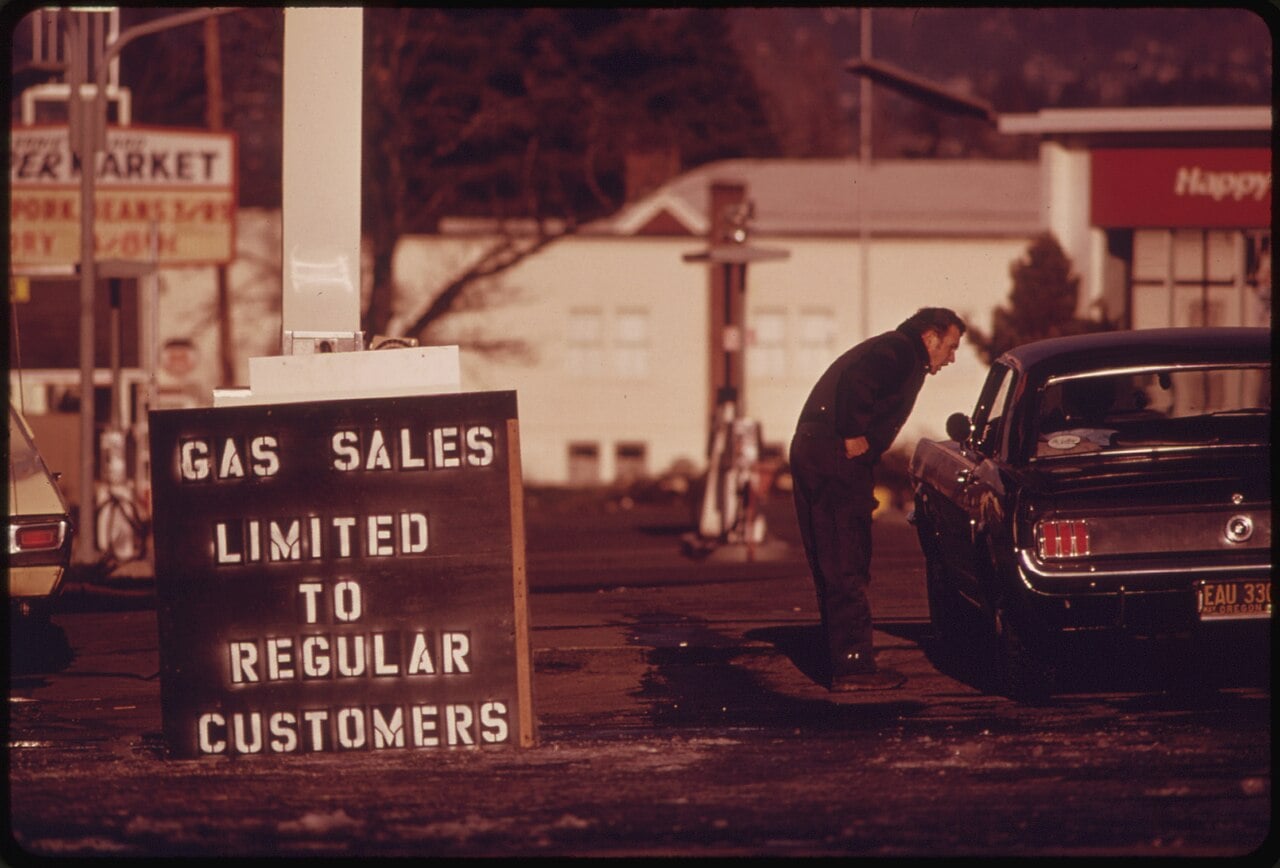
In the early 1970s, while a 3rd year law student at Brooklyn Law School living with my wife in Brooklyn’s Canarsie neighborhood, as oil-producing nations asserted control over supply and imposed an embargo in response to U.S. support for Israel during the Yom Kippur War, the result was immediate and visible. Long lines snaked from gas stations. “No Gas Today” signs became a daily sight. Tempers flared. Daily routines were disrupted.
The federal and state governments responded with rationing schemes that now seem almost surreal. Drivers were assigned “odd-even” days based on their license plates. You could only buy gasoline on certain days, whether you needed it or not. And even when it was your turn, you couldn’t necessarily fill up.
In some places, stations imposed strict purchase limits—sometimes as low as three dollars per transaction. And some required that you be a regular repair customer before they’d sell you gas.
That figure sounds almost absurd today. Three dollars wouldn’t get you out of the parking lot. But at the time, it bought a meaningful amount of fuel. In my Dodge 330 with a Slant 6 engine, about a half-tank. The restriction wasn’t about price. It was about scarcity. There simply wasn’t enough gasoline to go around, and the system strained to distribute what little there was.
The experience left a lasting imprint. For perhaps the first time, Americans understood in a visceral way that their economy—and their daily lives—were tied to decisions made far beyond their borders.
Fast forward five decades, and the lines are gone. The rationing is gone. Gas stations are full, just check out the lines for gas at Costco, and Americans can, in theory, buy as much fuel as they want.
But the sense of vulnerability has not disappeared. It has simply taken a different form.
Today, the constraint is rarely access. It is price.
When global supply is threatened—by war, by political instability, by decisions made in distant capitals—the impact shows up instantly on the price sign at the corner station. There are no “odd-even” days anymore, no arbitrary purchase caps. Instead, there is a quieter but equally powerful limitation: what you can afford to pay.
In the 1970s, Americans were told they could not buy more gasoline. Today, they are told they can buy as much as they like—if they are willing to absorb the cost.
The mechanism has changed. The dependency has not.
It is tempting to argue that the United States is in a fundamentally stronger position today. Domestic production has increased dramatically. New technologies have unlocked reserves that were once inaccessible. The country is no longer as obviously dependent on foreign oil as it was during the embargo years.
And yet, oil remains a global commodity. Prices are set on a global market. Disruptions anywhere—from the Persian Gulf to Eastern Europe—reverberate everywhere. Even a nation that produces more of its own energy cannot fully insulate itself from the shocks of that system.
Recent developments in the Middle East only underscore the point. Longstanding alliances are shifting. Oil-producing nations are reassessing their roles, their partnerships, and their priorities. Some are even stepping back from the very organizations that once coordinated supply and pricing.
That may sound like a move toward greater independence and flexibility. In reality, it may signal something more volatile: a world in which coordination breaks down, national interests take precedence, and supply becomes less predictable.
In that kind of environment, the risk is not just that prices will rise. It is that they will swing—rapidly and unpredictably—leaving consumers and policymakers scrambling to adjust.
The lesson of the 1970s was never just about gas lines. It was about exposure.
Americans discovered that energy was not merely an economic issue but a strategic one, subject to leverage, pressure, and disruption. They learned that stability could vanish quickly—and that when it did, the consequences would be felt in the most ordinary aspects of daily life.
That lesson still holds.
We no longer wait in line for gasoline. We no longer watch attendants enforce arbitrary limits on how much we can buy. But we still watch the numbers climb on the pump, and we still feel the same unease when they do.
Fifty years ago, the constraint was physical: not enough fuel to go around. Today, it is financial: plenty of fuel, but at a cost that can rise beyond comfort.
The gas lines are gone. The illusion of control is not.