


Political Analyst - Columnist
Meridiam new shareholder of GSI. Next stop: Israel
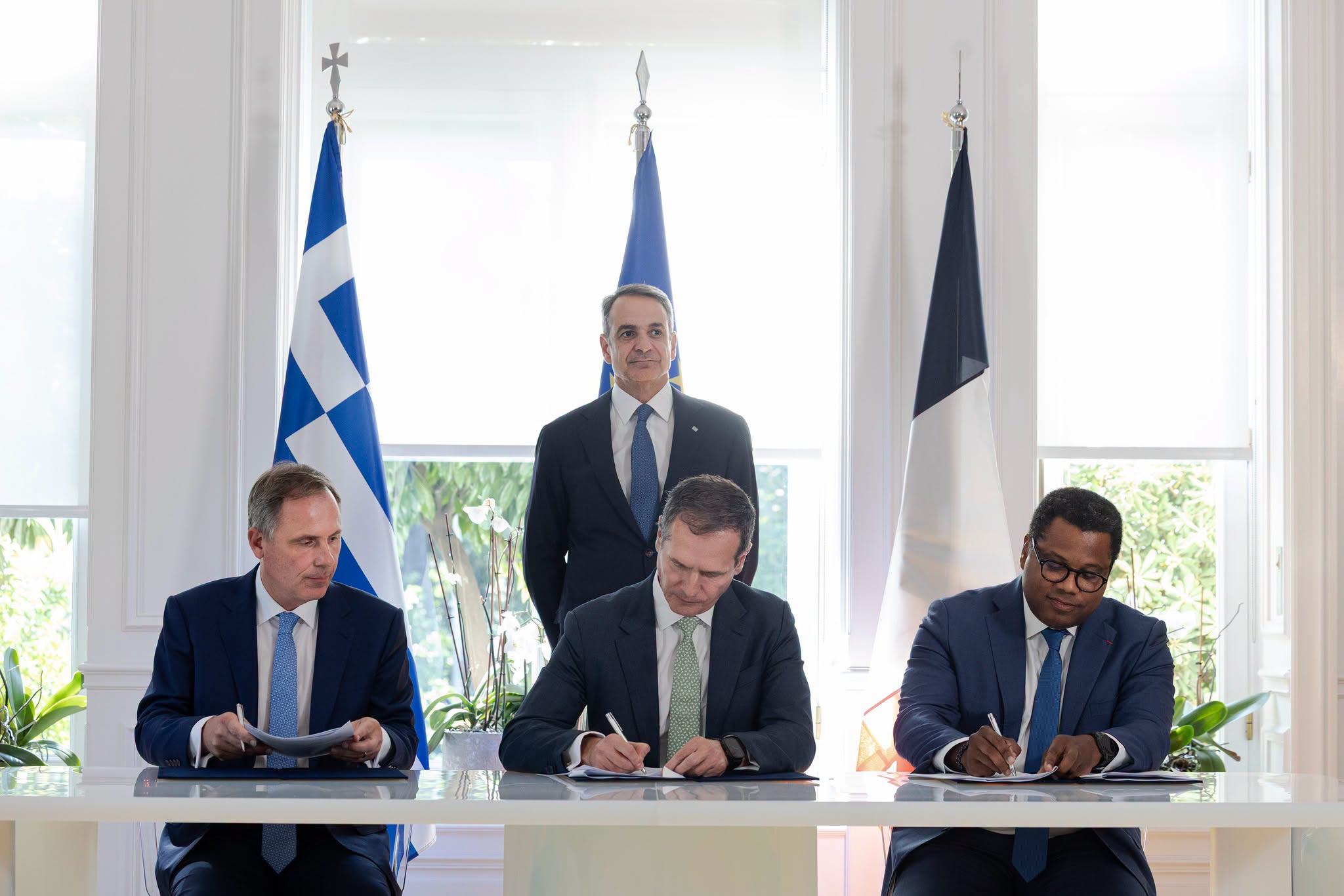
Senior Executive Vice President of Nexans, Mr. Pascal Radue, President & CEO of IPTO (ADMIE, Greece), Mr. Manoussos Manoussakis and President & CEO of Meridiam, Mr. Thierry Déau, during the signing ceremony of the entry of Meridiam in the Great Sea Interconnector (GSI) project in Athens, 5 August 2026 / Photo taken by the Official Facebook Page of the Prime Minister of the Hellenic Republic, Mr. Kyriakos Mitsotakis.
During the hot days of August, a positive “surprise” took place in Athens. The signatures for the entry of the French investment company Meridiam as a majority shareholder in the electricity interconnection project between Greece and Cyprus were signed at the Maximos Mansion, the Greek Prime Minister’s official seat. This is a development that is likely to be a catalyst for the implementation of this specific project, the geostrategic extension of which is expected to be the subsequent electricity interconnection between Cyprus and Israel. Therefore, strength in unity seems to be the only viable answer against the unlawful pursuits of Turkey.
Having undertaken the implementation of more than 130 critical projects around the world, which correspond to total investments of €100 billion, Meridiam has earned the reputation of a leading international strategic investor, as a development and manager of infrastructure projects, headquartered in Paris and with a strong presence in Europe, the United States and Africa.
Indicatively mentioned are:
- The NeuConnect project under construction, which is expected to electrically connect the United Kingdom with Germany: This is a 1.4 GW, 725 km long, high-voltage direct current (HVDC) submarine electrical interconnection, with an investment of €2.8 billion from private financing. It is the first direct electrical interconnection between the United Kingdom and Germany and one of the largest interconnections in the world. This is obviously the project that most resembles the Greece-Cyprus interconnection.
- Sud Europe Atlantique high-speed rail line (France): This is a 302 km high-speed line from Tours to Bordeaux, a €7.7 billion project. It is the first high-speed rail in France to be built under a concession to a private party, lasting until 2061.
- A 30-year concession for the second largest desalination plant in the world. It will transport water from Aqaba to Amman, Jordan. The total length of the desalinated water pipelines will be 450 km and is expected to cover up to 40% of Jordan’s drinking water needs. The total investment is around US$6 billion.
- Suez: In 2022, Meridiam led a consortium that acquired the global water and waste management group “Suez” and remains one of its main shareholders.
- Sofia Airport (Bulgaria): 35-year concession contract for Bulgaria’s main international airport, with committed investments of at least €624 million.
- Tram di Firenze (Italy): Contract for the Florence tram network, 19.5 km long with 38 stops, which serves over 34 million passengers annually.
- Montreal University Hospital Research Center (Canada): One of the largest health research centers in North America, implemented as part of a long-term partnership between Meridiam and the Government of Quebec.
In this regard, it is known that the Greece-Cyprus electricity interconnection project has encountered many obstacles. Several months ago, the Great Sea Interconnector (GSI) issue had experienced great tension between Athens and Nicosia, when the Minister of Finance of the Republic of Cyprus, Makis Keravnos, had “thunderbolt” everyone, declaring that the project was not viable. A tug-of-war followed between the two governments, Greece and the Republic of Cyprus, regarding its implementation.
Ultimately, the repeated public declaration of political will made by the Greek Prime Minister Kyriakos Mitsotakis and the Cypriot President Nikos Christodoulides was of crucial importance. Both were in favor of completing the project regardless of difficulties.
At the same time, the French President Emmanuel Macron has demonstrated similar political will on many occasions. As early as September 25, 2024, at a meeting of the three men on the sidelines of the 79th United Nations General Assembly in New York, Mr. Macron had proposed to his counterparts the inclusion of Meridiam in the consortium as an option that would “untie” the entire project financially. The discussion was repeated at a Mitsotakis-Macron meeting in Athens in April 2026, apparently in more detail and under the shadow of the previous rigidity between Athens and Nicosia that had been observed earlier.
The implementation of the project has been undertaken by the Independent Power Transmission Operator of Greece (ADMIE/IPTO), which in collaboration with the also French company Nexans is called upon to carry out the entire technical part of the investment after the seabed surveys that will be carried out and will determine the exact route that the cable should follow.
The entry of Meridiam into the GSI consortium with a stake of over 50% is primarily an injection of credibility and at the same time a strong financial boost, immediately after the recent share capital increase of €1 billion that IPTO has carried out.
And so we arrived at this summer and the signatures of August 5th 2026.
However, the whole issue is not only financial and energy-related. It is primarily geopolitical.
Cyprus’s integration into the European energy network takes it out of its regional isolation once and for all, dissolving any scenario of “Finlandization”.
This is something that obviously bothers several third parties. First of all, the occupying power Turkey, which both through official lips and through its organs on the island has threatened in the past to obstruct research to which the country is not the one who has given permission for it.
However, there were – and apparently still are – other interests inside and outside Cyprus, which do not see the project in a good light.
These are of course those who are concerned on the one hand by the economic competition that will arise since Cypriot consumers will now have more electricity choices.
At the same time, there are those who operate for the benefit of third powers, who desire a weak, marginalized and far from the West Cyprus, in order to control and exploit it as a “failed state” with a European shell.
It is logical, therefore, that these actors also find the latest development unprofitable.
Nevertheless, it is no coincidence that this time the political will of Athens and Nicosia seems to be followed by significant strategic moves, which cannot be easily ignored or downgraded. First, at the same time as the signing of the agreement in Athens, it became known that in the very next few days IPTO, as the implementing body, has completed and will send the cost-benefit study to the regulatory authorities of Cyprus and Israel within the next few days.
Thus, the public Greek implementing body of the project declares in the most official way that no one has “forgotten” that this is a project which, in its full development, connects Greece, Cyprus and Israel.
Overall, it integrates Cyprus and Israel into the single energy network of the European Union. In the meantime, the upcoming tender that Greece will hold for the electrical interconnection project with Italy should not be overlooked, while at the same time the electrical connections with the Aegean islands are also progressing.
Greece is now becoming an energy hub in the Eastern Mediterranean and an important geostrategic player within the European Union.
Secondly, at the geopolitical level, the fact that the signatures were made in the same year and with a time gap of five months from the events of March 2026 in Cyprus should not go unnoticed.
On March 1, the British bases in Akrotiri, Cyprus, were attacked by drones from Hezbollah in Lebanon.
Immediately, Greece, without delay, showed its practical defense solidarity with Cyprus.
On March 4, the Greek frigates “Kimon” and “Psara” entered the port of Limassol. On the same day, a pair of Greek F-16s from Athens landed in Paphos and conducted drone control and detection operations in defense of the aerial integrity of the Republic of Cyprus.
On March 9, Messrs. Mitsotakis, Christodoulides and Macron met in an emergency meeting in Paphos in the midst of the crisis to once again declare the solidarity of the three states, this time on defense issues.
It became clear then that if for Greece the support of Cyprus is taken for granted, for France it is now a clear geopolitical choice tested in the field.
A day later, on March 10, the French aircraft carrier Charles de Gaulle arrived in Cyprus, flanked by a sizeable French flotilla, while it was followed by other European powers (Germany, Italy, Spain and the Netherlands) a few days later. Finally, the inclusion of Meridiam in the project undoubtedly gives new life to the venture and confirms the will of all those involved to see it truly implemented.
The final completion of the Greece-Cyprus-Israel energy alliance, however, must be the next step, which will constitute the clearest guarantee of security and energy independence for the island and its friends, in extremely difficult and unpredictable times.
After all, as Thucydides used to say: “Opportunities do not wait”.