
Miketz: Dinah’s Pain to Brothers’ Peace
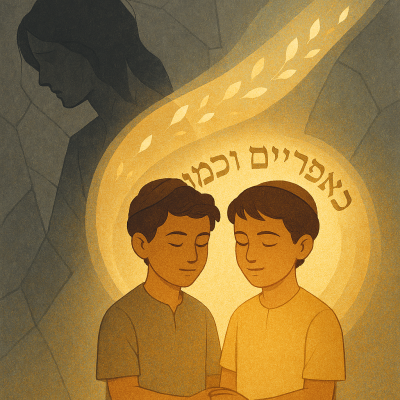
Every Friday night, many Jewish parents place their hands on their children’s heads for one of the most tender moments of the week.
For daughters, the blessing is based on a high degree of logic: we invoke the Matriarchs – Sarah, Rivka, Rachel and Leah – whose many qualities built what was to become Bnei Yisrael, the Children of Israel, rather than simply a family. But for sons, we bypass the Patriarchs of Avraham, Yitzchak, and Yaakov and instead recite:
יְשִׂימְךָ אֱלֹהִים כְּאֶפְרַיִם וּכְמְנַשֶּׁה
“May God make you like Ephraim and Menashe.”
Why these two?
The well-known answer is that Ephraim and Menashe are the first brothers in the Torah to live without rivalry. Unlike Kayin and Hevel, or Yaakov and Esav, or Yosef and his brothers, they represent pure sibling love. Their story is one of joy and peace.
Whilst this is true, there is perhaps another aspect we need to consider. To understand the miracle of their peace, we must look at the darkness from which they emerged. We must look at the story of Dinah and the tragic account of her brutal rape, described in Bereshit chapter 34, even if only judged by the reaction of two of her brothers.
The Silent Bridge: From Dinah to Asenath (Osnat)
On the surface, the stories of Ephraim and Menashe’s joy and Dinah’s trauma seem worlds apart, separated by generations and geography. But Jewish tradition suggests they may be inextricably linked through one woman: the boys’ mother, Asenath.
The Torah in our parasha, Miketz (Bereshit 41:45, 50), introduces Asenath simply as the daughter of an Egyptian priest. However, a startling Midrashic teaching (Pirkei DeRabbi Eliezer, ch. 38) identifies her as the daughter of Dinah, born from the tragic violation in Shechem and later adopted in Egypt. While not universally accepted, this Midrash offers profound insight into why the Torah names these two women so deliberately.
The text does not make this link explicit, perhaps deliberately. If it were stated plainly, we might treat the trauma as “resolved history.” By leaving it hidden, the Torah forces us to grapple with the fact that the abuse of Dinah did not have a happy ending, but it has to be recognized for what it was in all its pain.
Nonetheless, the Midrash offers us a profound potential insight: The most peaceful brotherhood in the Torah is linked to one of the most violent violations in the Torah.
Transforming the Legacy
This connection may add depth to how we view Yosef’s family. Yosef and Asenath are not just a political power couple; they are two survivors building a new reality.
Yosef was thrown into a pit by his brothers. Asenath possibly carried the lineage of Dinah’s terrible abuse. By all logic, their children should have inherited a legacy of resentment, victimhood, or strife.
Instead, they raise Ephraim and Menashe, boys who break the cycle.
When Yaakov, their Grandfather, blesses the boys at the end of his life, as has happened in similar cases, he brings about the possibility of sibling rivalry when he crosses his hands, placing the right hand on the younger Ephraim. In any previous generation, this “switch” could have incited a war between brothers. But Ephraim and Menashe accept it. There is no jealousy. There is only harmony.
Rashi notes that this moment establishes the permanent formula for blessing our sons:
“בְּךָ יְבָרֵךְ יִשְׂרָאֵל” – “By you shall Israel bless.”
Through Asenath, the brokenness of Dinah is not erased, but it is redeemed. The pain of the past is, to an extent, transformed into the peace of the future.
Our Moral Responsibility
This transforms the Friday night ritual from a mere wish for success into a charge of moral responsibility.
We live in a world that still has similarities to that of Dinah, a world rife with brokenness, violence, and exploitation. And let us be clear: these tragedies do not only happen “out there,” beyond the Jewish community. They happen within. The family of Yaakov was not immune, and neither are we. We must confront this reality with every ounce of strength we have and strive for better. When we bless boys, we cherish the story of Ephraim and Menashe. And when we look at the world around us, we must not forget the story of Dinah.
The Torah demands we face these truths, not sweep them under the rug. But the story of Ephraim and Menashe teaches us how to respond: by building homes that defy the chaos that can occur outside and inside our communities.
As Rav Soloveitchik taught in Family Redeemed, the family is the first unit of ethical commitment, the first brit (covenantal community). If we cannot create shalom bayit (peace in the home) at our own tables, we cannot bring justice to our surroundings and more broadly.
A Call to Action
If you are fortunate enough this Shabbat to place your hands on your sons, grandsons, or any other boy whom you wish to bless and whisper the age-old words of blessing that God make them like Ephraim and Menashe, recognize the weight of those words.
You are acknowledging the brokenness of the world (Dinah) while celebrating the potential for wholeness (Ephraim and Menashe). You are pledging to raise children who do not ignore the wounds of history, but who possess the strength to heal them. You are pledging to raise them in an environment in which what happened to Dinah cannot and should not happen.
This is the true blessing: to take what is shattered and, through love, make it whole.
Whether boy or girl, whether they are children, teenagers, or adults, the second part of the blessing surely remains relevant to all:
יְבָרֶכְךָ יְהֹוָה וְיִשְׁמְרֶךָ
May Hashem bless you and protect you.
יָאֵר יְהֹוָה פָּנָיו אֵלֶיךָ וִיחֻנֶּךָּ
May Hashem cause His countenance to shine upon you and favor you.
יִשָּׂא יְהֹוָה פָּנָיו אֵלֶיךָ וְיָשֵׂם לְךָ שָׁלוֹם
May Hashem lift His face to you and grant you peace.