


Mission Accomplished?
Where have all the young men gone?
Long time passing
Where have all the young men gone?
Long time ago
Where have all the young men gone?
They’re all in uniform
Oh, when will you ever learn?
Oh, when will you ever learn?
–Pete Seeger
The “Mission Accomplished” Speech and Its Legacy
On May 1, 2003, President George W. Bush delivered what became one of the most controversial speeches in modern American history. Speaking aboard the aircraft carrier USS Abraham Lincoln, Bush declared that major combat operations in Iraq had ended. Standing beneath a large banner reading “Mission Accomplished,” the president praised American troops and celebrated what appeared to be a swift military victory. At the time, many Americans viewed the speech as a symbol of success following the rapid defeat of Saddam Hussein’s regime. However, the years that followed transformed the event into a powerful example of political miscalculation and the dangers of declaring victory too soon.
The Iraq War began on March 20, 2003, when the United States and its allies invaded Iraq. The Bush administration justified the invasion by arguing that Saddam Hussein possessed weapons of mass destruction (WMDs) and posed a threat to international security. Within weeks, coalition forces captured Baghdad, and Hussein’s government collapsed. The speed of the military campaign created a sense of optimism among American leaders and much of the public. Against this backdrop, Bush chose to mark the apparent success of the operation with a dramatic speech aboard a returning aircraft carrier.
In his address, Bush stated that “major combat operations in Iraq have ended” and that the United States and its allies had prevailed. While he did not explicitly declare the war over, the visual imagery surrounding the event strongly suggested that the mission had been completed successfully. The “Mission Accomplished” banner quickly became the defining image of the day. For supporters of the administration, the speech celebrated the skill and courage of American military forces. It also reinforced Bush’s image as a wartime leader during a period when his approval ratings were exceptionally high.
The problem was that the war was far from over. Although Saddam Hussein’s government had been removed from power, the United States soon found itself confronting a growing insurgency. Armed groups, sectarian militias, and terrorist organizations began attacking coalition forces and Iraqi civilians. Rather than transitioning quickly to stability and democracy, Iraq descended into years of violence, political turmoil, and civil conflict.
One of the most significant failures associated with the Iraq War was the inability to find the weapons of mass destruction that had been a central justification for the invasion. Extensive searches failed to uncover active stockpiles of chemical, biological, or nuclear weapons. This discovery damaged the credibility of the Bush administration and led many Americans and international observers to question the rationale for the war itself.
The human and financial costs of the conflict also grew far beyond what many policymakers had anticipated. More than 4,000 American service members lost their lives in Iraq, while tens of thousands were wounded. Iraqi civilian casualties numbered in the hundreds of thousands according to various estimates. The war ultimately cost the United States trillions of dollars when military operations, reconstruction efforts, and long-term veteran care are included. These staggering costs stood in sharp contrast to the optimistic atmosphere surrounding the 2003 speech.
As the situation in Iraq deteriorated, critics increasingly used the phrase “Mission Accomplished” as a symbol of government overconfidence. The banner became a political liability for Bush and his administration. Although White House officials later explained that the sign referred only to the completion of the aircraft carrier’s deployment rather than the end of the war, the public largely associated it with the president’s declaration. The image was repeatedly cited in news reports, political campaigns, and historical discussions as evidence of a premature claim of success.
The speech’s legacy extends beyond Iraq itself. It serves as a cautionary lesson about the challenges of military intervention and nation-building. Military victory on the battlefield does not necessarily translate into long-term political stability. The removal of an enemy government may be only the beginning of a much more complicated process. Policymakers must consider not only how wars are won but also how peace will be established afterward.
In retrospect, the “Mission Accomplished” speech illustrates the dangers of triumphalism in foreign policy. What seemed like a decisive victory in May 2003 ultimately became the opening chapter of a prolonged and costly conflict. The speech remains one of the most enduring symbols of the Iraq War and a reminder that success in war cannot be measured solely by early battlefield achievements. Instead, true success must be judged by the long-term outcomes that follow. For many historians and political analysts, the gap between the optimism of the speech and the reality that unfolded afterward explains why the event is remembered not as a triumph, but as a significant failure of judgment and political messaging.
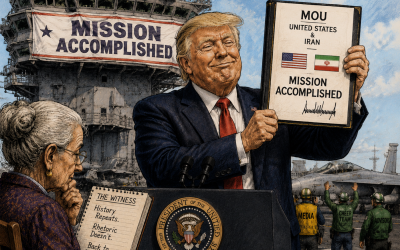
Image from The Witness Ledger series. “Mission Accomplished” © 2026 Steven Teplitsky. All rights reserved. Published in association with The Witness Ledger.