

Modena – Calculated Risk
Calculated Risk
Last week, I wrote my blog from Basel in Switzerland, the city where Theodor Herzl imagined a national home for the Jewish people. We were in transit, driving from London to Modena, carrying with us the usual assortment of luggage, books, medication, and ideas.
Modena is a relatively small city in northern Italy, known for three very different contributions to civilisation: balsamic vinegar, Lambrusco, and high-performance cars. Ferrari, Maserati, and Pagani all have roots in this region. The city is also affectionately known as the city of the pig, much of its celebrated cuisine revolving around pork in one form or another.
For observant Jewish travellers, this requires a certain amount of culinary navigation. Fortunately, Modena offers more than enough alternatives, and what we were seeking was not pork, but something quieter: elegant piazzas, remarkable food, and a temporary sense of calm.
We were not disappointed.
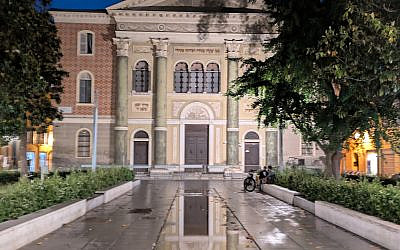
At the heart of the city stands the magnificent cathedral and the Ghirlandina tower, both rising above streets that feel measured and composed rather than chaotic. Nearby, at the top of Piazza Mazzini, stands Modena’s grand synagogue, constructed after the emancipation of Italian Jewry on the site of the former ghetto, much as the Great Synagogue of Rome emerged as a visible statement that Jewish life no longer needed to remain hidden.
Today, Modena’s Jewish community is small. During our visit, a solitary army truck stood guard nearby, a reminder that even in places of great beauty, Jewish life is never entirely detached from the realities of security. Yet there were no fences, no sense of siege, only a quiet confidence.
For a few days, we allowed ourselves to relax.
Coming from London, where vast demonstrations of very different political persuasions seem increasingly to occupy the streets, Modena felt like a welcome pause.
And then, on Saturday afternoon, in this same tranquil city, a vehicle-ramming and stabbing attack left several people seriously injured. Italian authorities began investigating whether the incident constituted an act of terrorism, and Prime Minister Giorgia Meloni travelled to Modena to express solidarity with the city and its citizens.
The irony was difficult to miss.
In attempting to avoid the perceived risks of larger and more visibly tense cities, we had chosen somewhere smaller and calmer, only to be reminded that risk has an unsettling habit of disregarding our plans.
That thought stayed with me.
Because whether in medicine, criminology, travel, or ordinary life, risk is rarely something we eliminate.
At best, we relocate it.
And sometimes, despite our most careful calculations, it finds us anyway.
Risk has been very much on my mind over the past three years, since the sudden death of my father.
There was a particular irony to the way he died.
He was sitting at home, watching television: perhaps one of the most apparently risk-free activities imaginable. No mountain climbing. No reckless driving. No dramatic act of chance. Simply a man in his own living room, engaged in the safest of domestic routines.
And yet life, as it so often does, paid little attention to the calculations.
My father was, by temperament, profoundly risk averse.
He approached life with the cautious precision of someone who understood that outcomes could turn unexpectedly. Perhaps this was partly generational. Born in the years immediately following the Holocaust, he belonged to a cohort for whom security was never entirely taken for granted. Stability was something to be built carefully, protected diligently, and never assumed.
Or perhaps his caution arose from experience. Like many of us, he had learned that risk and consequence do not always move in proportion, and that seemingly minor decisions can have enduring effects.
One of my favourite family stories captures this perfectly.
In the 1960s, he travelled to Cardiff for his medical school interview. For most applicants, the principal risk lay in not being offered a place. My father, however, managed to encounter a smallpox outbreak and returned not only with an acceptance, but with a vaccination scar he carried for the rest of his life.
Even at the threshold of his medical career, risk had a way of finding him.
As a gynaecologist, he spent his professional life navigating uncertainty.
Medicine, particularly obstetrics and gynaecology, is in many ways an ongoing conversation with risk. The possibility of infertility. The fear of cancer. The dangers of pregnancy and childbirth. The doctor is constantly balancing one probability against another, trying to reduce harm while knowing that certainty is rarely available.
The profession attracts those willing to make consequential decisions in the absence of perfect information.
As I have grown older, I have come to appreciate more fully the burden that this entails.
My own life has been shaped by DES (diethylstilbestrol), prescribed to my mother during pregnancy in the belief that it would reduce the risk of miscarriage. It was an intervention offered in good faith, grounded in the best medical thinking of its time, and motivated by a desire to protect life.
Yet the consequences for many daughters were profound.
What was intended to reduce one risk introduced another, unfolding slowly over decades and, in some cases, across generations.
My father understood this far more deeply than I did when I was younger.
As both a gynaecologist and a father, he observed the evolving landscape of my health with a professional eye and a personal heart. He knew that medicine can never eliminate uncertainty entirely. It can only make the most careful judgments possible with the knowledge available at the time.
That, I think, is one of the most sobering truths about risk.
We assess it. We attempt to manage it. We make decisions in good faith.
And still, life reserves the right to surprise us.
My work in criminology has taught me that risk does not end when a sentence does.
Indeed, for many people, the formal punishment imposed by the court is only the beginning. Once the sentence has been served, another, less visible process often begins: an indefinite series of informal risk assessments conducted by employers, landlords, insurers, voluntary organisations, faith communities, and friendship circles.
The criminal justice system may declare that a debt has been paid.
But society is often less certain.
And so a person continues to be assessed.
Can they be trusted?
Are they safe?
What if the newspaper report was accurate? What if it was not? What if the worst thing ever written about them online is the first thing a prospective employer, landlord, or community member sees?
Risk, in this context, becomes a kind of social afterlife.
This is one of the central concerns of my work on digital rehabilitation. In the United Kingdom, the Rehabilitation of Offenders Act 1974 recognises that, after a prescribed period, many convictions should be treated as spent. Jewish tradition offers a parallel moral architecture in the concept of teshuvah: the possibility that a person can acknowledge wrongdoing, make amends, and move forward.
Neither system is naive.
Neither suggests that all risks disappear.
There are circumstances in which safeguarding must take precedence. Some individuals cannot safely occupy certain roles or settings, particularly where vulnerable people are involved. Communities have both the right and the obligation to protect those in their care.
But there is a profound difference between thoughtful risk assessment and perpetual suspicion.
The former is careful, evidence-based, and proportionate.
The latter is often shaped by rumour, anxiety, and moral shorthand.
And this is where Jewish ethics offers another important lens.
The prohibition against lashon hara warns us about the destructive power of speech. It does not forbid truthful discussion where safety is genuinely at stake, but it does challenge the casual circulation of damaging information when the purpose is judgment rather than protection.
That distinction feels increasingly important.
Because if our assessment of another person’s risk is based not on current evidence, context, and lawful safeguards, but on gossip, selective memory, or the irresistible human tendency to define people by their worst moment, then we may be engaging in something far less noble than prudence.
We may simply be perpetuating harm.
Crime has existed since the Garden of Eden.
So have consequence, accountability, and the possibility of return.
The enduring challenge, both in criminology and in Jewish life, is to determine when legitimate caution ends and when we are merely denying another person the possibility of rebuilding.
Risk must be assessed.
But it must also be assessed with humility, fairness, and a willingness to believe that human beings are capable of change.
As Shavuot approaches, we prepare once again to stand at Sinai and hear the Decalogue, my favourite slightly grander term for what are more commonly called the Ten Commandments.
At Sinai, the Jewish people enter into covenant without knowing exactly where that covenant will lead. Their response, na’aseh v’nishma, “we will do and we will hear,” is one of the most remarkable statements in all of Jewish thought.
It is an act of trust.
An act of commitment.
And, in a very real sense, an act of risk.
The Book of Ruth, also read on Shavuot, offers a more intimate version of the same idea.
Ruth leaves behind homeland, family, and certainty, binding herself to Naomi and to the Jewish people with no guarantee of security or acceptance.
“Where you go, I will go. Your people shall be my people, and your God my God.”
Her decision is courageous precisely because it is uncertain.
And from that uncertain act emerges the lineage of King David.
Jewish history, it seems, is built not on the elimination of risk, but on the willingness to step forward despite it.
This brings me, unexpectedly, to Horace.
The Roman poet coined the phrase carpe diem, usually translated as “seize the day.”
It is often misunderstood as a call to recklessness, to live for the moment without regard for consequence.
But I have come to understand it differently.
Carpe diem is not an argument against caution.
It is an argument against waiting for certainty.
The phrase entered popular culture through Dead Poets Society, in which Robin Williams, as the inspirational teacher John Keating, urges his students to recognise that life is finite and that postponing one’s life until every risk has been neutralised is itself a decision.
My father spent his life trying to reduce uncertainty.
DES taught me that attempts to eliminate one danger may create another.
Criminology has shown me that risk must be assessed, but also that people must not be defined forever by their worst moments.
Travel reminds me that the world remains both beautiful and unpredictable.
And Judaism teaches that some of our most significant commitments are made without full knowledge of what lies ahead.
We assess. We prepare. We think carefully.
And then, at some point, we step forward anyway.
Because life does not begin when risk disappears.
It begins when we decide that uncertainty is not a reason to remain still.
Carpe diem.
Not because life is safe.
But because it is not.