
Professional Indian author and strategic affairs writer.
Modi in Jerusalem: 70 Years in the Making
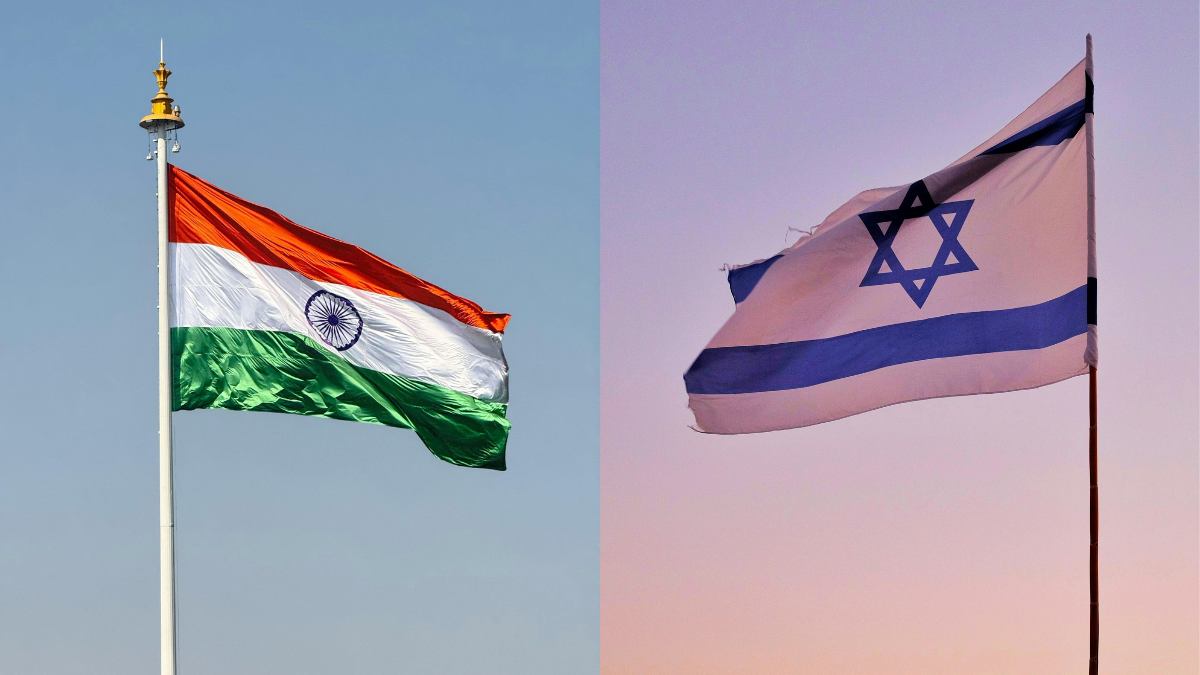
The flags of India and Israel. | Photos: Canva
I want to begin with a small detail that almost nobody covered when Narendra Modi landed in Tel Aviv on July 4, 2017. Among the first things on his itinerary were not a defense summit or a state dinner. It was a flower farm.
At the Danziger Flower Farm outside Tel Aviv, Israel’s leading flower genetics company had developed a new white chrysanthemum variety for the occasion and named it “MODI.” It was a gesture so specific, so personal, that it communicated something a joint press statement never could: this visit was not a routine diplomatic exchange. It was the closing of a long and complicated chapter.
For 67 years, no Indian prime minister had set foot in Israel on a bilateral visit. Modi was the first. That fact alone deserves more examination than it usually gets.
The Man Who Came Before the Prime Minister
What most accounts of the 2017 visit miss is that Modi had been to Israel before, eleven years earlier, as chief minister of Gujarat.
In May 2006, he traveled to Tel Aviv for Agritech-2006, Israel’s premier international agricultural technology exhibition. He was part of an Indian delegation that included other chief ministers and senior agricultural officials. At the India-Israel Business Forum, he presented Gujarat’s agricultural vision under a slogan he had coined himself: “Per Drop More Crop.” The presentation, according to Gujarat’s internal delegation report, received maximum applause from an audience of over a thousand international delegates.
That slogan, born at an Israeli agricultural fair in 2006, later became the official motto of the Pradhan Mantri Krishi Sinchai Yojana, India’s national micro-irrigation program. Modi also met with officials from Netafim, the Israeli drip irrigation company that had already partnered with a Gujarat government subsidiary, discussing specific proposals for Gujarat’s drought-prone districts and the Narmada Canal water network.
When he returned as prime minister in 2017, the agricultural cooperation agenda was therefore not assembled by officials preparing for a state visit. It had been in formation since that May afternoon in Tel Aviv more than a decade earlier. The 3-year work program in agriculture signed during the 2017 visit was the formal institutionalization of what he had personally initiated as a chief minister. India had the scale, the farmland, and the need. Israel had turned constraint into technique. The two fit together almost exactly.
This detail matters because it reframes the visit. Modi did not go to Israel in 2017 as a politician making a strategic calculation. He went as someone who had already decided, eleven years before, what this relationship could become.
The 70 Years That Came Before
To understand why the 2017 visit was significant, you have to understand why it took so long.
India recognized Israel’s sovereignty on September 17, 1950. It then spent the next 42 years refusing to establish full diplomatic relations. The reasons were real enough: a large Muslim electorate at home, dependency on Arab oil, the need for Arab support on the Kashmir question at the United Nations, and the ideological framework of non-alignment that made friendship with a US-aligned Israel uncomfortable.
Nehru explained the 1950 recognition with unusual honesty: the delay had been “because of our desire not to offend the sentiments of our friends in the Arab countries.” He permitted Israel to open a consulate in Bombay in 1953, but full relations remained withheld. His close confidant Maulana Abul Kalam Azad reportedly cautioned him against normalization, citing Kashmir and the domestic Muslim population.
What makes this stranger is that Nehru was not hostile to Israel in private. In 1959, he wrote to his minister of community development expressing a desire to send a small Indian team to study Israeli kibbutzim and cooperative agricultural settlements, saying plainly, “We can learn much from Israel in this matter.” For decades, India treated the relationship as a strictly clandestine affair. New Delhi was happy to engage intimately behind closed doors but completely unwilling to acknowledge the relationship in public.
Full diplomatic relations came finally on January 29, 1992, when Prime Minister P.V. Narasimha Rao announced the opening of embassies in Tel Aviv and New Delhi. The Cold War had ended, the Soviet Union had collapsed, and the Oslo Accords were in progress. If the PLO itself was negotiating with Israel, India’s rationale for distance had evaporated. The normalization was real, but it remained deliberately quiet. For the next two decades, the relationship grew in substance while staying cautious in optics, particularly on defense, where cooperation was significant but rarely acknowledged in public.
That caution ended in 2017.
What the 49-Hour Visit Actually Contained
The visit lasted 49 hours. Netanyahu cleared his schedule to be at Modi’s side for almost the entire duration, a level of personal attention usually reserved by Israeli prime ministers for American presidents.
The itinerary was constructed with symbolic precision. Modi and Netanyahu began at the Danziger Flower Farm, then visited a desalination plant and an agricultural research facility, signing a 3-year work program in agriculture along with seven memoranda of understanding covering water conservation, space, science, and technology. An India-Israel Industrial Research and Development and Technological Innovation Fund was established. Trade between the two countries, which had stood at a negligible $200 million in 1992, had grown to roughly $5 billion by 2017, and both sides were openly discussing accelerating that figure.
Then there was the moment that no communique could have planned. At the King David Hotel in Jerusalem, Modi met Moshe Holtzberg, then 11 years old, the son of Rabbi Gavriel and Rivka Holtzberg, who had been murdered at the Nariman Chabad House in Mumbai during the 2008 terrorist attack. Moshe had survived because his Indian nanny, Sandra Samuel, ran from the besieged building carrying the 2-year-old boy in her arms. The photograph of that run had gone around the world.
Modi held Moshe close, and the boy told him in halting English, “I hope I will be able to visit Mumbai and, when I get older, live there. I will be the director of our Chabad House. I love you and your people in India.” Modi replied that Moshe would always be welcome in India and that he and his family would receive long-term visas to come and go freely.
That exchange compressed several things at once: the shared wound of terrorism, the Indian nanny who saved a Jewish child, and the Indian prime minister who embraced that child in Jerusalem. It was a piece of civilizational storytelling that no speechwriter could have manufactured.
The final day took Modi and Netanyahu to Haifa, to the Indian War Cemetery, where 44 Indian soldiers lie buried. They had fought in World War I, and on September 23, 1918, the Jodhpur Lancers, supported by the Mysore and Hyderabad Lancers, charged a fortified Ottoman-held Haifa and captured the city in one of the last great cavalry charges in military history. Both Hindu and Muslim soldiers fell in that battle. The Indian Army still marks September 23 as Haifa Day.
The two prime ministers laid wreaths at the graves and unveiled a plaque honoring Major Dalpat Singh Shekhawat, who led the Jodhpur Lancers. Modi said during his remarks in Jerusalem, “Around 150 kilometers from here, there is a slice of history in the city of Haifa that is very dear to my country. This is the final resting place for 44 of the Indian soldiers who sacrificed their lives during World War I to liberate the city.” That Indian horsemen once liberated a Jewish city was a historical fact largely unknown to both publics. By the end of the visit, it was not.
The Thing Nobody Said Out Loud: De-Hyphenation
There was one more element of the 2017 visit that drew sharp commentary at the time, and I think it was the most consequential of all. Modi did not visit Ramallah.
Every previous Indian official who visited Israel had also visited the Palestinian Authority’s seat of government. It was a package: you went to Tel Aviv, and you went to Ramallah. The two visits were literally hyphenated together in Indian diplomatic practice, a signal that engagement with Israel was always conditional on equal engagement with Palestine and that India would never allow one relationship to outrun the other.
Modi broke that convention. He went to Israel alone, without the Palestinian stop. New Delhi described this as “de-hyphenation”: a policy declaration that India’s relationship with Israel would stand on its own merits, independent of and not contingent upon India’s relationship with Palestine. India was not abandoning Palestine. Modi had hosted Palestinian President Mahmoud Abbas for a state dinner in May 2017, just two months before the Israel visit, reaffirming India’s commitment to Palestinian statehood. He visited Ramallah as a standalone trip the following year.
But the signal was unmistakable. India was done treating Israel as the guilty party in a relationship that required constant hedging. It was, for the first time, simply a country India was choosing to partner with openly, on its own terms.
What 2017 Actually Set in Motion
The numbers that followed the visit are worth stating clearly. In 2017 itself, India was Israel’s largest arms customer. By 2022, approximately 42 percent of all Israeli arms exports were going to India. Between the 1999 Kargil conflict and 2010, India had already spent nine billion dollars on defense purchases from Israel. Israeli companies, including Elbit Systems and Rafael Advanced Defense Systems, have since established joint ventures with Indian firms, including Adani Group and Tata Advanced Systems, to manufacture weapons on Indian soil as part of Modi’s “Make in India” initiative. A factory in India now produces the Tavor assault rifle, the X95, the Galil sniper rifle, and the Negev light machine gun. Israel’s own Hermes 900 drones are partly manufactured in India and exported back to Israel for Israeli military use.
This is not a supplier-customer relationship. It is an industrial partnership between two countries that have decided to build things together.
Netanyahu visited New Delhi in January 2018, just six months after the 2017 trip, and went to Mumbai with Moshe Holtzberg, who stood in the building where his parents were murdered and spoke about light being brought into darkness. In 2021, the Indian Air Force participated in Israel’s Blue Flag multilateral air exercise. In February 2026, Modi returned to Israel for a second state visit, this time addressing the Knesset, the first Indian prime minister to do so.
From where I sit, in India, writing about a visit that happened eight years ago, what strikes me most is how long the relationship waited and how quickly it moved once the waiting ended. Two countries that share a 2,000-year civilizational overlap, that fought side by side at Haifa in 1918, that came to each other’s aid in 1971 and 1999 before they were even supposed to be friends, finally stopped pretending they had nothing to say to each other.
It took 70 years. When it happened, it took 49 hours.
–Ankit
Related Topics
Related Posts