

From Kibbutz to the global stage
Modi’s Busy: From Myanmar, UAE to Cyprus and Italy, Building India’s IMEC Future
As Hormuz Remains Closed, India Accelerates the Economic Corridors of the Day After.
As the war between Iran and the United States has yet to reach a final resolution and the Strait of Hormuz remains closed, preparations for the day after are becoming increasingly important. Many countries are reassessing their trade routes, supply chains, and strategic alliances, but few appear to be acting as decisively as India in building new economic corridors and partnerships.
During May 2026, Indian Prime Minister Narendra Modi conducted a series of visits and diplomatic engagements across India, the Gulf, and Europe that can be viewed as part of a broader effort to reshape India’s trade networks and geopolitical influence in a rapidly changing world.
One of the most significant developments was the visit of Myanmar’s president to India—the first visit by the country’s head of state since the military government came to power. Myanmar occupies a critical geopolitical position between China and India, serving both as a strategic buffer and an important trade corridor. The two Asian powers actively compete for economic and political influence in a country that shares long borders with both.
For China, Myanmar provides an alternative gateway to the Bay of Bengal and the Indian Ocean, helping Beijing reduce its dependence on vulnerable maritime chokepoints such as the Strait of Malacca. China is also Myanmar’s largest foreign investor. Major projects include oil and gas pipelines linking the Indian Ocean directly to China’s Yunnan Province.
Myanmar is equally important because of its natural resources. The country supplies a significant share of the heavy rare earth elements used by Chinese industry. These minerals are becoming increasingly valuable in the age of artificial intelligence, robotics, advanced energy systems, and future space missions.
For Myanmar’s military leadership, relations with India carry both political and economic value. For India, Myanmar represents an opportunity to strengthen its presence in Southeast Asia, expand trade options, and secure access to strategic resources.
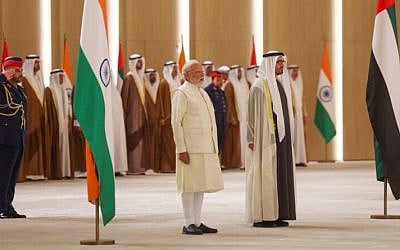
While strengthening ties in the east, Modi also worked to advance initiatives in the west. In mid-May he visited Italy, the Netherlands, Norway, Sweden, and the United Arab Emirates. These visits focused on expanding economic and security cooperation while advancing the India-Middle East-Europe Economic Corridor (IMEC).
During his visit to the UAE, important defense agreements were signed and a wide range of economic issues were discussed. Modi also expressed solidarity with the UAE over the difficulties it experienced during the regional conflict and the Iranian attacks that affected the Gulf region.
Shortly before Modi’s visit to the UAE, an Israeli transportation delegation led by the Director General of Israel’s Ministry of Transport arrived in Dubai. The delegation included representatives of Israel Railways and Israeli ports, who met with Emirati railway and port companies. Israeli officials described the visit as part of ongoing efforts to advance the IMEC project and strengthen regional connectivity.
Despite signs of warming relations between Saudi Arabia and the UAE during the war, it remains unclear whether the planned railway connection between Doha and Riyadh will eventually become part of IMEC. Saudi Arabia’s position regarding the project in the post-Iran crisis environment also remains uncertain.
This uncertainty may require India and its partners to examine additional alternatives. One possibility would be extending maritime routes to Haifa or Aqaba while strengthening connections between Jordan’s transportation networks and Israel’s infrastructure.
At the same time, alternative corridors through East Africa could also be considered, passing through Somaliland, the Horn of Africa, Ethiopia, the Nile Basin, and Sudan toward the Mediterranean. Such concepts resemble historical trade routes considered during the British Mandate era, including ideas similar to the VICMED corridor linking Lake Victoria to the Mediterranean Sea.
Should Egypt choose not to integrate the ports of Alexandria and Port Said into future corridor frameworks, planners may also need to examine Libya’s Port of Benghazi as an additional gateway to Europe. Such a scenario could further increase the strategic importance of Italy’s Port of Trieste as a European hub for IMEC.
During his visit to Italy, Modi found a partner interested in promoting Trieste as a major European gateway for the corridor. The two countries also discussed expanding cooperation in space, defense, and advanced technologies.
On May 22, the President of Cyprus visited India in his capacity as the rotating President of the Council of the European Union. Cyprus and Greece are increasingly viewed as important potential partners in future Eastern Mediterranean energy and transportation projects linking the region with Europe.
Between May 24 and May 28, US Secretary of State Marco Rubio visited India. The discussions focused, among other topics, on strengthening strategic cooperation and advancing the QUAD partnership, which includes the United States, India, Japan, and Australia.
At the same time, the I2U2 framework—bringing together India, Israel, the United States, and the United Arab Emirates—continues to evolve. Originally launched as a platform for cooperation in technology, innovation, and infrastructure, it may become increasingly important in the fields of artificial intelligence, space, energy, and advanced technologies.
Modi enters this period from a position of political strength. Following significant electoral successes by the Bharatiya Janata Party (BJP), including major gains in regional elections, his government appears determined to pursue its vision of transforming India into a leading economic and technological power by 2047.
The sequence of diplomatic engagements and visits undertaken by Modi throughout May suggests that India is not waiting for the Middle East crisis to end before planning for the future. While many countries remain focused on managing the current conflict, New Delhi is already working to shape a network of trade corridors, strategic partnerships, and supply chains designed to support its global ambitions in the decades ahead.
If India and its partners succeed in advancing IMEC alongside additional corridors in Asia and Africa, these projects may ultimately become some of the most significant geopolitical and economic initiatives of the 21st century.
About the Author
Rafi Glick is a writer, lecturer, farmer, and business executive with decades of experience at the intersection of academia, technology, agriculture, and international trade.
• He has served as a Senior Teaching Associate at Ben-Gurion University of the Negev, Ono Academic College, Ariel University, Ruppin Academic Center, and as a guest lecturer at Sofia University’s Faculty of Economics and Business Administration (FEBA). At Ben-Gurion University he also advised the BGU–NHSA Accelerator in the Faculty of Science.
• In business, Rafi was CEO of Bidsnet Ltd., a pioneer in deploying fiber-optic cables through unconventional infrastructure (in partnership with CableRunner), delivering high-speed connectivity to homes, enterprises, institutions, and cellular networks. Earlier he held senior roles at ECI Telecom and served on the board of RLF Venture Capital, working with partners such as Intel, Teva, and the Jerusalem Development Authority.
• He contributed extensively to Israel’s trade and investment ecosystem: he directed industrial and agricultural technology divisions at the Israel Export Institute, founded Israel’s AGRITECH as international exhibition, and served on the board of the Israeli Investment Center at the Ministry of Industry and Trade.
• In his early career, Rafi established and served as the first director of the Cargo and Aircraft Supply Security Department in the Security Division at Ben-Gurion Airport (1972–1976). He lived in Kibbutz Parod until 1974.
• Rafi has also been recognized for his writing: in 2008 he was named Best Economic Blogger by TheMarker, Israel’s leading business daily.
• Today he continues to publish essays and commentary—with a special passion for astrophysics, space exploration, technology, economics, and social issues.
From Kibbutz Parod to the global stage, Rafi Glick’s career reflects a lifelong commitment to building connections—between people, industries, and ideas.
Email: rafi.glick@gmail.com
Related Topics
Related Posts

Rafi Glick