


Stephen J Stern PhD
Monticello is Burning: Thomas Jefferson on Trial?!
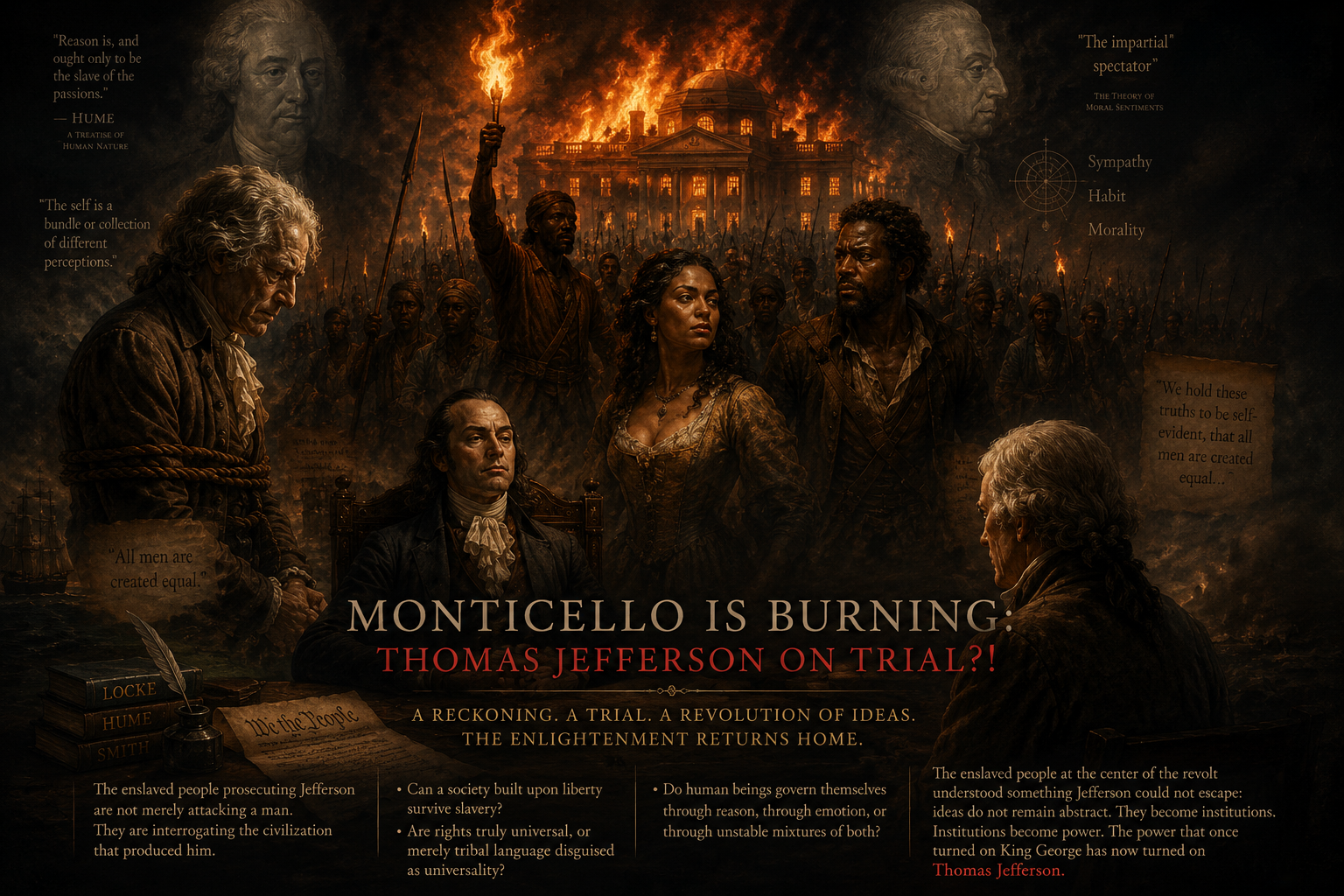
AI image created by author.
Imagine this.
Enslaved people have revolted. Smoke rolls across the Virginia hills while the author of the Declaration of Independence is dragged from the estate that once symbolized Enlightenment liberty and American possibility. The man who wrote “all men are created equal” now finds himself imprisoned by those excluded from his definition of equality.
Monticello is burning.
During a dinner party, a woman long believed lost at sea returns. She is Theodosia Burr Alston, the presumed-dead daughter of former vice president of the United States Aaron Burr. Years earlier, she vanished into the Atlantic and was mourned as dead. Now she reappears transformed, having lived among pirates, fugitives, and revolutions moving through the violent underside of the Enlightenment.
Her second husband, one of the pirates who returned with her, is James Hubbard, a man who escaped enslavement from Monticello itself. Together they helped organize the revolt long before this night arrived.
The Atlantic world Jefferson helped imagine politically has returned home as a reckoning.
Is the American experiment collapsing into irony?
Then comes the final insult.
Aaron Burr arrives at Monticello.
Years earlier, Jefferson politically destroyed Burr, helping turn him into the permanent villain of the American founding. Burr lost his future, his reputation, and eventually even his daughter, who disappeared at sea and was presumed dead. Now, impossibly, she has returned beside James Hubbard, a man who escaped enslavement from Monticello, and summoned her father to the burning plantation of the man who helped destroy them all.
Burr, brilliant, exiled, regarded by many as morally ambiguous, stripped of his future, now prosecutes the philosopher-president who once helped destroy him.
But the trial is not merely political.
It is philosophical.
Hovering over the proceedings are the ghosts of the Scottish Enlightenment, David Hume and Adam Smith, whose friendship argued modernity into existence. Hume argued that reason is ultimately the slave of the passions and reduced the stable self to a “bundle of perceptions.” Smith believed human beings regulate themselves through sympathy, habit, and what he called the “impartial spectator,” the imagined observer living inside conscience itself.
Jefferson borrowed English philosopher John Locke’s language of liberty and natural rights while drafting the Declaration of Independence. James Madison helped construct a Constitution grounded less in faith in human reason than in darker assumptions about human psychology inherited from English philosopher Thomas Hobbes and later sharpened by David Hume. Fear, ambition, faction, passion, and religious conflict. Alexander Hamilton, often called the architect of American government and later killed by Aaron Burr, shared Madison’s more Hobbesian assumptions about human nature, believing stable government required strong institutions capable of restraining ambition, passion, and disorder.
All of it is now on trial.
As Monticello burns, does the Enlightenment burn with it?
The enslaved people prosecuting and judging Jefferson are not merely attacking a man. They are interrogating the civilization that produced him.
Can a society built upon liberty survive slavery?
Are rights truly universal, or merely tribal language disguised as universality?
Do human beings govern themselves through reason, through emotion, or through unstable mixtures of both?
The enslaved people at the center of the revolt understood something Jefferson could not escape. Ideas do not remain abstract. They become institutions. Institutions become power. The power that once turned on King George has now turned on Thomas Jefferson.
Thomas Jefferson unleashed principles history would continue radicalizing beyond his control.
The film becomes less a historical drama than an autopsy of the American Enlightenment itself — a meditation on freedom, hypocrisy, sympathy, self-interest, slavery, and the terrifying instability of the human creature beneath political theory.
York, Alabama artist Garland Farwell and I developed this film idea in conversation. As America approaches its 250th anniversary, the themes feel less historical than immediate.