


Moral Posturing at Zero Cost
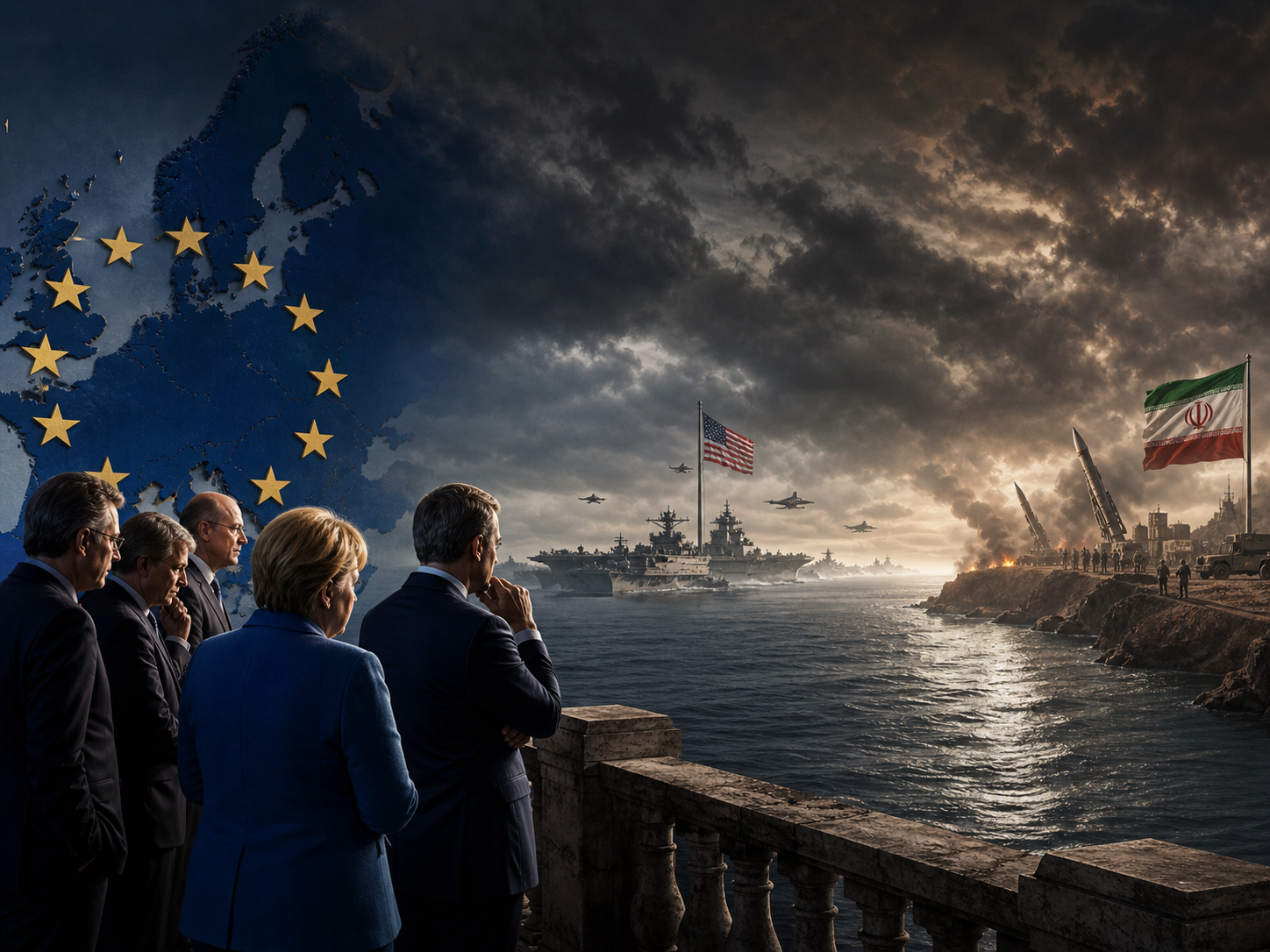
The European posture since the outbreak of the US/Iran conflict in February 2026 in 6 phases
1—Powerlessness as basic data.
Europe has no deployable navy in the Gulf, no bilateral alliances with Tehran or Riyadh that give it real leverage, and an energy dependency that the US and Qatari Liquefied Natural Gas have reduced but not eliminated. Its non-involvement is therefore not just a choice: it is a structural constraint. To criticize it as “cowardice” without naming it “impotence” is to confuse the symptoms and the disease.
2—Anti-Trumpism as a catalyst.
This is where the most intellectually dishonest confusion occurs in the European media. The rejection of the Trump method – open coercion, contempt for multilateral institutions, and simultaneous tariff blackmail – is legitimate and documented. But this rejection slips insensibly towards an anti-Americanism of substance which ends up invalidating the strategic substance of the action: to dismantle the Iranian ballistic capabilities and to cut off the financing of regional proxies. We reject D. Trump and inadvertently excuse the IRGC.
3—Third-world bias.
It is the oldest and strongest. It goes back to the post-colonial reading grid of the 1970s: any Western power projecting its force is suspect, and any peripheral resistance benefits from a presumption of legitimacy. Khamenei’s Iran—police theocracy with systematic repression of women, Kurds, and Baluchis—is received by part of the European intelligentsia as an actor of resistance. It’s a denial of reality, but a structured denial, not an accidental one.
4—The anti-Israel slide.
That is analytically the most interesting. Iran has strategically built its international identity around the Palestinian cause for decades. Implicitly supporting it (by condemning the US action without condemning Iran’s ballistic capabilities) is felt by its authors as an act of solidarity with Gaza. This is where the shift takes place: criticizing Israel becomes the currency of an anti-war posture, and anti-Zionism becomes the cement that binds together very different political currents—radical left, European Islamists, and anti-American sovereignist right. Antisemitism is not always aware of this shift, but it is the structural consequence, as documented.
5—The electoral calculation.
In no major European country today can a leader openly support US military action in the Middle East without immediate electoral costs. E. Macron is the most visible case: his position on Gaza, and then on Iran, is less a strategic line than a balance between incompatible electorates. This is not moral cowardice; it is ordinary political survival—but it produces an incoherent foreign policy.
6—Strategic cowardice as such.
It consists of systematically choosing the posture of moral indignation (condemnations, calls for dialogue, and demand for de-escalation) rather than one of two costly alternatives: either clearly support Washington and in return negotiate a seat at the table or propose credible mediation with real guarantees. Europe does neither. It produces communiqués.
The fact that the negotiations took place in Oman and then in Islamabad, with Pakistan as an active mediator, is the objective sanction of this position. Islamabad is of value to Washington (nuclear, South Asia) and to Tehran (non-hostile Sunni, channel of legitimacy). France has none of these assets in this particular case. It is marginalized not by punishment, but by irrelevance—which is analytically more serious.
The “primary” anti-Americanism that we observe is not a cause; it is the visible product of a superposition of layers, none of which is a cause in itself. -even irrational, but whose combination produces something indefensible—a stance that exonerates a theocratic regime in the name of an anti-Western reflex and which mechanically leads to anti-Israelism by proximity association. This is not an opinion; it is reconstructible logic.