A New York City Cantor
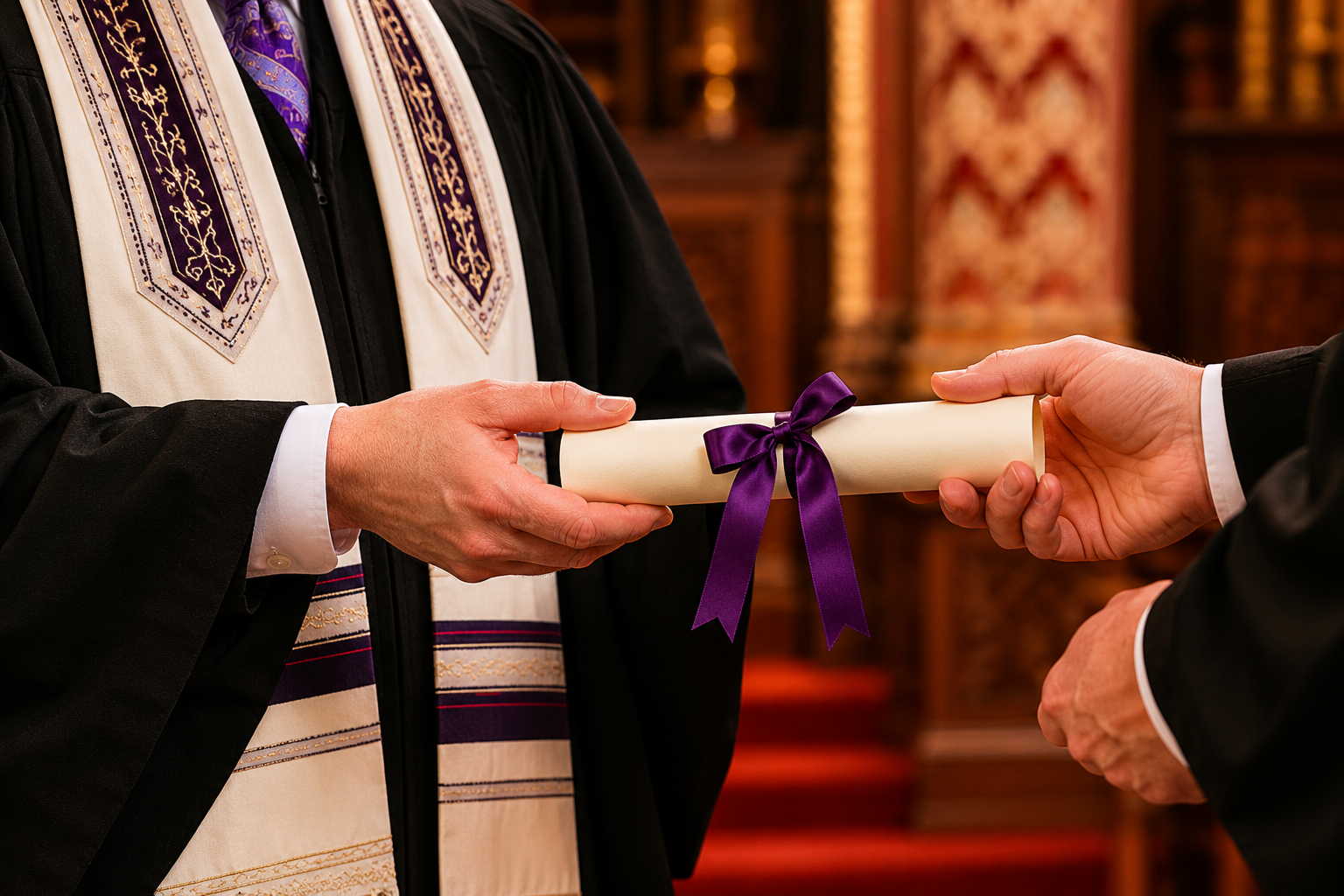
More Than a Diploma
One of the most formative experiences of my cantorial training took place during my final year as a student at Hebrew Union College-Jewish Institute of Religion, when I became the first cantorial intern in the history of Congregation Beit Simchat Torah.
CBST, New York’s LGBTQ synagogue, had not yet moved into the permanent home it occupies today. What made the internship especially meaningful was that although I was a student at HUC-JIR, I was serving alongside diverse rabbinical students and clergy from across the Jewish world. Some came from the Jewish Theological Seminary. Others came from the Reconstructionist movement and other seminaries. For the first time in my life, I found myself immersed in a Jewish community composed of people whose backgrounds, identities, and life experiences were often very different from my own.
Under the leadership of Rabbi Sharon Kleinbaum, now retired, and Rabbi Ayelet Cohen, then the congregation’s associate rabbi and now the Dean of the Rabbinical School at JTS, I learned lessons about Jewish community that have stayed with me ever since.
Many members of CBST knew what it felt like to be excluded from Jewish life. Some had spent years wondering whether there was a place for them in the Jewish communities they loved. Yet what I encountered was not a community defined by grievance. It was a community determined to build something better, and music was a large part of that experience.
Joyce Rosenzweig, longtime faculty member at HUC-JIR and CBST’s music director, pianist, and choir director, created one of the most extraordinary musical communities I have ever encountered. Week after week, she brought together people with different identities, backgrounds, experiences, and beliefs and somehow transformed them into a unified choir. People who may have disagreed about any number of things found themselves breathing together, harmonizing together, and praying together.
As a young cantor, I found it impossible not to be inspired by what Joyce had built. In many ways, it became a model for the kind of community I later hoped to help create in my own congregation. She taught me that unity does not require uniformity.
Among my fellow interns was Rabbi Reuben Zellman, one of the pioneering transgender rabbis of the Reform movement. Reuben is also quite musical, has a very beautiful voice, and we spent many hours singing together at the congregation and in cantorial classes at HUC. Another was Rabbi Darby Jared Leigh, among the first deaf rabbis to be ordained. I still remember Darby telling me that he loved “hearing” me sing because he could physically feel the depth and resonance of my voice reverberating through the room and floor, into his body. It was a reminder that music reaches people in ways we do not always understand.
Years later, I have remained connected to many of these wonderful colleagues. More recently, I had the privilege of supervising cantorial interns at Stephen Wise Free Synagogue, including some of the first openly nonbinary cantorial students at HUC-JIR. Watching a new generation of exceptionally talented young Jewish leaders find their place within our movement often brought me back to those early experiences at CBST.
One person who further shaped my thinking about these questions was my friend Matan Koch, of blessed memory, who died recently at the tragically young age of 44 from stomach cancer.
Matan attended our services regularly for years when he lived in Manhattan. For many years after he left the city, he returned as often as he possibly could. After leading Shabbat services, I would often walk him home, and we shared many enlightening conversations together. Somewhere along the way, those walks became a friendship.
Matan spent his life in a wheelchair. He was a lawyer, a nationally recognized disability rights advocate, and a powerful voice for inclusion. He spoke throughout the country about accessibility, equal opportunity, and the barriers that still prevented talented and dedicated people from participating fully in communal life. He also loved Jewish music.
Anyone who knew Matan remembers his humor, intelligence, and determination. He challenged institutions because he wanted them to be better. He believed deeply that the Jewish community should make room for every person who wished to contribute to it.
I often think about the obstacles he encountered while pursuing rabbinical study, an opportunity once denied him by HUC-JIR. In the years since, Jewish seminaries have become far more welcoming to people with disabilities. We have seen pioneering not only deaf rabbis, but blind rabbis, and clergy with significant physical disabilities demonstrate that assumptions held by earlier generations were often mistaken.
The same story appears throughout modern Jewish history. Women fought for ordination. LGBTQ clergy fought for ordination. Transgender and nonbinary clergy fought for ordination.
Cantors fought for generations not only for ordination, but for the creation of a cantorial school, something not achieved until after the Holocaust wiped out most of the cantorial traditions of Europe. Even after the establishment of the school, however, we were denied ordination by HUC-JIR for over sixty years and relegated to “investiture.” Not until finally in 2012 were we retroactively granted ordination.
Jews of color also challenged assumptions about who could stand before a congregation and represent the Jewish people. When Rabbi Angela Buchdahl became the first Asian American ordained as both a cantor and a rabbi, she expanded many people’s understanding of what Jewish leadership could look like. Numerous other clergy from all kinds of racial and ethnic backgrounds have since followed in her path.
Looking back across all of these stories, one thing strikes me: The issue was rarely ever ideology.
The women seeking ordination were not asking the movement to abandon its principles. Neither were cantors. Neither were LGBTQ clergy. Neither was Matan.
The argument was not that the movement should overlook or change its values. The argument was that these individuals were fully capable of embodying the values the movement had established and maintained for generations, ready to serve as its leaders.
Eventually, in most cases, the movement came to agree. This distinction is important because ordination has never been assumed to have been the pursuit of intellectual studies automatically resulting in the awarding of a diploma and ordination.
One of the clearest examples comes from Helen Levinthal.
Many decades before Rabbi Sally Priesand was ordained in 1972, in 1929, Levinthal was accepted to the school and completed all of her rabbinical studies at Rabbi Stephen S. Wise’s Jewish Institute of Religion. She earned her degree and fulfilled the academic requirements. Yet despite being a founder of the Men’s League for Women’s Suffrage and debating against the establishment as a fierce advocate for women’s right to vote against Rabbi Joseph Silverman of Temple Emanuel over a decade prior, Rabbi Wise refused to ordain Levinthal, explaining that “the time was not ripe to ordain women.”
Today, most all of us regard that decision as mistaken. Yet the story remains important because it reminds us that education and ordination have never been identical.
Levinthal had the education. What she lacked was recognition.
The movement eventually concluded that it had made a mistake. What changed was not the meaning of ordination. What changed was the movement’s understanding of who could embody its ideals.
For me, that is one of the most important lessons in the history of Reform Judaism.
Jewish communities should welcome debate. Jewish schools should encourage inquiry. Students should be exposed to competing ideas and difficult questions. Intellectual openness is one of Judaism’s greatest strengths.
Rabbi Stephen S. Wise himself championed freedom of pulpit and freedom of pew, believing that disagreement and vigorous discussion were essential to Jewish life. He even audaciously welcomed non-Jews to participate as full members of the Free Synagogue, but he stopped short of allowing them to serve as leaders who would determine the direction of the congregation.
Rabbi Wise clearly distinguished between participation and ordination. Despite being welcoming of robust debate, he was also discerning about ideology and what his school and the movement should stand for.
Ordination has always meant something more than intellectual achievement. It is a declaration that a community believes a person can represent its values as a religious leader.
The great inclusion struggles of the last century did not eliminate standards. They challenged assumptions. Again and again, the Reform movement discovered that it had confused identity with fitness for leadership.
The lesson was not that standards no longer mattered. The lesson was that more people were capable of meeting the standards than previous generations had imagined.
Every generation inherits the responsibility of asking whether its assumptions about leadership still reflect its values. The history of ordination suggests that when we ask that question honestly, the Jewish community grows stronger.
That was one of the lessons I learned at CBST.
It was one of the lessons Matan spent his life teaching.
And it remains one of the most important lessons our institutions can remember today.
Related Topics
Related Posts