Life on the Border with the Gaza Strip
More Than a Story to Tell
I’ve told Nirim’s story to audiences around the world countless times. But this time was different. I wasn’t there simply to share what happened to us. I was there to ask difficult questions, voice our disappointment, and speak on behalf of those who were taken into the tunnels of Gaza, some of whom never returned. Clearly, this was going to be a meeting like none I had ever had.
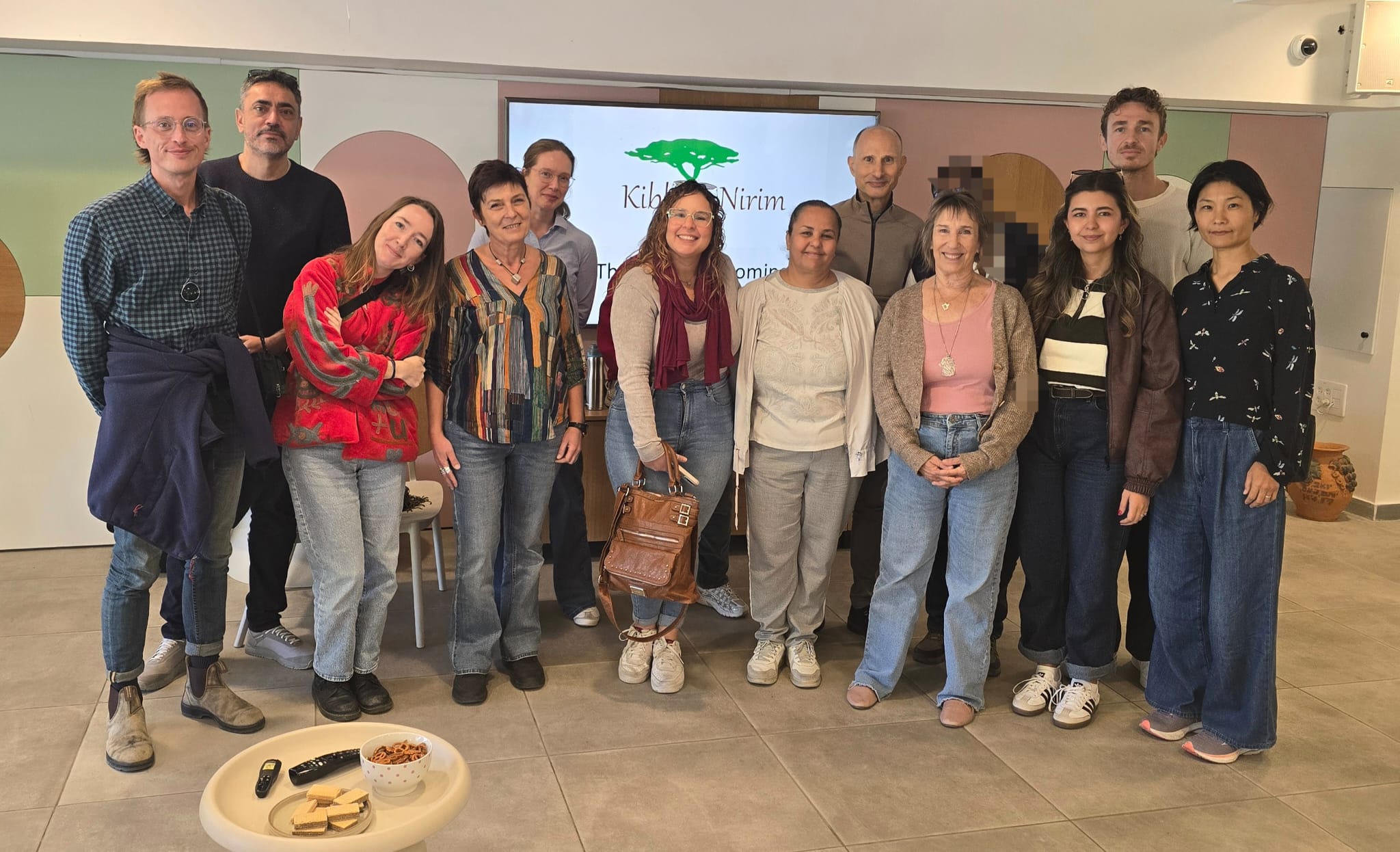
Today, November 11, 2026, with barely a day to prepare, I found myself with the opportunity of hosting a delegation from the International Committee of the Red Cross (ICRC), the same body that we had believed would look after our loved ones, bring them food and medicine; bring us news of their physical and mental conditions while in captivity. Among them were representatives from Spain, Belgium, Italy, Germany, the Netherlands, Ireland, Japan, Colombia, France, Australia and Israel.
We met in the members’ clubhouse, in the very hall where, on October 7, 2023, Nirim’s residents had gathered after being evacuated from our homes. We spent that day and night there, surrounded by the soldiers protecting us, before finally leaving the kibbutz and escaping the war zone the following day. What we thought would be a temporary evacuation turned into 627 days away from home, as refugees in our own country. We finally returned to Nirim in the summer of 2025.
A little over three years after October 7, in that same hall, after agonizing all day to decide how to adapt my usual talk for this special group of people, I shared some of our stories with the ICRC delegation.
I told them what it means to live on the border. How close I came to losing three of my young granddaughters, and how my daughter, my son and I almost became victims ourselves. I spoke about the friends we lost, and about how Nirim had always hoped to live in peace with our neighbors on the other side of the fence, doing what we could to help them build a better future.
I played them the song that was once Nirim’s anthem, written in the 1950s, a song about our home and our hopes for peace and coexistence in this region. A song that we have been unable to sing since October 7.
And then came the difficult part.
I spoke about our disappointment and the faith and hope we had placed in the Red Cross to help bring our hostages home. I shared a message from one of our former hostages, who described feeling abandoned while ill and suffering from a lack of medication in the tunnels. Help never came. Nor did anyone come to save her son.
Her message to the delegation was simple and unequivocal: Do better.
She also wanted them to consider the future. What happens the next time terrorists take innocent civilians, children or elderly people hostage? How can we trust that things will be different? What will the ICRC be able to do then?
The event was calm and respectful, and the delegation listened attentively. One representative even expressed regret that the ICRC had not come to speak with the affected communities sooner, to hear firsthand what we had experienced and explain the challenges they faced.
Many of my questions, however, went unanswered.
We were told that the ICRC is a highly centralized organization. Much of the information about diplomatic efforts, negotiations and what was or wasn’t attempted is held at the highest levels. The delegation members themselves are not privy to all of it. They explained that the organization’s effectiveness depends, in part, on strict confidentiality and centralized decision-making. In other words, the very secrecy that makes it possible for them to operate also means that even their own representatives cannot always explain what happened behind the scenes.
I also learned that the ICRC focuses its presence where humanitarian needs are greatest. Since Israel was not considered to be in need of such a presence before October 7, there was only a minimal ICRC presence here when the attacks and kidnappings took place. The events took them by surprise, just as they took Israel by surprise.
Another explanation was that the ICRC can only operate effectively where the governing authorities respect and trust it. Hamas, the de facto rulers of Gaza, did neither.
I asked a question that seemed to follow naturally:
Could you have turned to other countries, such as Qatar, which Hamas DOES respect?
The answer was: “We did what we were able to.”
I don’t pretend these explanations answer all our questions, or erase our disappointment and the suffering of those who waited desperately for help that never came.
Nevertheless, I came away with something else worth sharing. The people sitting in Nirim’s clubhouse that day impressed me as genuinely caring and empathetic individuals. They seemed sincerely committed to doing their work well and helping humanity to the best of their abilities. I believe they wanted to understand us, just as they wanted us to understand them.
That doesn’t mean I agree with every explanation or that the institution has no questions to answer. But I think it is important to distinguish between the people and the organization they represent. I saw people who care. I hope they can translate that caring into greater effectiveness.
My main takeaway was that the ICRC representatives recognize the importance of visiting former hostages who wish to speak to them, and communities directly affected, hearing their experiences and understanding the depth of the disappointment and mistrust. They also wanted us to understand their perspective: that they believe they did everything within their power.
I ended with a question posed to me by a former hostage: How can we trust that the ICRC will be able to help if innocent civilians are kidnapped again?
Their response was that the challenge ahead is to find a way to build trust and respect with all the parties involved.
I’m not quite sure how one builds trust and respect with terrorist organizations, but I genuinely wish them luck.
Because ultimately, their success is our success.
We have absolutely no interest in seeing another family go through what ours have endured. We don’t want another October 7, more hostages or more suffering, on either side of the border.
From Nirim, they went on to visit the site of the Nova Music Festival and then, to the city of Sderot, hopefully to further enrich and widen their understanding.
If the Red Cross can find a way to be more effective in protecting civilians and securing the release of hostages in the future, that benefits all of us.
And that is something worth hoping for.