The views expressed herein are solely mine.
Moroccan Hebrew: Empire’s Living Bridge
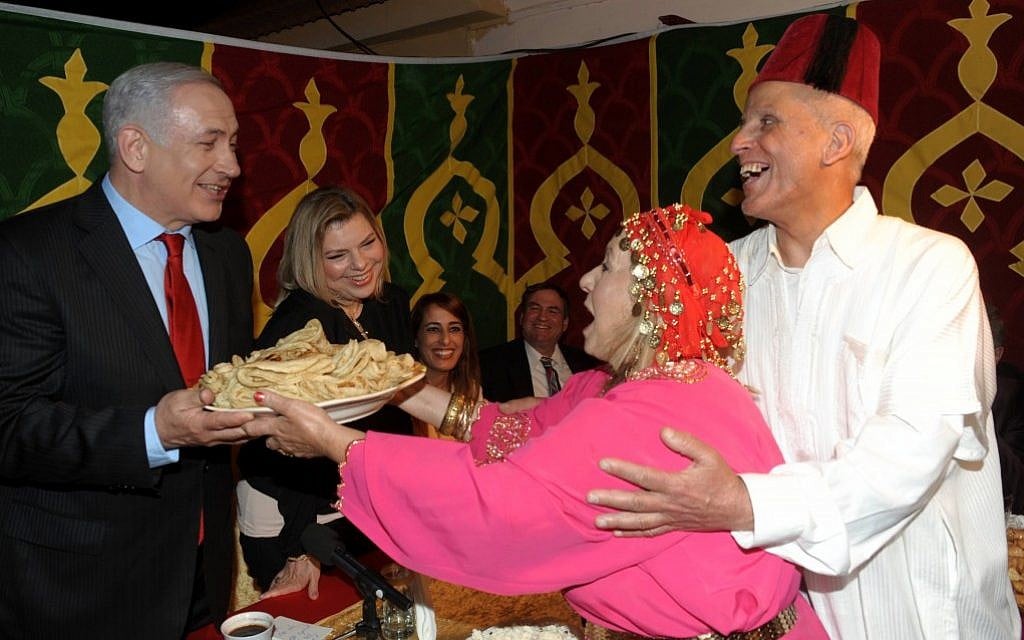
Benjamin and Sara Netanyahu celebrating the Mimouna, a traditional Jewish-Moroccan holiday that follows the end of passover (Amos Ben Gershom/Flash90)
Moroccan Jewry, the largest in the Islamic world before 1948, maintained a rare fusion of Hebrew and Maghrebi Arabic that functioned as a linguistic bridge across centuries.
Unlike European Jewry, which confined Hebrew to prayer, Moroccan Jews embedded Hebrew into everyday commercial life, using it in contracts, merchant codes, amuletic texts, and even in segments of family speech.
This created what scholars call “Hebrew permeability” — a social environment in which Hebrew words circulated constantly, even when Judeo-Arabic was the primary spoken tongue. The phenomenon is visible in ketubbot (marriage contracts) that mix juridical Hebrew with regional Arabic legal formulas, in merchant letters written half in Hebrew, half in Arabic, and in the persistence of uniquely Moroccan Hebrew melodies that carried Andalusi musical DNA.
By the 19th century, Morocco had become the unexpected conservatory of a medieval Sephardi-Hebrew world that Spain itself no longer possessed; its Jews transmitted the tunes, pronunciations, and liturgical patterns that would later re-enter global Jewish culture through North African immigration to Israel.
Consequently, Moroccan Hebrew reveals a world where commerce, mysticism, and empire braided a single linguistic rope.
Related Topics