


Middle East Forum Fellow/North Africa Risk Consultant
Morocco’s ‘Key Node’ Designation and the New Mineral Security Architecture
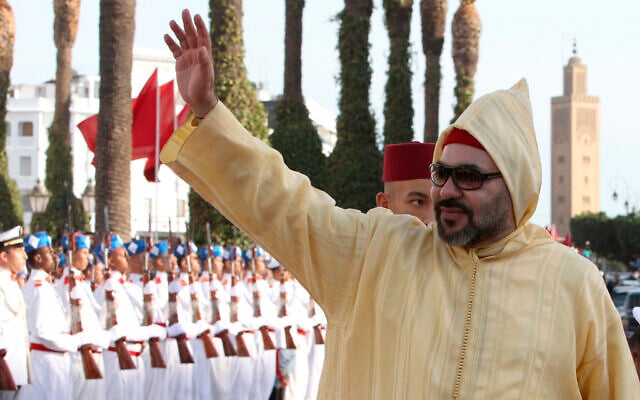
Moroccan King Mohammed VI waves to a crowd as he arrives for the opening session of the Moroccan Parliament in Rabat, Morocco, on October 12, 2018. (AP Photo/Abdeljalil Bounhar)
While diplomatic circles remain fixated on the “Madrid Breakthrough” regarding the Sahara, a far more permanent reality is being forged in the industrial hubs of Jorf Lasfar and the high-grade mines of the Anti-Atlas. Morocco has officially transitioned from a regional partner into a foundational pillar of American national security. This transformation is driven by a radical new doctrine that Foreign Minister Nasser Bourita has termed the “Loyalty Pact”—a strategic weaponization of critical minerals designed to secure Morocco’s sovereignty while providing the West with its only viable alternative to Chinese industrial hegemony.
The “Key Node” Designation and Project Vault
The cornerstone of this shift was laid when Secretary of State Marco Rubio and Foreign Minister Bourita finalized Morocco’s role as a “Key Node” in Project Vault. This landmark initiative, a $12 billion U.S. strategic mineral reserve, represents an unprecedented step in American industrial policy. Backed by a $10 billion EXIM Bank loan—the largest in the agency’s history—Project Vault is designed to stockpile 60 essential minerals to shield Western manufacturers from supply shocks and political coercion.
Under this framework, Morocco is not merely a supplier; it is a protected partner. The agreement includes price floor mechanisms that shield Moroccan producers from the predatory “price dumping” tactics frequently employed by Beijing to crush Western-aligned competitors. This partnership is the physical manifestation of the Loyalty Pact: a commitment that allied minerals will receive allied protection.
The “Full-Stack” Battery Hub: Jorf Lasfar
The crown jewel of this strategy is the COBCO facility at Jorf Lasfar. As Western EV giants like Tesla and Ford pivot toward Lithium Iron Phosphate (LFP) chemistries to escape the ethical and financial volatility of nickel-cobalt chains, Morocco has leveraged its 70% monopoly on global phosphate reserves to become the world’s most strategic geography.
The COBCO industrial platform is now fully operational, functioning as a high-tech “Full-Stack” node. It currently produces 120,000 tons of NMC precursors and 60,000 tons of LFP cathodes annually. By integrating the entire value chain on a single site, Morocco has achieved a staggering 36% cost advantageover Asian manufacturers. For the first time, a Western-aligned nation can out-compete China on both price and sustainability, with the Jorf Lasfar site powered by 80% renewable energy as of this month.
The Cobalt Sulfate Pivot
Parallel to the phosphate boom is a surgical pivot in the cobalt sector. While the Democratic Republic of the Congo (DRC) remains mired in logistical chaos and Chinese influence, Morocco offers “Clean Cobalt” that meets the strictest Western ESG standards. In January 2026, the Managem Group completed a historic transition at the Bou-Azzer facility, officially switching production from cobalt metal to cobalt sulfate.
This distinction is vital; sulfate is the specific chemical form required by battery cell manufacturers. With an annual capacity of 6,000 tons, Morocco is now the primary feed for a new generation of direct-to-OEM supply chains. This was underscored by a seven-year agreement with Renault Group to supply 5,000 tons of sulfate annually for its European gigafactories, effectively isolating the North African supply chain from the “grey market” vulnerabilities that have long plagued global mineral markets.
The Strategic Divergence
The implications of this pact extend far beyond the economy. By anchoring its future in the high-tech supply chains of the West, Morocco has secured a permanent U.S. interest in its territorial integrity. This stands in stark contrast to Algeria, which continues to tether its economic diversification to Chinese-backed heavy-haul infrastructure, such as the Gara Djebilet iron ore railway.
The divergence is clear: Morocco is building a high-tech fortress integrated into the U.S.-led FORGE (Forum on Resource Geostrategic Engagement) alliance, while Algeria builds a desert supply line to the Pacific.
The era of viewing Morocco through the lens of traditional regional diplomacy is over. Rabat is now a central player in the global resource war. By 2027, every American-made electric vehicle and strategic defense battery may very well depend on a “Moroccan heart.” In the high-stakes competition for 21st-century dominance, the Kingdom hasn’t just secured a seat at the table; it has built the table itself.