
A Moroccan Journalist
Morocco’s Mistake Was Lifting AFCON From Obscurity to the Global Stage
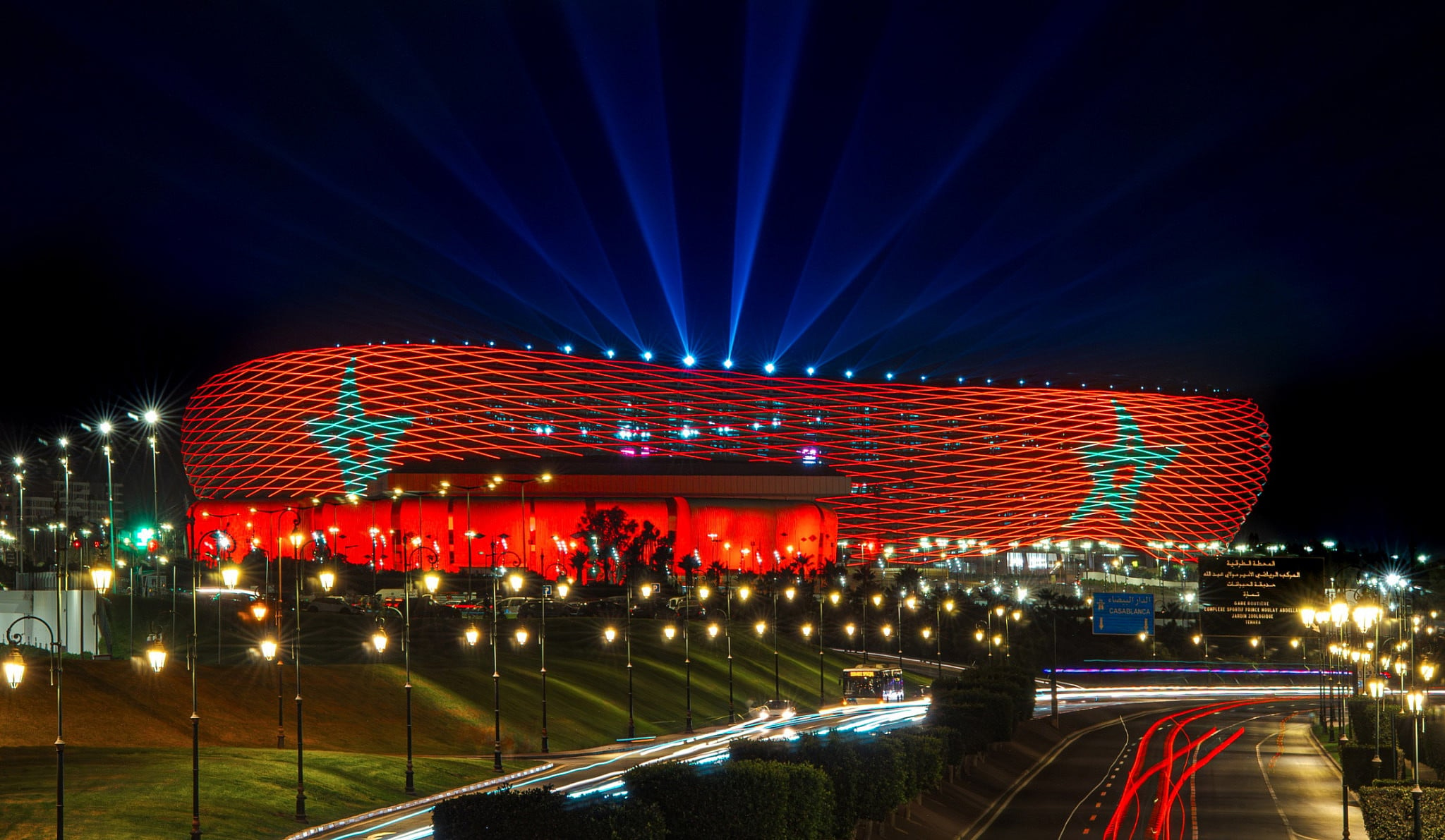
Rabat, adorned with fan zones, banners, and world-class venues like Prince Moulay Abdellah Stadium, was widely seen as the jewel of AFCON 2025, setting the tone for Africa’s premier football celebration.
Sometimes one has to undergo a catharsis – a moment of emotional release and intellectual reckoning – to purge illusions, confront uncomfortable truths, and make sense of collective disappointment.
As the title suggests, my catharsis will be the Africa Cup of Nations (AFCON) itself: a tournament meant to embody continental unity, yet one that ultimately revealed Morocco standing not alongside, but against, an entire continent.
Under the floodlights of Morocco’s modern stadiums, the 35th edition of this prestigious continental tournament was a resounding success by every measure.
Morocco delivered unprecedented infrastructure for the competition. The country deployed nine state-of-the-art brand-new or upgraded stadiums, including Rabat’s 69,000-seat Prince Moulay Abdellah Stadium and the 75,000-seat venue in Tangier.
High-speed rail lines connected major cities, while renovated airports and 5G networks operated seamlessly throughout the tournament.
The tournament achieved record-breaking attendance. Over 729,000 fans attended group-stage matches, establishing the highest opening-round total in AFCON history. Local broadcasters reported near-full capacity at nearly every game.
AFCON 2025 became an African financial juggernaut. Prize distributions reached unprecedented levels, with the champion earning $11.6 million and even first-round exits receiving up to $1.3 million.
Match broadcasts were high-definition and uninterrupted, and pitches were immaculate despite winter rain. The local organizing committee worked beyond the normal limits, coordinating transportation, security, and media logistics at a level never seen in African football.
Even many critics of past AFCONs found nothing to legitimately fault in Morocco’s performance.
In light of these successes, however, a chorus of skepticism arose. Some pundits expressed surprise – or thinly veiled disappointment – that Morocco’s AFCON did not conform to their nostalgic expectations of earlier tournaments.
What surfaces, disturbingly, is the persistence of a degraded imaginary in which African sporting championships are expected to unfold amid power outages, crumbling unpaved roads, erratic transport, swarms of mosquitoes, encroaching deserts, and mythologized jungles – spaces imagined as hostile, improvised, and perpetually on the brink, where disorder is presumed natural and institutional competence feels anomalous.
For example, South Africa’s coach Hugo Broos lamented that Morocco lacked the festive atmosphere of Ivorian or Gabonese Cup finals. He noted that in the Ivory Coast or Gabon, “fans [were] waving flags and welcoming teams on their way to training,” but “[in Morocco] that spirit feels absent.”
Similarly, murmurs on social media and some Algerian and Egyptian outlets suggested that Morocco’s organization was over-controlled or that the crowds seemed muted.
Egypt coach Hossam Hassan attributed the Pharaohs’ elimination to a litany of external factors, ranging from hotel rooms plagued by mosquitoes and exhausting train travel from Tangier to Casablanca instead of flights, to inadequate rest periods and alleged scheduling conspiracies and inequities favoring Senegal.
Senegal’s football federation lodged a formal protest with CAF, accusing the Moroccan hosts of organizational and security deficiencies ahead of the final, warning that these issues risked undermining fairness and equal conditions for the match.
Rather than confront their teams’ on-field shortcomings, several sought refuge in logistical critiques, attributing failure to travel arrangements, accommodation standards, or scheduling decisions – complaints that functioned less as substantive analysis than as post-hoc rationalizations for competitive defeat.
What followed was more than criticism – it was a discursive escalation. Segments of the international media capitalized on the controversy to insinuate behind-the-scenes engineering, casting Morocco not merely as fortunate, but as covertly manipulating outcomes to secure silverware.
This framing fed into a broader unease with Morocco’s rising strategic dominance beyond football – economic, diplomatic, and cultural – particularly unsettling for former colonial powers such as France, now watching influence ebb across spaces once presumed theirs.
Layered atop this was a strain of performative left ethics that hastily resurrected neo-colonial tropes, recasting Morocco as somehow not African enough – or worse, as a new, indirect disciplinarian presumed to be “teaching” Africa order and success.
In several cases, the framing seemed less ideological than careless – rooted in ignorance, indifference, or a Eurocentric lens unable or unwilling to process African excellence without suspicion.
Whether driven by threatened interests, ideological reflex, or sheer indifference, the result was the same: a Eurocentric narrative unable to process African achievement without imputing illegitimacy.
Worse still, this distorted framing was first echoed – and in many cases initiated – by segments of Arab and African media that might have been expected to show solidarity, but instead internalized and reproduced the same tropes, furnishing Western outlets from the outset with the discourse they later weaponized against Morocco.
When articulated by non-Africans, cultural theorists would identify this reflex as the imperial gaze – a racialized regime of perception forged by white supremacy that insists Africa be rendered intelligible only through savagery, barbarism, chaos, primitiveness, irrationality, excess, disorder, and perpetual failure.
Within this optic, Africa functions as spectacle rather than subject: a stage for violence, incompetence, emotionalism, and breakdown, endlessly available to reaffirm European rationality, discipline, and moral superiority.
Order in Africa is thus treated as suspicious, efficiency as anomalous, and excellence as provocation. When African institutions operate with rigor, professionalism, and control, they rupture the colonial fantasy that Africa must perform dysfunction to remain legible.
What unsettles these observers is not mismanagement but its absence – the collapse of a hierarchy that required Africa to appear backward so that whiteness could continue to appear modern, authoritative, and supreme.
It is in this context that cultural studies further illuminate what might be called the “African exceptionalism trap.” Across decades of discourse, African dysfunction has been normalized, even aestheticized. Delays are reframed as context, chaos as vibrancy, and improvisation as authenticity.
This low-expectation framework is not imposed only by the West; it is internalized and reproduced within Africa itself. When Morocco delivers timeliness, order, and procedural discipline, it violates an informal cultural contract about what Africa is supposed to look like. The backlash emerges not because something went wrong, but because too much went right.
Also at the core of this backlash lies a phenomenon long documented in postcolonial scholarship: intra-peripheral rivalry. Formerly colonized societies do not measure themselves only against Europe; they measure themselves against one another.
Within this horizontal field of comparison, Morocco occupies a position that disrupts the inherited pattern. It is African, formerly colonized, yet institutionally coherent, administratively effective, and globally legible.
This combination disrupts a tacit equilibrium built on shared underperformance. When one peer “escapes the script,” resentment does not rise upward toward the former colonizer, but sideways toward the peer who has broken rank.
Adding insult to injury, the final descended into a moment of institutional rupture when Senegal’s squad initiated a coordinated withdrawal following a legitimate penalty awarded to Morocco in the dying seconds of regulation time.
What followed was not a mere disruption of play, but a collapse of sporting authority itself – a breakdown so profound that it drew formal condemnation from both FIFA and the Confederation of African Football (CAF).
Broadcast images showed Teranga Lions supporters violently attempting to breach the pitch, hurling themselves into confrontations that forced emergency security intervention – with reports of assaults on Moroccan fans, the very hosts who had welcomed them with openness and hospitality – plunging the tournament into scenes of raw disorder and international disgrace. In that vacuum of authority, rules momentarily lost their binding force.
A Moroccan event steward later died at a Rabat hospital after sustaining injuries during the unrest, according to local reports, casting an even darker shadow over the night.
In Senegal, the fallout appeared even more severe, with footage circulating on social media showing confrontations targeting Moroccans in cafés and even attacks on Moroccan-owned shops and businesses – deeply straining what are often described as brotherly and historic ties.
The flashpoint occurred in stoppage time when referee Jean-Jacques Ndala Ngambo correctly sanctioned Malick Diouf’s foul on Brahim Díaz, a decision subsequently upheld through VAR verification.
Beyond reproach, the decision, though entirely justified and indisputably correct, provoked Senegal’s well-worn protest rituals and familiar repertoire of remonstration.
This almost reflexive descent into performative dissent has become a behavioral pattern emblematic of African football’s chronic inclination to substitute theatrics for sporting decorum – an undisciplined, choreographed obstruction that reflects a persistent failure to uphold accountability when confronted with adverse officiating.
Adverse officiating is not absorbed as part of a shared regulatory framework, but treated as a provocation demanding performative eruption, deliberate derailment, and moral dramatization.
Head coach Pape Thiaw amplified this failure by instigating his team’s exit from the Prince Moulay Abdallah Stadium pitch – an act symptomatic of the professional shortfall that continues to undermine African football’s global credibility. Responding to the call, players dispersed from their positions.
Although later interventions steered Senegal back from institutional disgrace toward sporting completion, the damage had already been done. The episode reinforced enduring perceptions of volatility and indiscipline that African football has struggled – often unsuccessfully – to escape on the international stage.
Only after lifting the trophy did Thiaw acknowledge the gravity of the moment, admitting: “I regret telling my players to leave the field… apologies to football,” he told beIN Sports. That post-victory contrition did not redeem the act; it merely exposed the incident for what it was – a grotesque histrionic excess, a self-inflicted spectacle rather than a principled protest.
In contrast, the Atlas Lions, though crestfallen in defeat, emerged with their institutional integrity intact, earning widespread praise from domestic supporters and international observers alike for their composure, merit, and unwavering commitment to fair play.
Morocco’s half-century wait for continental glory drags on, stretching back to their lone AFCON triumph in 1976; still, according to FIFA rankings, the Atlas Lions remain Africa’s top-ranked side and sit eighth worldwide.
From a structural perspective, this episode exemplifies a Bourdieusian mismatch between material modernization and institutional habitus. Modern infrastructure can be imported in a single budget cycle; institutional habitus cannot.
African football has accumulated the visible symbols of modernity – polished stadiums, elite infrastructure, global broadcasting standards, and technocratic tools such as VAR – while the internalized norms governing conduct under constraint, and the slower, contested work of producing procedural legitimacy – the shared belief that rules bind everyone even when they hurt “us” – have evolved far more unevenly.
The distinguished Moroccan intellectual and philosopher Abdallah Laroui’s assertion that “Morocco is an island, and our destiny is to be an island, and we must behave as island inhabitants” constitutes a profound geopolitical diagnosis rather than a geographic claim.
Laroui’s conceptualization emerges from Morocco’s historically singular position of strategic isolation and selective permeability – a state shaped by Atlantic and Mediterranean interfaces, Saharan depth, and a long tradition of negotiating power without dissolving into imperial dependency.
Crucially, this “islandness” also signals Morocco’s partial escape from the imperial gaze that cast Africa not as a subject of history, but as a spectacle – an affective landscape framed through tropes of barbarism, designed to affirm European centrality and white authority.
In postcolonial theory, this dynamic maps onto the classic West-and-the-Rest binary, in which Africa exists to be encountered, managed, and symbolically mastered, rather than to assert parity or modern competence.
This mode of perception is conditioned to anticipate dysfunction and is unsettled when confronted with efficiency, order, and institutional maturity. Morocco’s world-class stadiums, logistical capacity, and professional governance disrupt the epistemology of inferiority upon which colonial authority once relied.
Morocco refuses to perform primitivism for Western consumption; it no longer conforms to the mythologized terrain of savagery and disorder immortalized in “Heart of Darkness,” written by Joseph Conrad in 1899.
Unfortunately, elements within African sporting culture still appear tethered to this inherited script – revealing how certain mentalities remain trapped in a colonial time-warp, reproducing the very imagery once imposed upon them rather than decisively breaking from it.
What remains uneven across the continent is not capacity, but the resolve of mentality and the institutional fortitude required to sever inherited scripts and assume full subjecthood within the global order – a deficiency marked by a lingering, retrograde disposition that clings to obsolete modes of conduct long after their historical moment has passed.
I am not inclined toward victimhood or excuse-making. What matters is the lesson Moroccans must draw – even if it is uncomfortable: we should stop overvaluing foreign approval and assert our nationalism with clarity and dignity, so that no one feels entitled to disrespect us on our own soil.
As Hassan II once observed – speaking of Algeria, but with a wisdom that travels well beyond that context – “We do not wait for the world to recognize our Moroccan Sahara; we simply wanted people to know with whom God placed us as neighbors.”
The principle is universal: respect is not requested, it is imposed by confidence. AFCON 2025 made one truth unavoidable – our only reliable ally is ourselves. Even teams we backed to the end ultimately rallied behind Senegal against us.
There is no shame in learning from others – be it Europe’s unapologetic nationalism or Israel’s instinctive self-assertion in its region. Sovereignty begins with self-belief, and dignity follows.
Related Posts