
An Aging Jewish Feminist
Moses’ First Act: Violence, Gender, and Moral Ambiguity in Parshat Shemot
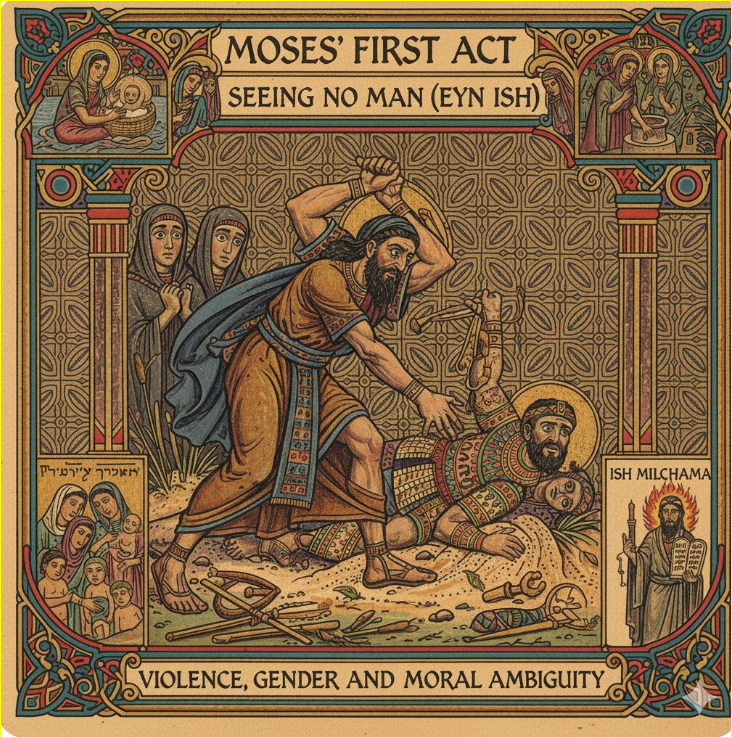
“SEEING NO MAN” (EYN ISH): MOSES’ SEARCH FOR A MODEL
Chapter 2 of Exodus presents one of the most troubling episodes in the Torah: Moses’ first independent action as an adult.
“He turned this way and that, and, seeing there was no one [man] about (eyn ish), he struck down the Egyptian and hid him in the sand” (Exod 2:12).
The Hebrew phrase eyn ish is ambiguous. Although often translated as “no one,” ish literally means “man.” This word appears eight times in Exodus chapters 1–2 (1:1; 2:1, 11, 12, 14, 19, 20, 21), as though the narrator is insisting that we pay attention to masculinity, authority, and male models of behavior.
The final ish in this section is Moses’ father-in-law, Reuel (Yitro). By contrast, Moses’ biological father, Amram, appears only once, briefly, while his mother, sister, the midwives Shifrah and Puah, Pharaoh’s daughter Bitya, and later Zipporah dominate the narrative.
This imbalance raises crucial questions. Who are Moses’ role models—men or women?
Moses grows up almost entirely surrounded by women. When he goes out into the world of men, he sees only violence: an Egyptian taskmaster beating a Hebrew slave. This moment raises a fundamental question: is Moses acting because there is no one else to intervene, or because he has no male moral role model to guide him?
Is Moses, at this moment, searching for an ish to show him how to act? When he finds none, does he act alone? It is striking that Moses will later encounter God in the burning bush—and that this same God will eventually be described as ish milchama, “a man of war” (Exod 15:3). The search for a “man” thus runs from Moses’ first act to Israel’s theology of divine power.
THE ACT ITSELF: KILLING, CONCEALMENT, AND EXPOSURE
“When Moses had grown up, he went out to his kinsfolk and witnessed their labors. He saw an Egyptian man beating a Hebrew man, one of his kinsmen. He turned this way and that, and, seeing no man (eyn ish), he struck (va-yach) the Egyptian and hid him in the sand… ‘Who made you chief and ruler over us? Do you mean to kill me as you killed the Egyptian?’ Moses was frightened and thought: ‘Then the matter is known’” (Exod 2:11–14).
Moses sees an act of brutality and responds with violence. He strikes the Egyptian—apparently killing him—and hides the body. The text insists that Moses saw “no man,” yet the very next day his act is widely known. If “no one” was there, how did the news spread?
The illustrator Arthur Szyk, in his 1936 Passover Haggadah, depicts two figures peering out from behind Moses as he kills the Egyptian. Are they witnesses? Is Szyk glorifying Moses’ heroism or quietly criticizing his brutality? The biblical text itself seems uneasy.
Even the language hints at unease. Moses “turns this way and that,” acting furtively. He hides the body. When confronted, his reaction is fear, not reflection. “The matter is known”—not “I did wrong,” but “I have been found out.”
The verb va-yach (“he struck”) is also significant. It shares its root with makot, the plagues. Moses strikes first; God later completes the punishment. The violence Moses initiates will become the paradigm for divine violence—but that does not mean the text endorses Moses’ action.
MORAL JUSTIFICATION AND MORAL DISCOMFORT
Tradition often praises Moses’ act as a mitzvah: killing one person to save another. The Egyptian was beating a Hebrew slave, and Moses intervenes decisively. On this reading, Moses had no choice. If Moses is meant to be a moral exemplar, is this truly how God’s chosen leader resolves injustice—by killing another human being?
And yet—what a way to begin a career.
Each year, this passage raises the same troubling question: is this a stereotypically male solution to conflict—war rather than negotiation, force rather than mediation? These past years, especially, amid political uncertainty and division, the question feels acute. Could Moses not have spoken to the Egyptian? Could he not have said: “What you are doing is wrong. Is there a better way to discipline an insubordinate slave?” The Egyptian might well have listened. Moses was, after all, known as the ward of Pharaoh’s daughter, raised in the palace. Instead, Moses chooses violence.
FORGETTING THE WOMEN WHO SAVED HIM
In acting this way, Moses appears to forget the lessons of the women who shaped his life: Shifrah and Puah, the midwives who resisted Pharaoh; his mother Yocheved, who hid him to save his life; his sister Miriam, who orchestrated his rescue; Bitya, Pharaoh’s daughter, who defied her father through her compassion; and later Zipporah, who will save Moses himself. These women consistently resist injustice without violence. They protect life through cunning, cooperation, and courage. Moses, upon “going out” (va-yetzeh), leaves their world behind.
MIDRASHIC DISSENT: GOD’S REBUKE
There is at least one midrash that suggests killing was not the only option. In Midrash Petirat Moshe, God rebukes Moses at the end of his life:
God said: “Did I tell you to slay the Egyptian?”
Moses replied: “You slew all the first-born in Egypt.”
God answered: “Can you liken yourself to Me? I cause death, but I also revive the dead.”
According to this midrash, it is precisely this act of killing that prevents Moses from entering the Promised Land. Killing may be acceptable for God—but not for humans.
EYN ISH REVISITED: ISAIAH’S ECHO AND DIVINE JUSTICE
The prophet Isaiah seems to echo this critique:
“The Lord looked, and it was evil in His eyes that there was no justice. He saw that there was no man (eyn ish), and was astonished that no one intervened; so His own arm brought salvation” (Isa 59:15–16).
Isaiah seems to suggest that when there is no human capable of bringing justice, only God may act through force. Was Moses wrong to take justice into his own hands? Had he chosen another path, might he have been allowed into the Promised Land? Moses, perhaps, overstepped his role.
LEAVING THE WORLD OF WOMEN, ENTERING THE WORLD OF MEN
A more subtle critique emerges from the narrative structure itself. Moses goes out (va-yetzeh), just as Dinah once went out (va-tetzeh), leaving a protected, nurturing environment for a dangerous public sphere—and both encounter violence.
Leaving home, leaving women, leaving protection—both find trouble outside. When Moses leaves Pharaoh’s household, he leaves a world dominated by women. Outside, there are only men: masters and slaves, oppressors and victims. There are no women to mediate, soften, or reframe the conflict. In this male world, problems are resolved through force.
NATURE, NURTURE, AND MOSES’ ANGER
Questions remain unresolved: Why did Moses have to kill? And from whom did he learn how to kill? Is there a symbolic parallel between his mother hiding him in the basket (va-tizpenehu) to save his life and Moses hiding the Egyptian (va-yitmenehu) in the sand to save his own skin? One act preserves life; the other conceals death. Was Moses’ true nature violent? Or was this a survival instinct?
Tradition often gives Moses a pass, portraying him as morally passionate and unable to tolerate injustice. Yet Abraham Ibn Ezra suggests that had Moses grown up among boys his own age, he might have learned alternative ways to resolve conflict (Ibn Ezra on Exod 2:3).
Perhaps Moses’ speech impediment itself is divine pedagogy—designed to slow a man prone to impulsive action. This tension remains throughout Moses’ life. He is chosen for his passion against injustice, yet punished later for anger at the rock (Num 20). God needs Moses’ fire—but limits it.
INTERNAL CRITICISM WITHIN THE BIBLICAL TEXT
I suggest that the Torah itself contains an implicit critique of Moses’ action.
- First, Moses acts furtively, suggesting he himself doubts the righteousness of what he is doing.
- Second, the rebuke comes from below: “Who made you chief and ruler over us?” The Hebrew slave does not praise Moses; he challenges his authority and recalls the killing.
- Third, the law of the land condemns Moses. Pharaoh seeks to kill him, and Moses flees. There is no apology, no self-examination, and no explicit divine approval.
- Fourth—and most subtly—the narrative contrasts worlds. Moses leaves a female-centered environment and enters a male world. In that world, there are only men: masters and slaves, oppressors and victims. No women are present to mediate. Without a woman’s voice, Moses chooses violence. Only after the second confrontation does Moses realize his mistake. He flees to Midian, a sanctuary of women—the seven daughters of Reuel (Yitro). There he marries Zipporah, who will later protect him during the frightening episode of the “bridegroom of blood” (Exod 4).
ISH AND GENDERED MORAL VISION
The repeated emphasis on ish seems intentional. The narrator begs us to contrast the violent behavior of men with the life-preserving actions of women.
It is bitterly ironic that Pharaoh decrees the death of baby boys but allows the girls to live: “Every daughter you shall keep alive.” The girls do live—and they save life.
Men threaten, dominate, and kill. Women nurture, cooperate, and preserve humanity.
This contrast finds resonance in Carol Gilligan’s theory of “care ethics.” Gilligan argued that women are not morally deficient but morally different, oriented toward relationships and responsibility rather than domination. Exodus anticipates this insight. Women in the story sustain life across ethnic and social boundaries—even Egyptian midwives conspire to save Hebrew children. Moses, by contrast, embodies the male model of nation-building: forging unity through opposition, loyalty through violence. Only Moses, Pharaoh, and the Egyptian men consistently resort to force.
WHY MOSES WAS CHOSEN: COMPASSION, NOT VIOLENCE
A midrash provides the clearest answer. God chose Moses not for killing, but for compassion:
“He looked upon their burdens and wept… and used to shoulder the burdens and help each one.”
Moses rearranges workloads, crosses gender norms, and shares pain. Only then does God say: “You have left your work to share the sorrow of Israel; I will leave those on high and below and speak only with you.”
God calls Moses not because he strikes—but because he turns aside to see.
CONCLUSION
Exodus 2 is not a simple heroic tale. Embedded within it is a sustained critique of violence, masculinity, and leadership. Moses’ killing of the Egyptian is neither fully justified nor fully condemned—but deeply problematized.
The text asks whether justice achieved through violence is truly justice, and whether true justice emerges not from the arm that strikes, but from the heart that cannot look away. In the end, Moses becomes God’s chosen servant not when he kills, but when he learns—again—what the women in his life always knew: that saving life, not taking it, is the supreme value.
Related Topics