
An Aging Jewish Feminist
Moses, Modesty, and Moral Leadership: Parshat Vaera
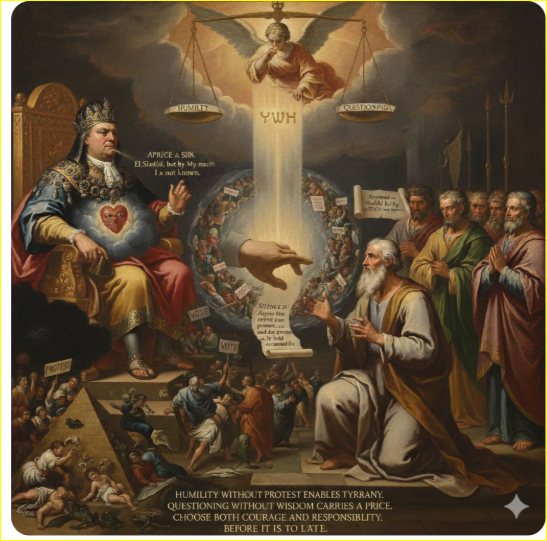
Moses is described by God as anav me’od—exceedingly humble or modest (Numbers 12:3). This description appears in a charged context: Miriam and Aaron confront Moses over the Cushite woman; an act God treats as a minor rebellion. God’s response affirms Moses’s unique moral stature. Humility, unfortunately, is a trait largely absent from contemporary leadership. Many modern leaders project unshakable certainty, resembling Louis XV’s infamous après moi, le déluge—an attitude of indifference to what follows once they are gone. Too often, voters only realize what they have chosen when it is already too late. Yet Moses complicates our assumptions about leadership. He is not only humble; he is also a model for questioning authority—including God’s authority.
KNOWING GOD: THE STRUCTURE OF PARASHAT VA-ERA
Parashat Va-era opens with a theologically dense passage:
And God spoke to Moses and said to him, “I am YHWH. And I appeared va-erah to Abraham, to Isaac, and to Jacob as El Shaddai, but by My name YHWH I was not known no-da-ati to them. And I also established My covenant with them to give them the land of Canaan, the land of their sojournings in which they sojourned. And also I Myself have heard the groaning of the Israelites whom the Egyptians enslave, and I do remember My covenant. Therefore say to the Israelites: ‘I am YHWH. I will take you out from under the burdens of Egypt and I will rescue you from their bondage and I will redeem you with an outstretched arm and with great retributions. And I will take you to Me as a people and I will be your God elohim, and you shall know vi-da-atem that I am YHWH, your God Who takes you out from under the burdens of Egypt (Exodus 6:2-7).
This passage is framed as an inclusio—an envelope structure—beginning and ending with the theme of knowledge (yeda). Although the patriarchs did not know God as YHWH, Israel will come to know that it is YHWH who redeems them. Knowledge, not blind obedience, stands at the heart of redemption.
THE MIDRASH: OBEDIENCE VERSUS QUESTIONING
A striking midrash contrasts Moses with the patriarchs. Abraham, Isaac, and Jacob never questioned God’s name or challenged His actions. Moses, by contrast, insists on knowing with whom he is dealing. God reminds Moses that the patriarchs accepted promises that were repeatedly contradicted by reality—yet they never complained. Abraham was promised land but had to purchase a burial plot. Isaac was promised territory yet fought over water. Jacob was promised land yet had to buy a place to pitch his tent. None protested. Moses, however, demands answers—first asking God’s name, then accusing Him directly: “Why have You done harm to this people? Why have You sent me?” (Exodus 5:22).
The midrash portrays this as a flaw. Redemption, it claims, comes because of the merit of the patriarchs—not because of Moses, who questioned too much. Some traditions go further, suggesting that Moses was barred from the land precisely because he challenged God (Exodus Rabbah – Exodus 6:4).
IS SILENCE A VIRTUE?
This portrayal is troubling. The Israelites themselves complain repeatedly throughout the wilderness narratives, so the claim that they “never complained” strains credibility. More importantly, are the sages truly advocating silence in the face of injustice? Applied today, such logic would delegitimize protest entirely. Imagine telling demonstrators in today’s Israel—protesting corruption, war without strategy, and democratic erosion—that silence is the higher virtue. Actually, we do not have to imagine it—since all over the world autocracy–in the US and Iran–is in the process of delegitimizing and/or fighting protest.
A COUNTER-TRADITION: MOSES AS GOD’S INTIMATE
On the other hand, Abraham Ibn Ezra (1089- 1167, Spain) argues that the patriarchs never reached Moses’s level of intimacy with God, whom Scripture says God knew “face to face” (Ibn Ezra on Exodus 6:3). And in a similar vein Sechel Tov (a 12th century midrash) in comparing Moses with the patriarchs, says that God did not make his name known to them, like he did to Moses in the bush. Only he was chosen to learn God’s holy name mouth to mouth, like a man speaks to his friend. To them he only revealed Himself with suggestions and hints (Sechel Tov (Buber) on parshat va-erah 6:3). In this tradition, Moses is not punished for questioning; he is chosen because of it.
The Torah preserves both views. Questioning authority can be noble, but it carries consequences. Moses’s leadership is burdened by doubt, conflict, and isolation. His humility does not shield him from criticism—divine or human. This tension remains unresolved because it reflects a permanent human dilemma: Do we obey quietly and trust, or do we question and risk destabilization?
PHARAOH, POWER, AND HARDENED HEARTS
In Va-era, Pharaoh encounters the first plagues. God “hardens” his heart, but Pharaoh’s cruelty predates divine intervention. He does not care about his people’s suffering—only about maintaining power. Only when the tenth plague threatens his own household does he relent: “There was no house where there was not someone dead” (Exodus 12:30). Pharaoh changes only when the cost becomes personal.
This ancient narrative is uncomfortably close to our present reality. We live under a hard-hearted leadership willing to gamble recklessly with citizens’ lives to remain in power. Endless war, no viable future plan, and no accountability—yet no change until consequences touch their own homes.
PROTEST AS MORAL OBLIGATION
The Torah and the rabbis are clear: silence in the face of wrongdoing is itself a sin. The Talmud teaches:
“Anyone who can protest the conduct of his household, his city, or the world and does not protest is held accountable” (BT Shabbat 54b).
Maimonides codifies this into law: rebuke must be given—patiently, privately, if possible, but persistently. Failure to rebuke makes one complicit. After the destruction of the First Temple, even the righteous were punished. Why were they subjected to this punishment? Because they failed to rebuke the transgressors. What this means is that we have to go back to protesting and doing everything to change our government and make sure that we call for new elections and do everything to bring out the vote, for that is the only tool in a democracy that can be used for rebuking sinners–and if we don’t exercise our voting privilege we will be responsible for the sins that will continue to be committed in our name.
LEADERSHIP, RELUCTANCE, AND RESPONSIBILITY
Moses never wanted to lead. He calls himself aral sefatayim—blocked of speech. Whether physical or moral, it is a limitation that haunts him. God appoints Aaron as his spokesperson, yet Moses remains responsible.
What does it mean to be incapable of speech: is it a physical defect, or a moral defect? In Jeremiah 6:10, the ear is uncircumcised, it is unreceptive. And in Jeremiah 9:25 it is the heart or one’s character that is defective. According to Rashi, it is a blockage—something that is holding Moses back from being a leader. Clearly the narrator wants us to pay attention to this phrase, for he repeats it twice. Not everyone is gifted with speech. In fact, very often it is the demagogue who is best suited to convince people and who is chosen to lead. Not everyone is meant to be a leader and the tragedy of Moses is that he was put into a situation by God, where he had no choice but to lead. And his flaws remained throughout his life. Each time the people rebelled and challenged him God had to reassure him. He held his hand, took his side and sometimes put him at odds with the people. Because of Moses’s personal flaws, one of which was his inability to speak, God has him perform miracles to convince him and the nation and ultimately the Egyptians, that he is the true representative of God. But all this is at a cost. The miracles will end up being the 10 plagues and will result in endless suffering to the Egyptians.
It is interesting that Isaiah also complains of his lips being tameh (unclean or impure) and thus unworthy of being a messenger of God. His lips are physically cured by an angel who brings a burning coal and touches Isaiah’s mouth and psychologically cures him:
I cried, “Woe is me; I am lost! For I am a man of impure lips And I live among a people of impure lips; Yet my own eyes have beheld The Sovereign GOD of Hosts.” Then one of the seraphs—who had taken a live coal from the altar with a pair of tongs—flew over to me, touched it to my lips, and declared, “Now that this has touched your lips, your guilt shall depart and your sin be purged away” (Isaiah 6: 5-7).
CHOOSING OUR MODELS
Some seek power for its own sake. They manipulate, never admit failure, and cling to authority at all costs. Such leaders should never be trusted. Our task is not passive faith, but active moral engagement: protest, criticism, voting, and demanding accountability. In a democracy, these are our tools of rebuke. If we do not use them, we bear responsibility for what is done in our name. The Torah offers no simple answer—only a warning: humility without protest enables tyranny, and questioning without wisdom carries a price. The challenge is to choose both courage and responsibility, before it is too late.
Related Topics
Related Posts