


Mathematics Teaching Professor, Author
Mt. Sinai Congregation, Wyoming’s Oldest Synagogue
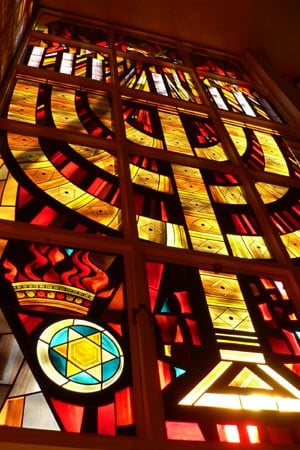
Stained glass window with Menorah (Source: Mt. Sinai Congregation, Cheyenne, Wyoming)
Mt. Sinai Congregation in Cheyenne is the oldest synagogue in Wyoming and one of the most remarkable symbols of Jewish life on the High Plains. Founded in 1910 by Jewish immigrants from Eastern Europe and Germany, the congregation built Wyoming’s first permanent Jewish house of worship before moving to its present synagogue building in 1951.
I would like to express my gratitude to Dave Lerner, President of Mt. Sinai Congregation in Cheyenne, Wyoming, for his support of this article.
The Synagogue

The synagogue sanctuary filled with stained-glass artistry. Its main sanctuary contains dozens of window, the largest window features a twelve-foot menorah, and sunlight streaming through the glass creates what visitors often describe as a breathtaking effect. Additional windows portray scenes from Biblical history and the Twelve Tribes of Jacob.

The congregation preserves seven Torah scrolls and serves not only as a synagogue but as a vibrant Jewish community center for Wyoming’s small but enduring Jewish population.
The synagogue maintains a library that houses an extensive collection of Jewish books, tapes, CDs, and films, serving as an important educational resource for the community.
Social and Religious Life
Social life has long been central to Mt. Sinai. Mt. Sinai holds services every Friday evening without fail, both in person and via Zoom. The congregation celebrates all Jewish holidays, offers classes, and hosts a wide range of social events. While smaller than it was in 1950—with about 50 member units—it warmly welcomes non-members and, in some cases, those who are not Jewish.
Shabbat Services are held every Friday at 7 PM, with additional services on select Saturdays at 10 AM. Adult Education classes are offered during Scholar-in-Residence weekends.

Torah Tuesday is held Tuesdays at noon, and participants are invited to bring lunch and join a discussion led by Jeff Weinstein.

The Yiddish Food Festival and Kugel Cookoff is a lively event that features music, traditional foods, synagogue tours, and a cookbook.
History
The history of Jews in Cheyenne may be in part traced back to one General Grenville M. Dodge. Grenville Mellen Dodge was a Union Army general on the frontier, served in the Civil War as General Grant’s intelligence Chief through the Vicksburg campaign.

After the war, Dodge found a pass for the Union Pacific Railroad, west of the Platte River. In May 1866, he resigned from the military and, with the endorsement of Generals Grant and Sherman, became the Union Pacific’s chief engineer and thus a integral figure in the construction of the Transcontinental Railroad.
Grenville Dodge arrived in what is now Cheyenne on July 4, 1867. At the time, it was little more than flat plains with a few creeks running through it. As he planned the route of the transcontinental railroad, he determined that Cheyenne would be an ideal location for a work camp to build the section of track between Cheyenne and Laramie. He laid out streets and established a tent settlement.
By August 1,600 people had arrived, Jews among them. A city was formally organized on August 4, and a mayor was elected the very next day. By September, tents were already being replaced with wooden buildings. Cheyenne grew so rapidly that it earned the nickname “Magic City of the Plains,” a title it still carries today.
Jewish people arrived in Cheyenne immediately following its founding in 1867, often arriving with the Union Pacific Railroad expansion. Many early Jewish settlers were immigrants from Germany who established businesses during the town’s development in the late 1860s, contributing to a 140-year history in the region.
In the late 1800s, there were two Jewish congregations in Cheyenne. In 1910, they merged to form Mt. Sinai. Thus, Cheyenne is home to the oldest synagogue in Wyoming, the Mt. Sinai Congregation.
That same year, Mt. Sinai built its first permanent building. Today, the synagogue maintains a safe deposit box containing newspaper clippings from the dedication of the original building in 1910. According to those accounts, both the governor and the mayor attended to welcome the new Jewish “church” which was located at 20th and Pioneer, on the site where the Laramie County Government Building now stands. A large plaque marks the location of the first synagogue in the state of Wyoming.
In 1949, synagogue leaders determined that a new building was needed. They purchased land a few blocks from the state capitol and began construction. During excavation, an underground river was discovered beneath the site. Architects were brought back to redesign the basement, ultimately incorporating a mikveh—a Jewish ritual bath containing natural water used for purification which is still in use today.
The new building opened in 1951 and continues to serve the community. It features two sanctuaries—one seating 450 people and a smaller one accommodating about 30—as well as a commercial-grade kitchen and a large social hall. As mentioned, the synagogue also houses an extensive library, along with seven Torah scrolls.
The building was added to the National Register of Historic Places as a notable example of mid-century modern architecture. The congregation celebrated its centennial in 2010.
Cheyenne is home to Wyoming oldest synagogue. Mt. Sinai. A synagogue whose building is ornate, with stain glass windows and sevn Torahs. A synagogue rich in social activities, from shabbat services to a religious school to food festivals, dancing and even offers a cookbook. A synagogue with a rich history dating back to post Civil War years. Generations of worship, culture, and fellowship have made it a lasting cornerstone of the Cheyenne community.
Contact Information:
Mt. Sinai Congregation, 2610 Pioneer Avenue, Cheyenne, Wyoming 82001
Phone: (307) 634 – 3052
Email: info@mtsinaicheyenne.org
Website: mtsinaicheyenne.org/