


“Multipolarity and the Survival Strategy of Small States”
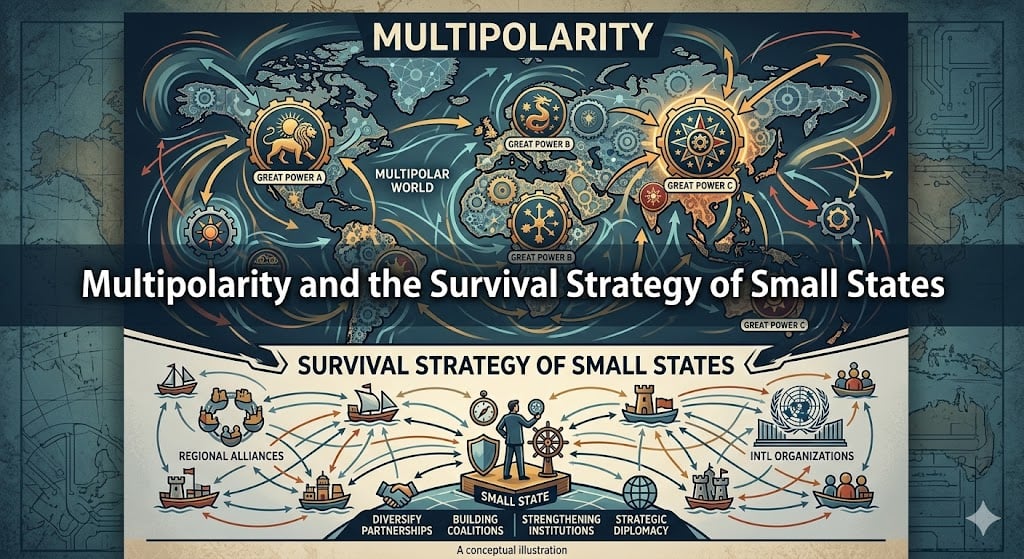
In today’s rapidly shifting global order, power is no longer concentrated in a single dominant center. The post–Cold War moment once defined by the overwhelming influence of the United States is giving way to a more complex and fragmented system. The rise of China, the resurgence of Russia, and the growing assertiveness of regional actors have ushered in what scholars describe as a multipolar world.
For large powers, multipolarity is a contest. For small states, it is a test of survival.
A World Without a Single Center
Multipolarity is not merely about the redistribution of power; it is about uncertainty. Alliances are more fluid, global rules are less predictable, and institutions struggle to maintain consensus. The ongoing Russia-Ukraine War illustrates how geopolitical rivalry can reshape trade, security, and diplomacy far beyond the battlefield.
In such an environment, small states particularly those with limited recognition or fragile economies must navigate a system where guarantees are scarce and risks are high. Yet, within this uncertainty lies opportunity.
The Strategic Advantage of Smallness
Contrary to conventional wisdom, small states are not merely passive actors. Their size can offer flexibility. Without the burden of global commitments, they can pivot more quickly, adopt pragmatic policies, and engage with multiple partners simultaneously.
Countries like Singapore and Qatar have demonstrated how strategic diplomacy, economic specialization, and neutrality can translate into influence disproportionate to their size. They do not compete with great powers they position themselves between them.
This is the essence of survival in a multipolar world: not choosing sides, but managing relationships.
Hedging, Not Aligning
For small states, the traditional model of strict alliance is increasingly risky. Aligning too closely with one power can limit options and expose vulnerabilities. Instead, many are adopting a strategy of “hedging” maintaining balanced relations with competing powers while avoiding overdependence on any single partner.
This approach is visible across Africa, the Middle East, and Southeast Asia. It allows states to extract economic benefits, security cooperation, and political support from multiple actors without becoming entangled in their rivalries.
Even Israel itself, though not a small state in the traditional sense, has demonstrated elements of strategic balancing maintaining critical ties with Washington while expanding economic and diplomatic engagement in Asia and beyond.
Recognition, Legitimacy, and the Politics of Visibility
For partially recognized or unrecognized entities, the challenge is even greater. The issue is not only survival, but visibility. In a system where diplomatic recognition determines access to international institutions, trade agreements, and security frameworks, being overlooked can be as dangerous as being weak.
Take Somaliland, for example. Despite relative stability and democratic progress in a turbulent region, it remains outside the formal international system. Yet, multipolarity may offer new pathways. As global powers diversify their partnerships, pragmatic engagement can sometimes precede formal recognition.
In this sense, multipolarity disrupts the traditional gatekeeping of international legitimacy.
Economic Statecraft as a Survival Tool
In a fragmented global economy, economic policy becomes a central pillar of survival. Small states must identify niches whether in logistics, energy, technology, or finance and build competitive advantages.
Strategic geography, often overlooked, can also be transformed into leverage. Ports, trade corridors, and digital infrastructure are no longer just economic assets; they are geopolitical tools.
However, dependency remains a critical risk. Overreliance on a single external partner whether for aid, investment, or security can undermine sovereignty. Diversification is not just an economic strategy; it is a political necessity.
The Role of Regionalism
As global institutions face increasing paralysis, regional organizations are gaining importance. For small states, regional integration offers both protection and influence. Collective bargaining can amplify voices that would otherwise go unheard on the global stage.
At the same time, regional dynamics can mirror global rivalries. Navigating these layers requires diplomatic skill and a clear understanding of national interests.
Survival as Strategy
Ultimately, survival in a multipolar world is not about power in the traditional sense. It is about strategy. It requires:
- Diplomatic agility in managing multiple partnerships
- Economic resilience through diversification and innovation
- Political clarity in defining long-term national interests
- Institutional strength to withstand external pressures
Small states cannot control the structure of the international system. But they can control how they respond to it.
A New Reality, A New Opportunity
Multipolarity is often described as a source of instability and it is. But for small states, it also represents a break from a rigid hierarchy that historically limited their agency.
In a world where power is dispersed, influence is no longer the exclusive domain of the largest actors. It belongs to those who can adapt, balance, and think strategically.
Survival, in this context, is not merely endurance. It is the ability to turn uncertainty into opportunity and to exist, and even thrive, in the spaces between great powers.