An Aging Jewish Feminist
Murder and the End of the Line: Parshat Breishit
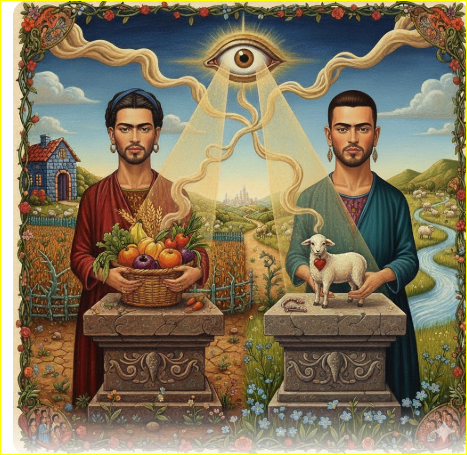
“And the Lord turned to Hevel and his offering, but to Cain and his offering He did not turn. Cain was very angry, and his face fell.” (Genesis 4:4–5)
“And the man knew his wife Eve, and she conceived and bore Cain, saying: ‘I have acquired (קָנִיתִי) a man with the Lord.’” (Genesis 4:1)
“And she bore again, his brother Hevel.” (Genesis 4:2)
What If God Had Accepted Both Offerings?
The tragedy of Cain and Hevel is the Bible’s first tale of bloodshed—and the first moment when divine preference divides human beings. Both brothers offer sacrifices to God. Hevel’s is accepted; Cain’s is not. From that divine judgment spring jealousy, rage, and ultimately, murder. But what if the story had unfolded differently? What if God had accepted both offerings? What if He had found value in Cain’s produce as well as Hevel’s lamb? Could that moment of affirmation have changed the course of history? Might it have prevented the first murder—and every act of violence that followed?
From the very beginning, names shape the meaning of this story: Cain (קַיִן) is named by Eve with triumphant pride: “I have acquired a man with the Lord.” The verb kaniti (קָנִיתִי) suggests possession, achievement, power. Cain is the firstborn, the promise, the embodiment of human will. He is the one who builds, sows, fences the earth—the founder of civilization. His brother’s name, Hevel (הֶבֶל), means vapor, breath, vanity, nothingness. The word appears throughout Ecclesiastes to describe the fleeting futility of life. From the moment of his birth, Hevel seems destined for disappearance. He is the breath that vanishes. In this framing, Cain is substance, and Hevel is shadow. And yet—God chooses the shadow.
The text offers no explanation for why God accepts Hevel’s offering and rejects Cain’s. The ambiguity is maddening—and perhaps deliberate. Hevel brings the best of his flock; Cain brings from the fruit of the ground. Is the issue quality? Intent? Or is it something deeper?
Cain, the tiller of the soil, brings what he has nurtured by hand. His work is dirty, difficult, and thankless. He is building a world out of thorns. But Hevel’s offering, rich with blood and smoke, is visceral, dramatic. Perhaps God prefers the life-force in blood. Perhaps He responds to the death implicit in sacrifice. Or perhaps the text is showing us something even more unsettling—that divine choice can appear arbitrary, even unfair. Cain cannot see it that way. His face falls. His soul sours. And into that chasm slips the first murder.
In my retelling, the tragedy begins in a moment of frustration, not evil.
One hot, windy day, Cain was fencing a garden for his mother when a heavy stone dropped on his foot. The pain made him furious. “Where is Hevel?” he shouted. “He’s always pestering me, asking what he can do to help. And today, when I need him, he’s off playing with that disgusting pet sheep of his!”
In anger and exhaustion, Cain cried out, “Oh, that I were back in the Garden of Eden, where the weather is pleasant and the ground gives its fruit without toil!”
To calm himself, Cain climbed a nearby hill, a place of refuge. There he decided to place some cornmeal on the altar he had built. Just then Hevel appeared. On impulse, Cain invited him to join. Hevel, delighted to be included, brought a sheep, thinking they could offer together and share a meal.
But the smell, the bleating, the blood—it all disturbed Cain. “Can’t you walk faster?” he snapped. “Who told you to bring a sheep? It’s messy and it stinks!”
At the clearing, they built two altars. Cain placed his cornmeal; Hevel his sheep. Cain concentrated, hoping for peace. Nothing happened to his offering. Hevel’s flamed up instantly.
Cain’s fury erupted: “Could the killing of an innocent creature be preferable to my simple peace offering?” He yelled at God, grabbed a stone from the altar, and screamed, “So it’s shedding blood You want!” In a moment of rage, he struck Hevel.
What follows is grief, horror, and despair. Cain hides the body, then collapses in shame. He blames his parents, blames God, blames the world. He is not a monster, only a wounded soul—a child seeking approval, undone by divine silence. His mistake was not the offering, but his inability to process rejection. And God’s refusal to explain Himself deepens the wound.
This pattern recurs throughout Genesis. God chooses Isaac over Ishmael, Jacob over Esau, Joseph over his brothers, Moses over Aaron. The younger, the weaker, the overlooked—these are the ones God lifts. So too here: Cain, the firstborn, the “acquired one,” is passed over for Hevel, the breath. Why? Perhaps to teach that the proud and strong will fall, and the gentle and fleeting will rise. Or perhaps simply to remind us that God’s ways are inscrutable—and that in a world without explanation, violence becomes the language of the wounded.
There is also a deeper theological tension: was God teaching that blood offerings are superior? That grain and peace are not enough? If so, the consequences are staggering—millennia of animal sacrifice, blood altars, even martyrdom in His name. But what if both offerings had been accepted? What if God’s fire had honored both altars? Perhaps that link between violence and divine favor would never have been forged. The first lesson in worship might have been one of gentleness, gratitude, and offering what one has, not what one slaughters.
Later in Genesis, we read that “Cain left the presence of the Lord and settled east of Eden.” His descendants—Enoch, Irad, Mehujael, Methushael, Lamech—build cities and found the first industries. Lamech’s children are innovators: Yaval, the ancestor of shepherds and tent-dwellers; Yuval, the father of music; Tuval-Cain, the first metalworker; and their sister Naamah. Generations later, Adam’s other line continues through Seth: “God has provided me with another offspring in place of Hevel, for Cain had killed him.” Seth’s son Enosh inaugurates a new era: “It was then that men began to invoke the Lord by name.”
Years ago, reading the genealogies at the end of this parasha, I wrote a piece called “The End of the Line: An Ecological Midrash.” I imagined that at Adam’s funeral, the two surviving branches of humanity—the descendants of Cain and those of Seth—gathered together. Though related by blood, they embodied opposing worldviews:
Cain’s descendants were sophisticated, artistic, and urban. Tuval-Cain, Yaval, Yuval, and Naamah were brilliant creators—builders, musicians, artisans—but they had chosen not to have children, valuing innovation over fertility. Seth’s descendants were simple, pious shepherds, devoted to family and harmony with nature.
At the funeral, a debate erupts over who should carry Adam’s legacy. The Sethite family claims that theirs is the true “chosen” line, since Seth was born to replace Hevel. Tuval-Cain defends his lineage, arguing that culture and creativity are also divine gifts. But the Sethites counter that without children, Cain’s line is doomed to extinction.
A young woman—one of Noah’s daughters—confronts Tuval-Cain, accusing his people of destroying the earth through their pursuit of progress and domination. He retorts that humanity cannot return to Edenic simplicity, yet her words haunt him. At sunset, he realizes the tragic cost of his lineage’s brilliance: the loss of balance with nature, the silence of the womb, the end of the line.
This midrash reflects the eternal tension between civilization and simplicity, progress and preservation. It is a moral and ecological warning: that unchecked creativity without renewal, and mastery without humility, lead to self-destruction.
I am less certain today about my doomsday prophecy, yet there is truth in it. Technology brings wonder and danger. We cannot go back to Eden—but perhaps we can learn from its loss.
Renewal: Seth, Enosh, and Hope
After the deaths of Hevel and Cain, Adam and Eve face unimaginable grief. “Adam knew his wife again, and she bore a son and named him Seth, meaning, ‘God has provided me with another offspring in place of Hevel, for Cain had killed him.’” And to Seth was born Enosh, “and it was then that humankind began to invoke the Lord by name.”
Today, as we witness burial after burial, it is painfully clear that nothing replaces children who are lost. Their memory remains forever, etched in the soul. Despair is easy; carrying on is hard. Adam and Eve had no counselor, no therapy, no community of mourning. Yet the first human family chose the difficult path: to begin again.
Adam could have said, “Enough. The world is cursed.” Instead, he took a chance: I won’t know if I don’t try. Like The Little Engine That Could, he whispered, “I think I can.“
Having children is always an act of faith—a declaration that the future is still possible. Adam’s renewal through Seth, and the naming of Enosh (“humanity”), symbolize that second chance. Through them, humankind begins again to call upon God, to speak, to hope.
As we begin another year of mourning and renewal—amidst both sorrow and moments of unexpected joy, such as the return of hostages—we, too, are called to reclaim that fragile faith. The faith that creation, though wounded, can still be healed. That humanity, though divided like Cain and Hevel, can still learn to offer together. That we can, once more, invoke the Lord by name.
Shabbat Shalom and Happy After Holidays!
Related Topics
Related Posts