"I don't mind a reasonable amount of trouble"
Muslim Kosovo Loves Israel. For How Long?
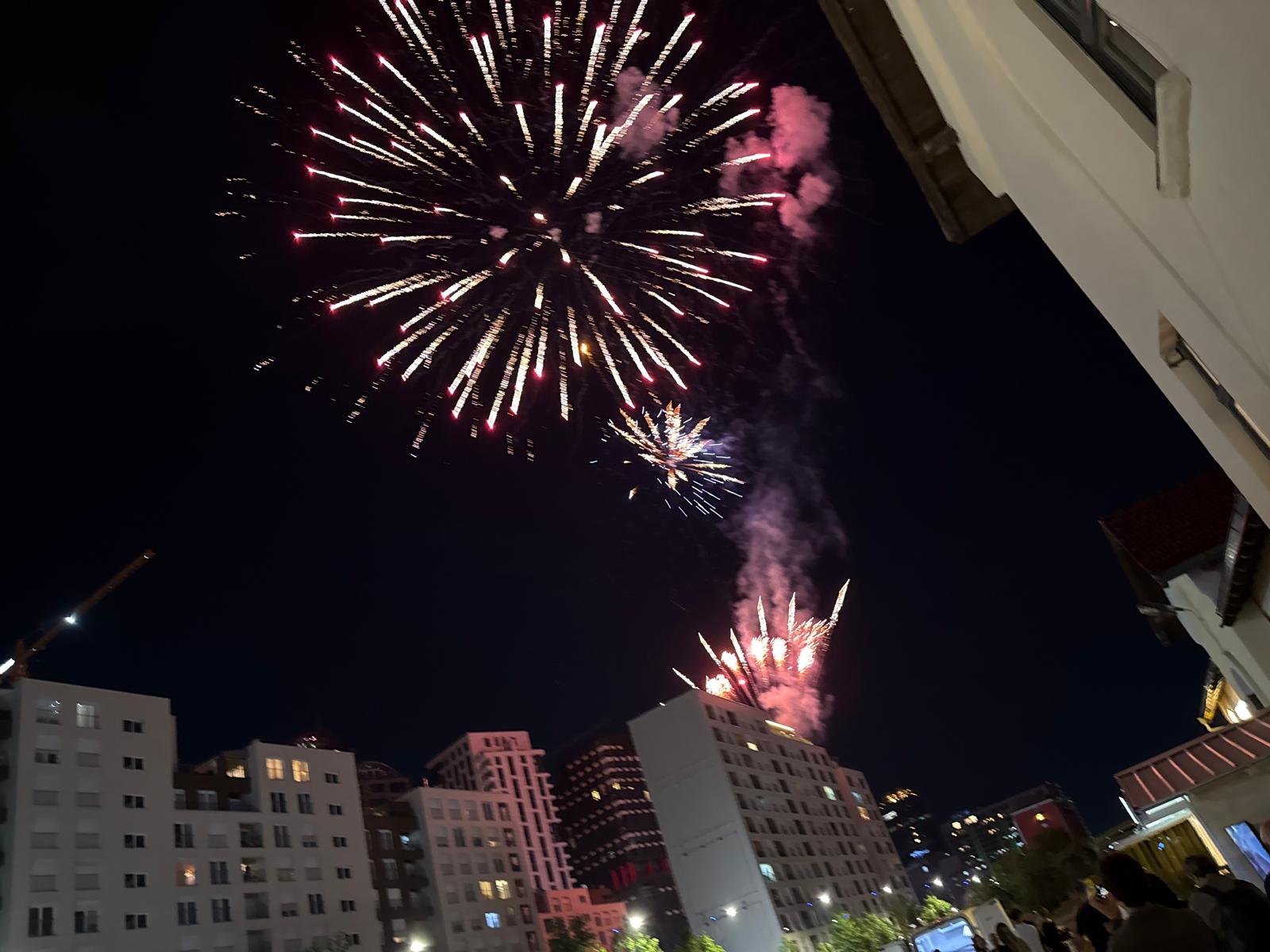
Fireworks over Pristina on for National Liberation Day, June 12 (Dan Perry photo)
How a Muslim-majority Balkan state became one of Israel’s most unlikely friends—and why some Kosovars say that bond is beginning to fray
PRISTINA, Kosovo — One of the most pro-American and pro-Israel countries I have visited in recent years is also a Muslim-majority country. It is one of the very few places in the world where Bill Clinton still inspires reverence, where Americans are still welcomed with reflexive warmth, as if there were no Donald Trump, and whose embassy in Israel stands not in Tel Aviv but in Jerusalem.
Most Israelis know remarkably little about Kosovo. Many probably associate it vaguely with the breakup of Yugoslavia and assume that, because the ethnic-Albanian population is overwhelmingly Muslim, it belongs politically and culturally in the same category as other Muslim societies. Arriving in Pristina, however, one quickly discovers that such assumptions miss the mark entirely.
Yet there is another reason Kosovo deserves attention. During days of conversations with diplomats, politicians, academics and ordinary Kosovars, I repeatedly encountered a new concern. Kosovo may represent one of Israel’s most unlikely success stories in the Muslim world, but there is reason to worry that this reservoir of goodwill, while still substantial, is no longer secure.
There are real reasons for the good karma that has so far prevailed. Kosovo’s modern history – like Israel’s – is shaped by questions of recognition, legitimacy, displacement and national survival. It declared independence from Serbia in 2008, after much violence on all sides, and its existence remains contested. Serbia refuses to recognize it, convinced that ethnic Albanians schemed to intimidate Serbs into leaving a province that was their historical heartland, creating the current large Albanian majority. Russia and China refuse to recognize it. Five members of the European Union still withhold recognition because of concerns about separatism at home. Kosovo remains outside the United Nations and continues to spend a considerable amount of diplomatic energy defending its right to exist.
Kosovo has a government, borders, elections, passports, ministries, police and a national football team, yet it remains compelled to justify its existence in ways that most countries never have to. One does not have to stretch very far to understand why many Kosovars might sympathize with Israelis.
I arrived for a conference on post-conflict societies around National Liberation Day, June 12, which commemorates the end of NATO’s bombing campaign against Serbia in June 1999 and the arrival of international forces that paved the way for Kosovo’s eventual independence. The anniversary marks the moment many Kosovars believe their survival as a political community was secured.
The Kosovo war of 1998–99 culminated in a massive campaign of displacement that drove more than a million ethnic Albanians from their homes. During my stay, I attended a new museum memorializing this trauma.
“Some of us were teenagers and journalists in 1999 and have avoided talking about this for 30 years,” said Jeta Xharra, journalist and co-founder of the Exodus 99 museum. “Now we are a bit more of a normal country, enough time has passed for us not to be scared that we will be wiped off and expelled again. We have been rebuilding our country but not healing our souls enough, not reflecting enough how we made it through.”
Driven by the United States, NATO intervened militarily without United Nations authorization, arguing that preventing ethnic cleansing justified action. It took a side – though also later insisted that Kosovo try its own militants who committed crime against ethnic Serbs. The intervention remains controversial in some international circles. In Kosovo, however, it is remembered as salvation.
As a consequence, I cannot recall many places where an American accent produces such immediate goodwill. In much of the world, Clinton is simply another former president. In Kosovo, he occupies something closer to the status of a national benefactor. There is a statue of him in central Pristina. There is a boulevard in his name.
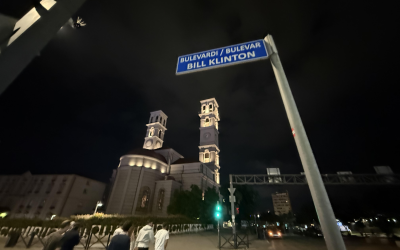
That gratitude remains durable, and the connection to Israel flows naturally. When Israel formally recognized Kosovo in 2020 and diplomatic relations were established the following year, the decision was welcomed enthusiastically here. Kosovo then opened its embassy in Jerusalem, becoming the first Muslim-majority country to do so. The ambassador, then as now, is Ines Demiri, from a prominent Jewish family in the small local community.
This happened as a corollary to the Abraham Accords push, and so was somewhat overshadowed internationally by the excitement surrounding the Gulf states.
“Kosovo is probably the only Muslim-majority country that has a monument erected to Jewish Holocaust victims at the gate of our own Parliament,” says Petrit Selimi, former foreign minister who was my host in the country.
He spoke warmly about visits he and his wife had made over the years. As a former bar owner in Pristina, he recalled evenings spent enjoying Tel Aviv’s nightlife and described the country with genuine affection.
“We opened our Embassy in Jerusalem despite strong misgivings by our own European allies. But strong feeling of older generations and political establishment towards Israel is dissipating in recent few years – just like in rest of Europe. Young people’s view of Israel is more shaped by images of destruction in Gaza than old political considerations.”
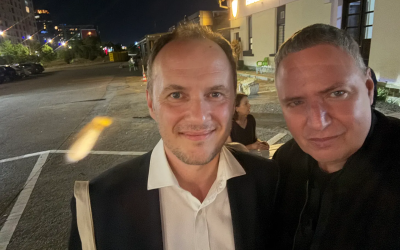
It is, in effect, precisely because they are fundamentally Europeans. My conclusion – after enough conversations like this – was that Israel’s problem, after the reputational damage it absorbed with its conduct in the past years’ wars, is so great in Europe that it reaches even corners of the continent that could certainly not be labelled as woke.
Islam is a factor here, but walking through central Pristina, one is struck less by religion than by cafés. The city seems to run on espresso, conversation and a distinctly European social rhythm. Outdoor tables spill onto sidewalks. Young people gather late into the evening. Bars remain busy. Restaurants serve alcohol freely. Many Serbs remember a kind of Islam-based repression during the years of conflict and transition – but there is only moderate public evidence of Islam today, at least in the capital city.
Although roughly 90 to 95 percent of today’s Kosovo residents identify as Muslim, religious identity here is at this point often cultural rather than deeply observant. Most women do not wear head coverings. Religion plays only a limited role in politics. Public debate tends to revolve around governance, corruption, economic opportunity, relations with Serbia and eventual integration into Europe rather than matters of faith.
Over the years, Turkey, Saudi Arabia and various religious organizations have invested considerable resources attempting to strengthen Islamic identity in Kosovo. It does not seem to have stuck. People do mark Ramadan, but largely as a party.
But whereas the generation that remembers 1999 is one thing, younger Kosovars possess no such memories. Like young people almost everywhere, they absorb politics through social media, and their impressions are shaped less by historical parallels than by images appearing on a screen.
There is a strong sense of justice, and some uncertainty about what is the place of retribution and accounting in a post-conflict situation – that was the theme of the conference I attended. Petrit noted that more Kosovars than Serbs have been tried to crimes during the war – an attempt to appease the West that is not deemed successful.
One participant argued that painful memories should eventually be buried. Many disagreed. Among those present was Sir Geoffrey Nice, the lead prosecutor in the case against Slobodan Milosevic at The Hague (he died mysteriously during the trial). “How important is it to achieve justice? I asked. “Is it better to forget?”
The fabled barrister had a view. “I am certain that it is better for citizens around the world that governments reveal the truth and accept error where error has been made. It is also better for individual leaders, political and military, to do the same thing. In Kosovo, nothing could be better than the fullest possible revelation.”
He stared at me intently. I am fairly certain that his message is directed more widely than just at Kosovo.