

Rabbi, Economist and Community Builder
Must We Erase Differences to Bring Blessing to Humanity?
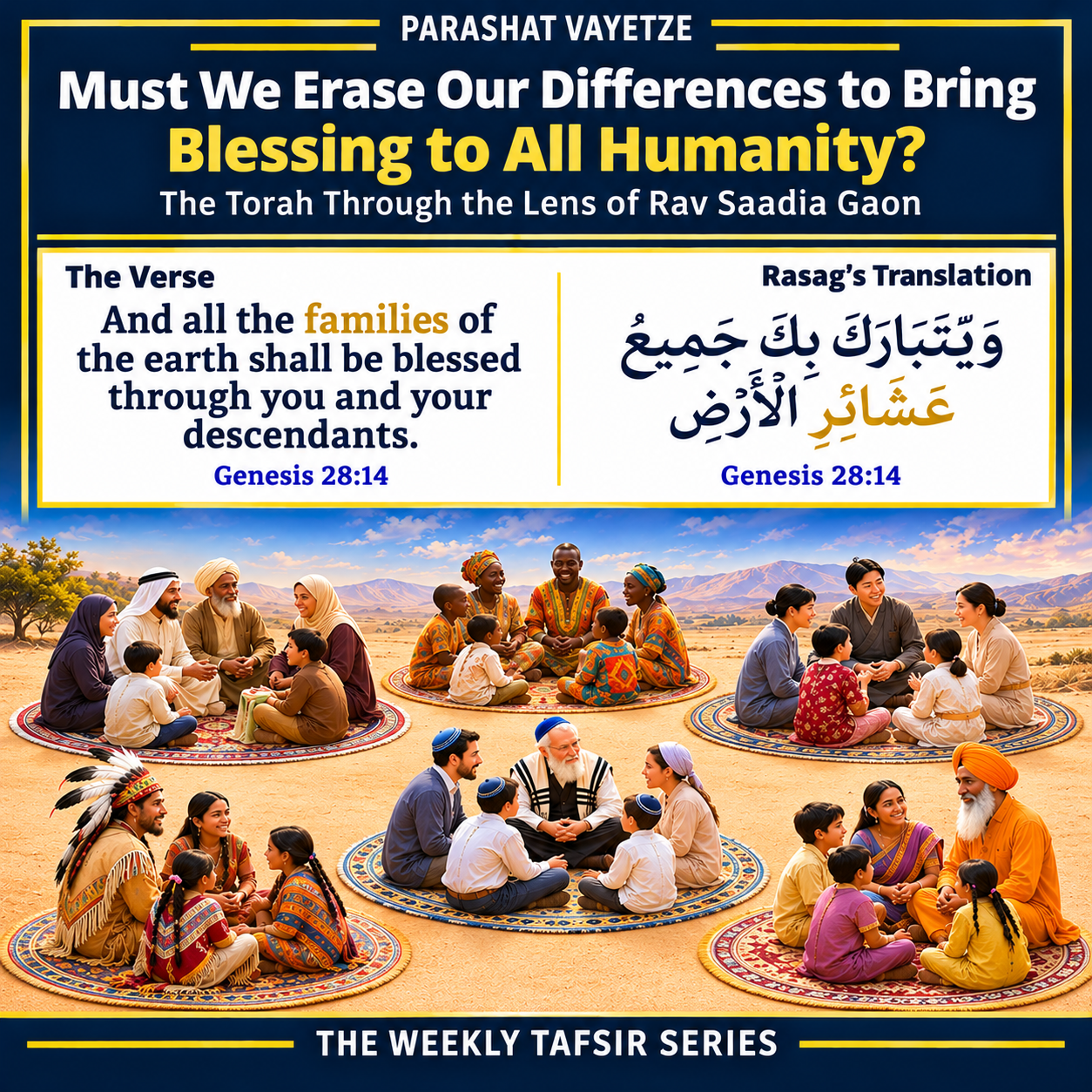
Must We Erase Our Differences to Bring Blessing to All Humanity?
Can we understand a person apart from the environment and society in which they grew up? More importantly, can we bless an individual without also blessing the community to which he or she belong?
In this week’s Torah portion, Vayetze, Jacob receives from God the blessing, or status, previously bestowed upon his forefathers, Abraham and Isaac. The Torah emphasizes that the blessing given to the three patriarchs was never intended to benefit only them, or even just their families or the future Jewish people. It was meant to be a universal blessing for all humanity.
Abraham, for example, is told: “And all the families of the earth shall be blessed through you” (Genesis 12:3). In this week’s portion, Jacob receives a similar promise: “And all the families of the earth shall be blessed through you and your descendants” (Genesis 28:14).
The Torah could have directed this divine blessing toward “all the people of the earth” or “all nations.” Instead, it deliberately chooses the word “families,” treating the family as a fundamental social unit.
More than a thousand years ago, Rabbi Saadia Gaon (Rasag) produced his monumental Arabic translation of the Torah, known as the Tafsir (تفسير), meaning interpretation or explanation. His choice of words allows us to uncover additional layers of meaning in the biblical text and explore how Hebrew and Arabic illuminate one another.
Rasag translates the verse containing Jacob’s blessing as follows:
وَيَتَبَارَكُ بِكَ جَمِيعُ عَشَائِرِ الْأَرْضِ
The word عشائر (ʿashāʾir) is the plural of عشيرة (ʿashīra), which refers to a group of people connected by common ancestry and kinship. It is generally translated as “clan,” “tribe,” or “extended family.”
Modern Arabic also uses the words عائلات (ʿāʾilāt) and أُسَر (usar) to describe families, whether nuclear or extended. By contrast, عشائر emphasizes broader kinship groups organized around shared ancestry and, at times, a common tribal identity.
But here we discover something particularly interesting: in Biblical Hebrew, the word mishpacha (“family”) does not necessarily refer to the nuclear family of parents and children, as we commonly understand it today. In many cases, it refers to a broader kinship group within a social structure consisting of tribes, clans, and households.
Therefore, Rasag’s choice of عشائر does not necessarily expand the meaning of the biblical word “family.” Rather, it preserves and highlights a meaning that modern Hebrew tends to overlook: not merely parents and children, but clans, kinship groups, and communities united by shared ancestry and identity. In other words, the community as an extended family.
This opens the door to an intriguing interpretation of the patriarchal blessing.
The divine blessing is not directed toward humanity as a uniform, faceless mass, nor toward individuals detached from their surroundings. Rather, it addresses humanity as it actually exists: families, clans, and human communities, each possessing its own identity.
We may therefore suggest that biblical universalism does not require the erasure of particular identities. On the contrary, it can emerge precisely through them.
In a world where questions about our relationship with the “Other” and with different identities are becoming increasingly central, this message is particularly important.
The Torah, as highlighted by Rasag’s translation, does not view humanity as a collection of isolated individuals, but as an interconnected fabric of families, clans, and communities.
Human beings do not develop in a vacuum. As the Hebrew poet Shaul Tchernichovsky famously wrote, “A person is but the reflection of their native landscape.” And as the well-known proverb reminds us, “It takes a village to raise a child.”
But there is an even deeper idea here: the divine blessing does not require humanity to abandon its diverse identities in order to receive it. Quite the opposite. The blessing is addressed to families and communities precisely as such.
Biblical universalism is not a universalism of uniformity, but one of partnership among distinct identities.
This message is especially relevant when confronting ideologies that seek to erase human differences in the name of one universal vision or another.
Whether we are speaking of radical ideologies that seek to abolish national and communal identities, or religious-political ambitions, such as those promoted by certain currents of political Islam, that seek to subordinate all humanity to a single overarching order, the result may be similar: the erasure of human diversity in the name of unity.
Perhaps this is one of the great messages of the patriarchal blessing:
To bring blessing to all humanity, we do not need to make everyone the same. We need to learn how to bless humanity precisely through the diversity that makes it what it is.
Special thanks to Rabbi Yom Tov Gindi of Kfar Chabad, who made Rasag’s Tafsir accessible in a modern edition using Arabic script, opening the door for us to embark on this journey.
Shabbat Shalom, and see you next week!