
"These fragments I have shored against my ruins"
Mutual Unintelligibility: Limits of Memory at Auschwitz
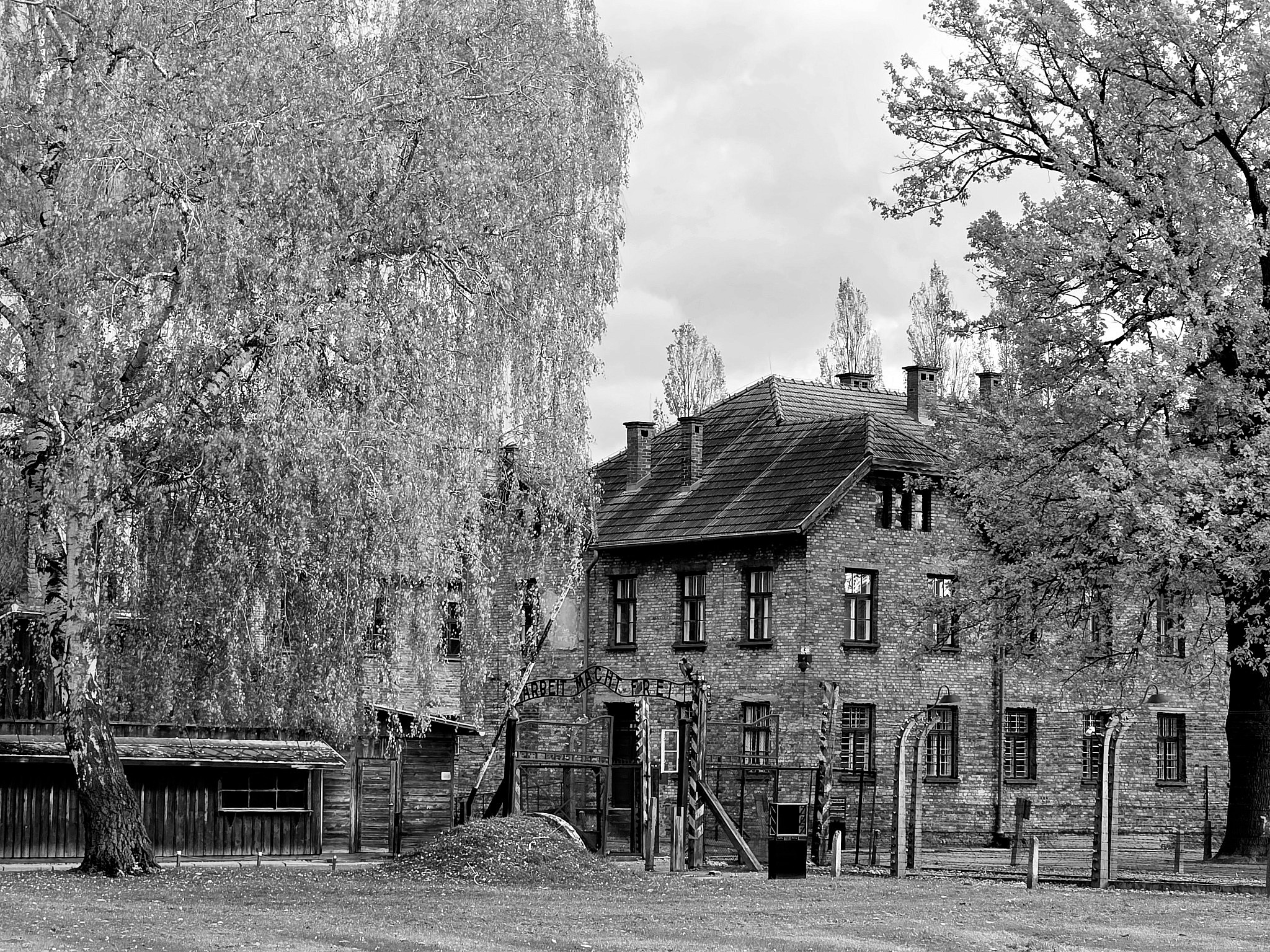
Auschwitz entrance gate with the “Arbeit macht frei” inscription (Photo courtesy of the author)
Last October, during a seminar for journalists held at Auschwitz, I had to confront the fact that the narrative framework I encountered and the one I entered with were constructed according to different premises.
What unsettled me was not a single remark or omission, but the cumulative effect of a narrative architecture in which the history I brought with me had no stable place. The proportions were evident from the outset: the emphasis lay elsewhere, and the categories through which the story was told left little room for the particular dead I carried in my keeping.
The dissonance did not arise from disagreement, but from the recognition that the institutional narrative and the one I inherited were constructed according to incompatible premises. The former organised the past around national categories, calibrated to produce a coherent account of occupation, resistance, and loss; the latter was shaped by a diasporic memory that does not map neatly onto those coordinates.
The result was not conflict but mutual unintelligibility. I understood what the narrative required in order to sustain itself, and I understood, simultaneously, that my own history could not be integrated into it without distortion. Once that became clear, there was little left to say.
I had anticipated the contours of the institutional narrative: the familiar reluctance to acknowledge complicity, the displacement of Jewish history, the national defensiveness that has long shaped the country’s relationship to the site. None of this surprised me, and none of it altered my understanding of the past; it merely confirmed the conditions of the present.
But the distance between these premises was not only conceptual; it was also shaped by the particular history I carried with me.
Part of the difficulty lay in the fact that my own point of reference was shaped by a closeness that the institutional frame could not register; it was organised along a different axis altogether. For Hungarian Jews, Auschwitz is not an abstract site of European memory but the primary site of their destruction, and this proximity determines how the place is approached.
The devastation was so extensive that Hungary established its Day of Remembrance for the Hungarian Victims of the Holocaust in 2000 (with the first commemorations held in 2001), four years before the international remembrance day was introduced.
The coordinates of the catastrophe do not correspond with the international commemorative calendar, which is organised around different temporal and symbolic premises. Hungarian Jews remember the start of ghettoisation on 16 April 1944, not the liberation of one of the camps — even the largest. This is not a matter of symbolic alignment but of historical sequence: that date remains the decisive point in a process that unfolded with unusual speed, a fixed point in national and familial memory.
Auschwitz, in this framework, occupies a position that is neither abstract nor emblematic. It is the site to which the majority of Hungarian Jews were transported in less than eight weeks, between 15 May and 9 July 1944 — 437,402 people, effectively the entire Jewish population of the Hungarian countryside — where they constituted the largest single national group murdered there. This chronology is precise, and it shapes how Hungarian Jews relate to the site: not as abstraction, but as the endpoint of a process whose scale and velocity remain traceable within families.
Since 2005, 27 January has served as International Holocaust Remembrance Day, chosen to mark the liberation of Auschwitz and to provide a shared point of reference for countries whose histories diverge sharply. Its purpose was to establish a common symbolic centre of European memory, a date that could anchor disparate national narratives within a single commemorative frame. Whether this framework can still sustain the weight placed upon it is no longer certain — a fragility evident scarcely two decades after its introduction.
In recent years, the Holocaust has increasingly been reframed as a universal moral resource, its specificity treated as politically inconvenient. The emphasis falls on general lessons, on the dangers of hatred in the abstract, on forms of inclusion that require the dilution of particular histories. Within this logic, Jewish suffering becomes one example among many, and attention to it is often perceived as disproportionate or politically charged.
The result is a conditional form of participation: one may speak of the Holocaust, but only within a register that avoids the asymmetry of the event itself. This shift does not alter the past, but it recalibrates the terms under which the past may be acknowledged in the present.
In the contemporary commemorative landscape — particularly in the climate that has emerged in the past two years — the universalisation of the Holocaust no longer follows the ethical trajectory imagined by Hermann Cohen, in which the particular generates obligations that extend outwards. Instead, the universal has become a mechanism for managing the political pressures of the present.
This shift is not the result of a belated recognition that other atrocities deserve attention; it is driven by the insistence that those framed as perpetrators in the present cannot be acknowledged as victims in the past. The boundary between Israel and the diaspora, and between contemporary conflict and historical destruction, has been deliberately blurred.
Within this framework, Jewish specificity becomes a politically unwelcome liability, and attention to Jewish loss is treated as disproportionate. The past is not denied, but its interpretive permissions are already being adjusted to align with the demands of the present.
Its implications became apparent soon enough; the shift was not confined to institutional narratives but was present among the participants themselves. That even one of those who had chosen to attend a seminar on the Holocaust would reproduce the same logic revealed how far the shift had gone more clearly than any institutional gesture could. When she remarked that Jewish suffering had already received sufficient attention, the comment did not so much shock me as clarify the extent.
What had changed were the terms under which the past could be acknowledged, not the historical record but the framework through which it could be interpreted. It became evident that even within Auschwitz, the premise I had assumed to be shared — that the Holocaust was the subject of our attention — could no longer be taken for granted. The present had begun to reorganise the past, and the rupture lay not in the hostility of the remark but in the recognition that it was no longer an aberration.
I do not know what form remembrance will take in a landscape where the present controls the past. I know only that the narrative I inherited and the one I encountered cannot be reconciled without loss, and that the limit I reached in Auschwitz was not personal but structural.
Related Topics
Related Posts