

My Father My Teacher
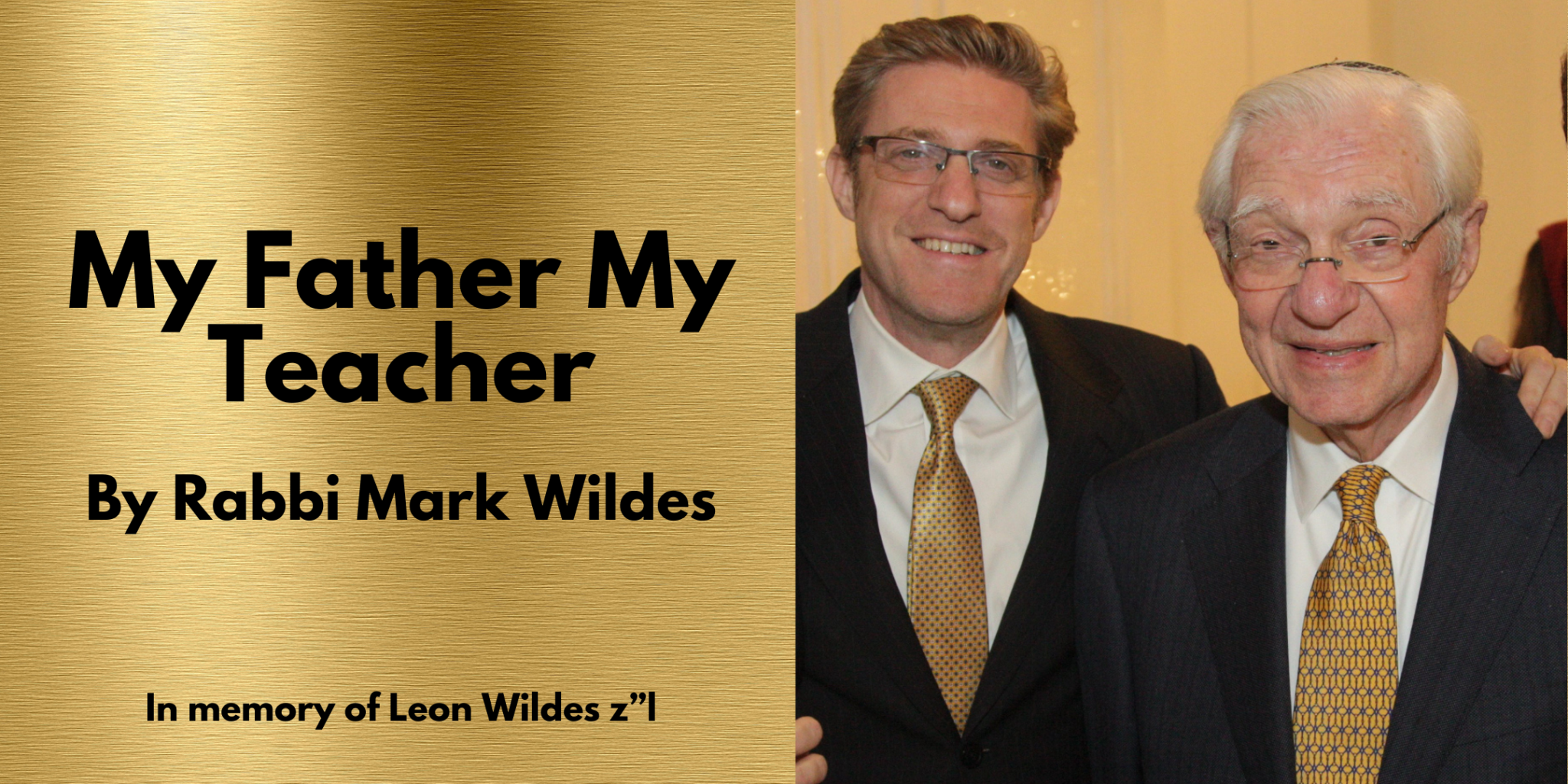
The Talmud (Kiddushin 31b) relates that when quoting a father in a Torah discussion, one should not mention his father by name, but rather refer to him as Avi Mori – “my father, my teacher.” The Talmud goes on to relate how when the Sage Mar bar Rav Ashi quoted a Jewish teaching from his father, he wouldn’t call his father by his name but instead Avi Mori – “my father, my teacher”. The Shulchan Aruch (Yoreh Deiah 240:2) codifies this law and rules that a child should refer to his father by this phrase both during the father’s lifetime and even after he passes away.
Although our Sages created this phrase to ensure we do not refer our parents by their first names, I believe this term is hinting at something deeper and aspirational: to be both a parent and teacher to our children.
My brother Michael and I were blessed to have an Avi Mori – an unconditionally loving father,
and at the same time, a mentor and teacher from who we learned so much. Growing up I felt like I hit the jackpot, like I got two Dads in one – the love and devotion of a thoughtful and caring father – an Av and also a Moreh – a teacher par excellence from whom I absorbed so much.
Here are just a few of the many things we learned from him: My father taught me to read and write. He sent us to school of course but we learned so much more from him – from the poetry he would share at our Shabbat table to the infamous red pen he would use to correct our papers and sometimes to correct our teacher’s corrections!
I think about my father every time I teach. He helped me develop so much of what I’ve shared over the years. I’ve been reviewing mydrashot – my MJE Shabbat talks with my father for close to 30 years every Friday – sometimes in person, sometimes on the phone. He would listen to me go on and on. In the beginning he would rip them apart with his red pen – it was brutal, but little by little I started feeling more comfortable. My father was always honest but encouraging.
And He taught us to love all Jews. My father got that from his father, my Zaide who didn’t have much money but used to give us a crisp dollar bill every time we answered his salutation of Shalom Elechim Ayid (“peace be unto my fellow Jew”) with Aleichem Shalom Ayid(“peace back unto you my fellow Jew”). A Jew was to be treasured irrespective of his background or ideology. My father was one of the most tolerant and open-minded people I ever knew. He had strong convictions but one of them was to hear another’s perspective which is why he had friends from all walks of life and from literally all over the world. It’s also why he loved MJE so much. Like his father he loved all people and taught us to listen to what others have to say.
My father also taught us to be tzanua – to be modest. He never boasted his extraordinary accomplishments or the acts of kindness he consistently did for other people. He helped people from all over the world without any fanfare. You would have to hear about what he did from other people because he rarely shared any of this himself. The following story demonstrates this powerfully: When I was about seven or eight years old, I was obsessed with superhero action figures. Every Sunday I would go to The Center, the local stationery and toy store in Forest Hills where I grew up. The store was owned by two Persian Jews – the Sedge brothers. One Sunday, one of the brothers saw me eyeing the action heroes, he climbed up on the ladder, took down the Spiderman, and just gave it to me. I was thrilled. I offered to pay but he wouldn’t take the money. I came back the next week and he gave me Batman and the next week Superman. I couldn’t understand why he wouldn’t let me pay. Years later I learned that the store owners were two of the 300 Persian Jews who escaped Iran after the revolution and who needed permission to enter the United States. All these organizations tried but couldn’t get them visas but somehow my father did. He never talked about it. I only found out because of the action figures!
To this day, when I bump into random people on the street and they hear my last name, they tell me what my father did for them, how he helped their aunt, their cousin, etc. get into the country and how, in many instances, he didn’t take a penny to help.
My father also had Kavod Harav – he respected rabbis and their scholarship. He was careful about coming to shul on time, not speaking during davening and always sharing ideas in the Siddur, especially the Piyyutim – the beautiful poetry found in our prayers. And he always taught by example, never preaching, or lecturing but simply modeling the right behavior. That is how we learned from him, by watching.
But all the while he mentored us – that he was Mori – “my teacher” he was also Avi – he was also a devoted and loving father. No matter how busy he was at work he always took my calls. No matter how late at night – he was there to talk to get advice, and next to our mother, of blessed memory, he was my biggest cheerleader: Back in 1998 I was finishing my rabbinic work at Kehilath Jeshurun (KJ) on the East Side, and I was at a crossroads. I could stay in the rabbinate or go back into law but just then a third option presented itself – my friend George Rohr offered me some funding to start an outreach program, but on the condition that I only did that – no more doing a little of law and little rabbinate, I’d have to commit. I went to my father for advice. As always, he listened attentively, asked a few questions and then said: “Mark, I was blessed to follow my dreams, to do what I wanted to do, what do you want?” I told him I wanted to do it and that I thought the work was critically needed, “but I’m scared – I’m just not sure I’ll be successful”. He immediately responded: “Don’t be afraid. I know you can do this. Your mother and I always believed in you, and I’ll be there every step along the way to help”.
And so MJE was born. It started with a father’s belief in his son. I remember thinking to myself: if the person I most look up to in life thinks I can do it then maybe I can.
And it wasn’t just belief. He got involved, actively supporting our outreach and educational work all these years. And so all the mitzvot MJE has inspired so many young Jews to keep, the love for Israel we have inspired in our participants, the hundreds of couples who have met and married and their children now learning in Yeshivot and Day schools are all in the zechut (spiritual merit) for Avi Mori, for my father and teacher. We will be adding my father’s name to MJE’s dedication and so, going forward MJE will be dedicated in memory of not only our mother but now also our father – Ruth and Leon Wildes, of blessed memory.
Avi Mori: thank you for giving us so much. Your devotion to our family, to the Jewish people and to the world has left an incredible legacy which we will do our best to perpetuate and grow. We, your family, friends, and clients from all over the world, are the beneficiaries of your love and kindness, your mentorship and wisdom. We thank you and ask forgiveness for any slights or lack of honor we may have ever showed. We owe you everything.
Tehei Nishmasu Tzura Bitzror Hachaim: May his holy soul be bound up in eternal life.
I love you Dad.
Leon Wildes z”l passed away January 8th, 2024