Partner with Gotham Government Relations
My Jewish Debt to Dick Cheney
I never got to meet Dick Cheney, but I know firsthand at least one way he helped the Jewish people at a critical juncture.
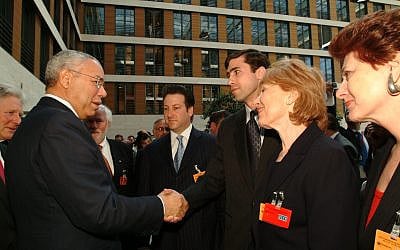
Since 2002, a few Jewish organizations and Members of Congress had been mobilizing to make the issue of antisemitism a priority for U.S. foreign policy and across the Atlantic. Our efforts began to pay off when the German government hosted a landmark conference on combating antisemitism, under the auspices of the Organization for Security and Cooperation in Europe, popularly known as the Helsinki process. This 2004 event was headlined by the President of Germany, Natan Sharansky and Elie Wiesel, attended by dozens of foreign ministers including Secretary of State Colin Powell, and hundreds of non-governmental activists. The meetings were convened in the Foreign Ministry headquarters, formerly home to Hitler’s Reichsbank. The concluding document, the Berlin Declaration, reflected the consensus of the 55 member states on specific steps to monitor and combat antisemitism, and for countries to hold each other accountable.
The following year, Spain — with its own dark record on Jewish issues — was to host the first follow-up conference to Berlin, this time in Cordoba. Slovenia, whose foreign minister held the rotating chairmanship of OSCE for 2005, had drafted a concluding document for governments to consider. A week before the big event, I joined some colleagues from Jewish and human rights organizations around a small conference table in the State Department, so we could give our input before the U.S. delegation responded to the Slovenes.
I couldn’t believe my eyes: The draft was a jumble of platitudes, with scant reference to the Berlin Declaration and the commitments undertaken by governments. As I told the unfortunate State Department staffer, the blank back of the paper would be better than what was printed on the front. If that was to be the outcome from Cordoba, then I would make sure my organization and our 100+ community leaders from across Europe and the United States would stay away. Our leadership would not be sharing the stage with the other dignitaries, nor legitimizing the spectacle with a keynote address.
On the brief cab ride to National Airport, I called a colleague who was also in DC that day, and on his way to a barbecue at Defense Secretary Don Rumsfeld’s home. The Vice President was sure to be there, and my concerns about Cordoba would be raised. By the time I got back to New York, my colleague had an update. Because most of the barbecue crowd was so intimidated by him, Cheney was sitting off by himself and it was easy to get time with him. I was given a fax number to use just this once and then throw away, and instructed to send a single page with brief background and what it was we needed (The Ask). And so I did.
The next morning, I got an excited call from a different State Department staffer, who had heard from the U.S. Mission to OSCE headquarters in Vienna: Slovenia had an all-new document with real teeth. So Berlin would not be a one-off, there would be real implementation and continuity covering education, police training, enforcement, judicial mechanisms, public statements, coordination within and between governments, dialogue with civil society, and objective metrics for tracking and strategizing. Cordoba was a big success, and critically it fed momentum for permanent staff within OSCE to work with governments and experts and communities, right up to today.
I don’t recall any award or other recognition for Vice President Cheney’s role behind the scenes, making all Jews — and by extension other minorities — safer. No doubt, there were other situations where he played a critical role, because he could and because it mattered.
We have lost a quiet champion.
Related Topics