My One-Minute Prayer at Birkenau
Every visitor to Poland arrives with a different story.
Some come as students. Some come as historians. Some come because their grandparents survived. Others come because their grandparents never left.
Each deserves to remember in their own way.
Before we arrived, I carried questions I had wrestled with for years. Knowing that some Poles had collaborated with the Nazi occupation, I wondered what it would feel like to travel through Poland. I wasn’t sure what to expect. I carried those questions with me as we entered Birkenau.
For most visitors, Birkenau is a place of unimaginable horror.
For me, it is a sacred place of remembrance for the families in my congregation whose loved ones were murdered in the Holocaust. Over the years, I have had the privilege of listening to survivors and their families tell their stories. Standing there, I felt the weight of those stories.
The one-minute prayer was not planned. Once I stood there, I knew I had to recite El Malei Rachamim—the traditional Jewish prayer for the souls of the dead.
It almost didn’t happen.
At the site of one of Birkenau’s crematoria, where so many Jews were murdered, I respectfully asked the Museum-assigned guide leading our group if I could recite a brief memorial prayer. It would have taken about a minute.
She told me it would be better if I prayed somewhere else—somewhere private.
I understand the Museum’s responsibility to maintain decorum. Thousands of people pass through its grounds every day, and the staff must ensure that remembrance never becomes spectacle.
But there is a profound difference between spectacle and mourning.
I wasn’t making a speech. I wasn’t disrupting the group.
I simply wanted to stand where countless Jews and others had been murdered and offer a brief prayer in their memory.
As the guide began leading the group away from the crematorium, I chanted the prayer. A young man in our tour group recorded the moment on video.
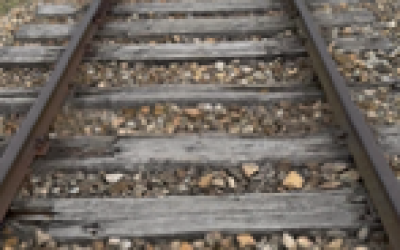
When I finished, I quietly left the tour and walked alone along the railroad tracks—the very tracks that had carried hundreds of thousands of Jews and countless others condemned by the Nazis into Birkenau in crowded cattle cars.
As I walked, I kept thinking about something my wife, Judy, had said earlier that day after we had passed beneath the infamous iron gate at Auschwitz bearing the words “Arbeit Macht Frei”—German for “work sets you free.” She told me she had tried to internalize every step. She imagined what it must have felt like to be one of the Jewish men, women, or children arriving there, uncertain of what lay ahead, stripped of dignity, family, and hope. It was her way of honoring those who passed beneath that gate and never returned.
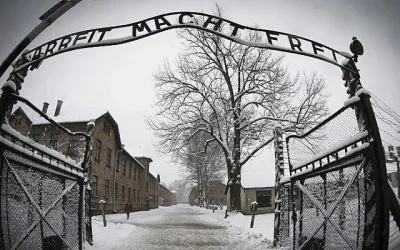
The Auschwitz-Birkenau Memorial and Museum remains one of humanity’s most important places of remembrance. Every person should visit it at least once. It stands as irrefutable evidence of what hatred can become when the world looks away.
But memory is preserved not only by places. It is also preserved by people.
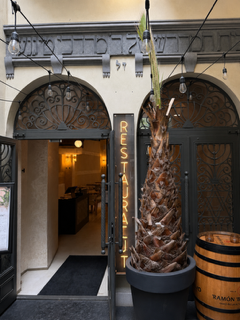
One of our guides through Old Kraków and the Jewish Quarter took us off the usual tourist route to a building tucked away in a quiet courtyard. Before the Holocaust, it had been the Beit Midrash of Mordechai Tigner. Today, it is a restaurant. I later learned from the restaurant’s own website that its ground floor had once been the synagogue’s main sanctuary. Today, people gather there around tables for a meal. Before the Holocaust, Jews gathered in that same room to pray and study. Above the entrance, the original Hebrew inscription remains, and inside, stained-glass windows bearing Stars of David have been carefully preserved by the restaurant’s owners. That quiet act of preservation spoke volumes.
Our guide through Oskar Schindler’s Factory was an exceptional educator whose remarkable scholarship was matched by her genuine compassion. She shared that members of her own family had hidden Jews during the Holocaust and were later recognized by Yad Vashem as Righteous Among the Nations. Even more moving was her quiet hope that, had she lived in those times, she would have found the courage to do the same. Her family members were among more than 7,000 Poles recognized by Yad Vashem as Righteous Among the Nations—the largest number from any country.
Together, the two guides helped us understand not only what Poland had endured, but also how profoundly Jewish life—and the countless contributions of Polish Jews—had shaped the nation’s history, culture, and identity over the centuries. Before the Holocaust, some 3.3 million Jews lived in Poland, forming the largest Jewish community in Europe. By the end of the Holocaust, approximately 3 million had been murdered. Today, fewer than 10,000 Jews are estimated to live there.
The memorials, museums, and acts of preservation we encountered were deeply meaningful. But they also bear witness to an irreplaceable loss that no act of remembrance can restore. The vibrant Jewish life that had flourished in Poland for centuries was all but destroyed.
I left Poland carrying two memories.
One is the unbearable silence of Auschwitz-Birkenau.
The other is the quiet determination of those who refuse to let that silence have the last word.
Republished with permission, this essay appeared in Gazeta Wyborcza, one of Poland’s leading and most widely read national newspapers. Founded in 1989 as Poland was emerging from communist rule, Gazeta Wyborcza has become an important voice in Polish public life. Click here to view the essay in Polish.