
My Professor Saw the Future. I Didn’t Understand It Until Now.
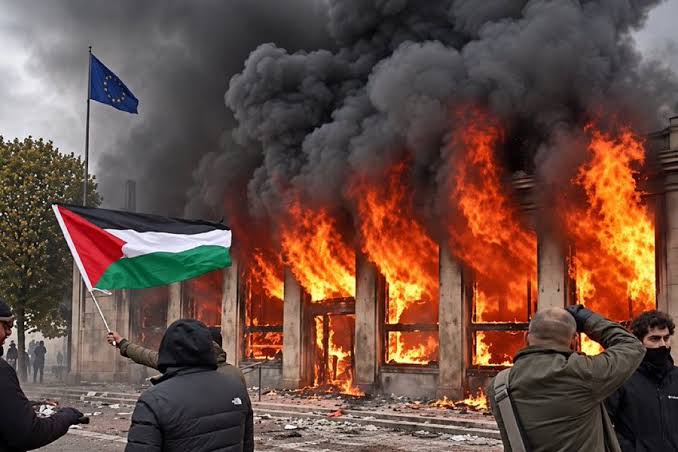
Forty years after a college lecture, I find myself thinking about the dividing lines of our world—and the histories we would rather not confront.
I don’t remember many of my college lectures. I remember even fewer of my professors’ predictions. One has stayed with me for nearly forty years.
I studied international relations at Boston University in the 1980s, as the political order that had defined much of the twentieth century began to shift. For most of my life, the world had been divided into East and West. The Soviet Union and the United States. Communism and capitalism. Two competing ideologies, two spheres of influence, two ways of understanding the world.
Then my professor said something I’ll never forget.
The next great divide, he predicted, would not be East versus West.
It would be North versus South.
I remember finding that fascinating. But I was a college student. I understood the theory but didn’t fully appreciate its implications. What I didn’t realize was how much of that changing world I was already witnessing.
My parents were living in the south of France, and I remember looking out their window at the Mediterranean and seeing American naval vessels offshore. It was the summer of 1986.
Only months earlier, tensions between the United States and Libya had escalated dramatically. In March, American naval forces clashed with Libya in the Gulf of Sidra. In April, following the bombing of a nightclub in West Berlin that killed American servicemen and civilians, President Reagan ordered airstrikes against targets in Tripoli and Benghazi. The U.S. Sixth Fleet had been at the center of the confrontation.
There I was, looking out at the beautiful blue Mediterranean, with American warships on the horizon. I remember how incongruous it all was. The elegance of the French Riviera, the seemingly endless sea, and the unmistakable presence of American military power. I cannot say today exactly which ships I saw or why they were positioned there. But I remember the sight of them.
I also remember driving through some of Nice’s poorer neighborhoods. It was there that I first heard the expression les pieds-noirs. At the time, I didn’t understand the complicated history behind those words.
The term referred primarily to Europeans who had lived in French Algeria and relocated to France around the time of Algerian independence in 1962. Their history was distinct from that of North African immigrants and their descendants, many of whom experienced discrimination and economic exclusion in France.
But those drives through Nice introduced me to something I had never really considered: the long shadow of colonialism. France conquered and controlled large parts of North Africa. Algeria, in particular, had endured more than a century of French rule, followed by a brutal war for independence.
In the decades that followed, immigrants from North Africa and their families became an integral part of French society. Many helped build the country, worked in its industries, and raised children who knew no other home.
Yet being in France and being accepted as French were not necessarily the same thing. Many families encountered discrimination, economic exclusion, and neighborhoods physically and socially separated from the opportunities available to others. Their children grew up French, but some were made to feel they didn’t belong.
I remember the contrast between the elegant French Riviera and neighborhoods that felt like an entirely different world. Looking back, I realize the tensions my professor described were not simply theoretical. They were unfolding outside my parents’ window and along the streets of Nice.
Nearly forty years later, I find myself thinking about that summer with surprising frequency.
Today, the language of the Global North and Global South is everywhere. We hear it in conversations about colonialism, economic inequality, migration, climate change, and the distribution of political power. We hear it in debates about Israel and Gaza, about Western influence, and about whose voices have historically been heard.
My professor was remarkably prescient. I have begun to wonder whether the most consequential division isn’t geographical at all. Perhaps it is about how we decide who holds power, who has suffered, and whose history deserves recognition.
And perhaps it is also about something far more uncomfortable: our willingness to confront the consequences of our own history.
The colonial powers of Europe left behind a complicated and often brutal legacy. France in North Africa. Britain across Africa, Asia, and the Middle East. The Netherlands in Indonesia and elsewhere. Decolonization did not erase those histories. Nor did it erase the obligations, economic relationships, and human connections that followed.
Over the decades, European countries admitted immigrants and refugees for various reasons: labor shortages, family reunification, humanitarian commitments, and longstanding colonial ties. For some, they also felt a sense of historical responsibility. But opening a country’s borders is not the same as creating a functioning, integrated society.
And this is where I believe Europe failed.
Governments let communities grow without consistently ensuring newcomers had the language skills, educational opportunities, economic mobility, and social connections needed to participate fully in the societies around them.
At the same time, integration cannot rest solely with the host country. It requires a willingness to participate in the civic life of one’s adopted home, to respect its laws, and to accept the rights and freedoms on which that society is built. It is a two-way obligation.
For too many people, that process failed. Some faced discrimination and exclusion even though they wanted to belong. Others remained socially or culturally isolated. And within certain extremist movements, rejection of Western democratic values became an explicit ideology. These are different problems, and they require different responses. But ignoring any of them has consequences.
Europe was warned.
Warnings came from immigrant communities demanding equality and opportunity. Educators, researchers, and policymakers also raised concerns about segregation and alienation. They also came from those concerned about radicalization, antisemitism, and violent extremism.
Not every warning was justified, and not every proposed solution was reasonable. But the underlying challenges were real. Too often, political leaders seemed more comfortable debating the language used to describe these problems than confronting the problems themselves.
When I look at images of unrest in France, Italy, the Netherlands, Britain, and even Mexico, I see different countries confronting different grievances. Economic hardship, political frustration, deteriorating public services, and anger at governments that seem unable to respond.
And again, I see Palestinian flags.
Some of these demonstrations are specifically about Gaza. Others concern domestic political and economic grievances. I understand that protesters may see these struggles as connected through a broader opposition to colonialism and Western power. I find myself asking why Israel has become such a recurring symbol in political conflicts that have their own distinct histories and causes.
And more troubling still, what happens when anger directed at Israel becomes hostility toward Jews?
I keep returning to something Dara Horn has written about antisemitism. Her argument is not simply that Jews have been blamed for society’s problems. It is that the accusation against Jews changes depending on what a particular society values most.
In Christian societies, Jews were accused of killing Christ. In societies fearful of communism, Jews could be portrayed as communist revolutionaries. Under communist regimes, Jews could be condemned as capitalists. In contemporary political environments where racism, colonialism, and oppression are understood as profound moral wrongs, Jews can be cast as racists, colonizers, or oppressors. The accusation adapts to the anxieties and moral language of the moment.
That is what I find so unsettling.
The specifics change. The underlying willingness to turn Jews into symbols of whatever a society most condemns can remain. There are moments when the distinction between political protest and antisemitism becomes impossible to ignore.
On October 18, 2023, demonstrators gathered outside a synagogue in Melilla, a Spanish enclave in North Africa, during a pro-Palestinian protest. According to the Federation of Jewish Communities of Spain, protesters attempted to reach the synagogue’s entrance while shouting accusations of murder. Jewish-owned businesses were also subjected to intimidation and insults.
I keep returning to one question.
What did a synagogue in Spain have to do with the actions of the Israeli government? The people worshipping there were not responsible for Israel’s military decisions. Yet their Jewish identity made them targets of anger about a conflict thousands of miles away. It was not an isolated example of extremist rhetoric appearing alongside demonstrations for Palestinian rights.
In London, police investigated placards expressing support for Hamas. At another demonstration, a man wearing a headband judged to signal support for Hamas was arrested and subsequently convicted. In American cities, the Anti-Defamation League documented displays of Hamas and Popular Front for the Liberation of Palestine imagery, along with symbols associated with the glorification of violence. These incidents do not define every demonstrator, nor do they invalidate peaceful advocacy for Palestinian rights.
But neither should they be dismissed as insignificant.
There is a difference between demanding justice for Palestinians and celebrating organizations responsible for murdering civilians. There is a difference between criticizing Israel and intimidating Jews outside a synagogue. There is a difference between acknowledging historical injustice and using that injustice to justify hatred today.
This is what brings me back to Dara Horn. The accusations change with the times. But the willingness to make Jews collectively responsible for whatever a society condemns remains a danger.
My own family knows that pattern all too well.
My grandfather was a successful Jewish art dealer in the Netherlands before World War II. He lived in Europe, participated in its cultural and economic life, and dealt in paintings by some of the greatest artists of the Dutch Golden Age.
By today’s geographical definitions, he belonged to the Global North.
But geography did not protect him.
When the Nazis invaded the Netherlands in May 1940, the world he knew collapsed. His Jewish identity made him a target. His family’s survival depended on extraordinary negotiations, escape, and ultimately an exchange involving a Rembrandt painting that helped secure freedom for 25 relatives.
For decades afterward, our family struggled to recover artwork lost through Nazi persecution and the circumstances of forced flight. The Netherlands, the country my family once called home, remains at the center of that struggle.
I think about the contradictions.
A family can be European and persecuted. It can be prosperous and suddenly powerless. It can belong to a country and be made to feel that it never belonged at all. None of these truths cancels out the others. I think about how easily we assign people to categories that cannot possibly contain the complexity of their lives.
Colonizer or colonized. Powerful or powerless. Privileged or oppressed.
These categories can help us understand historical injustices. But they can also obscure the people who don’t fit neatly within them. My grandfather was a European Jew who lost nearly everything because he was Jewish. His story does not fit comfortably into a simple narrative about European privilege.
Nor should it have to.
I keep returning to France.
It is a painful irony to watch a country struggle with divisions rooted, at least in part, in its own colonial history while debates about a conflict thousands of miles away become intertwined with its domestic grievances.
France’s treatment of North African populations during colonial rule was often brutal. Its subsequent failures to provide equal opportunity and full social inclusion to many immigrant families and their descendants have had lasting consequences.
Those consequences deserve to be examined on their own terms. They deserve political accountability, historical honesty, and meaningful solutions. Yet I wonder how much easier it is to direct anger toward a distant conflict than to confront the failures of one’s own society.
To be clear, I am not suggesting that every Palestinian flag represents antisemitism. It does not. Nor am I suggesting that concern for Palestinians is misplaced. But there is a distinction between advocating for Palestinians and turning Israel—or Jews more broadly—into a convenient explanation for unrelated grievances.
That distinction matters.
I don’t believe that today’s Europe is identical to the Europe of the 1930s. History is never that simple, and careless comparisons diminish our understanding of both periods. I do believe that history teaches us to recognize patterns. One pattern is the temptation to blame others rather than confront uncomfortable truths about ourselves.
For much of my adult life, I carried my family’s history privately.
It belonged to my mother, my grandfather, and the relatives whose names appeared in documents, letters, and faded photographs. Writing their story has changed that. It has made me more conscious of how history is told, who gets to tell it, and what happens when certain stories are left out. It has also made me less willing to accept simple explanations for complicated histories.
Perhaps that is why I feel an increasing responsibility to speak about Jewish history and antisemitism. Not simply to defend an identity, but to insist on the complexity of the people who carry it. I can acknowledge the suffering caused by European colonialism while also insisting that Jewish suffering deserves recognition.
I can recognize the legitimate grievances of marginalized communities in France while questioning why Israel becomes a symbol at demonstrations addressing problems created by French policies and history. I can care about Palestinian lives while refusing to accept that Jewish history must be erased or distorted to make room for that concern.
These positions are not contradictory.
They require something that seems increasingly scarce: the willingness to hold more than one historical truth at a time. Perhaps that is what bothers me most about the world I see today. We have become extraordinarily adept at identifying injustice when someone else is responsible for it.
We are far less comfortable examining the injustices committed by our own societies, our own institutions, or our own predecessors. We inherit not only the consequences of history but also the responsibility to understand it.
That does not mean today’s generation is personally guilty of its ancestors’ actions. It means that history does not disappear simply because the people who created it are gone.
The consequences remain – In neighborhoods. In institutions. In cultural memory. In families.
And sometimes, as I know from my own family’s experience, in paintings that have still not found their way home.
I wish I could return to that classroom at Boston University. I would tell my professor that I never forgot his prediction. That the East–West divide he knew would give way to a world increasingly shaped by questions of North and South, colonialism and inequality, power and dispossession.
I would tell him that he was right about much of what was coming, and I would also ask him something. What happens when the categories we create to understand the world become the very things that prevent us from understanding one another?
What happens when we become so certain of who is powerful and who is powerless that we stop listening to the histories that complicate our assumptions?
What happens when societies refuse to confront their own past and instead look for someone else to blame?
Forty years ago, I thought my professor was teaching me about the future of international relations. Today, I understand his prediction through the lens of my own inheritance.
The world may indeed have shifted from East versus West to North versus South. Perhaps the more enduring divide is between those willing to confront their own history and those who need someone else to blame.
Every time we reduce a person to a category, we risk erasing their history. I know, perhaps better than I once did, what it means to spend a lifetime trying to recover one.