Hadassah Foundation Board, Former Hadassah National Board Member
My Safe Room: Six Meters by Three Meters
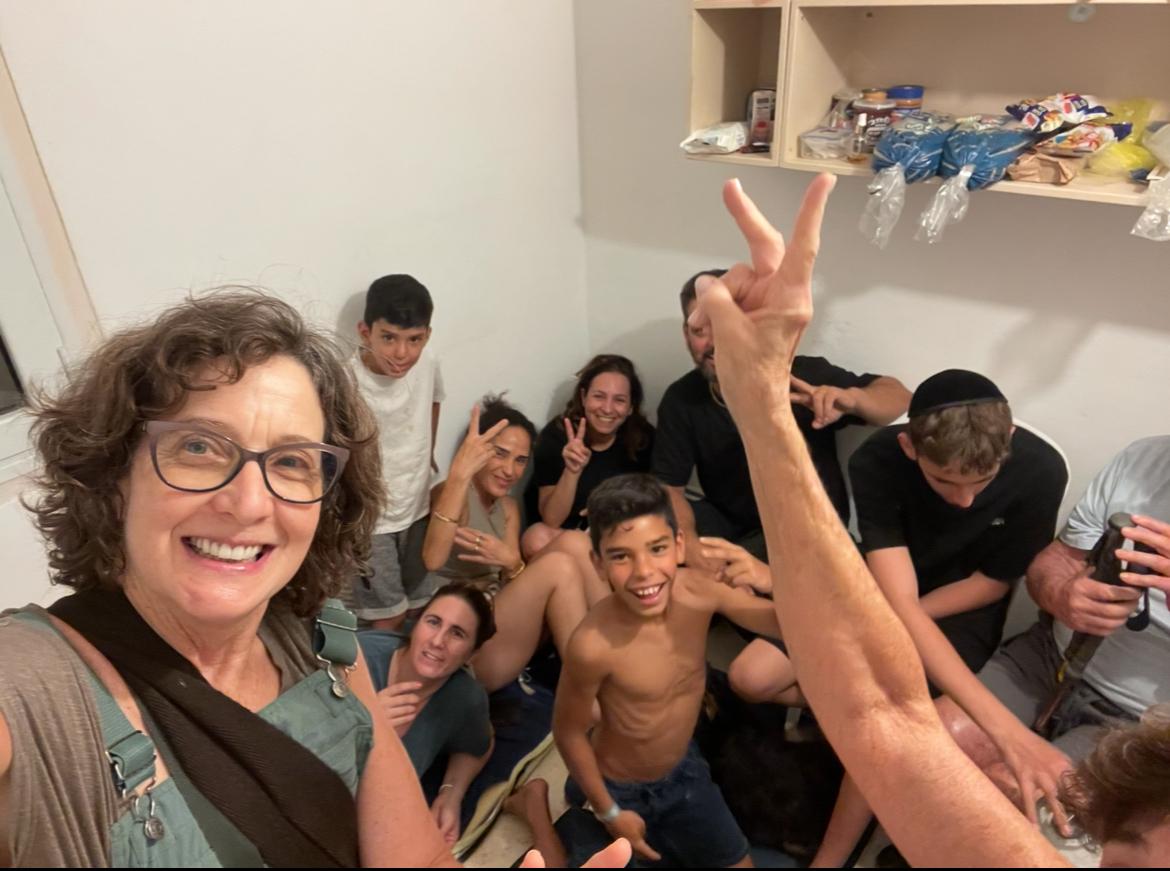
Photo courtesy of the author.
“By the way, where’s your mamad (safe room)?” I once asked my Israeli friends years ago. As usual on my visits to Israel from my home in Northern California, I had been staying with them in their house on the moshav — the Israeli settlement near where my 94-year-old friend was born. “We don’t have one,” Uri said. “No rockets can reach us here in the center of Israel and, when I built the house in the 1960s, a mamad wasn’t required. We go to our stairwell when the sirens sound.” Good to know.
And Uri Bar-Lev knows! As a teen, he fought in the Palmach (the military defense force of pre-state Israel) during Israel’s War of Independence. He’s the El Al Airlines captain who foiled terrorist Leila Khaled’s skyjacking attempt in 1970. Khaled, leader of the Popular Front for the Liberation of Palestine (PFLP) at that time, attempted to hijack an El Al flight traveling from Amsterdam to New York City).
Uri is tough and brave and has survived five wars and six assassination attempts by terrorists to blow up planes he captained.
Now it’s June 2025. It’s three o’clock on a Friday morning. What happened didn’t change Uri, but it sure changed me. The emergency alerts on my phone, followed by the screams of the siren, jolted me out of bed. It sounded to me like the dead had risen and were calling us back to the underworld. I raced down to the stairwell. Uri and his wife Yona joined me and turned on the radio that was plugged in nearby.
“What’s happening?” I asked.
“The Israeli Air Force is bombing Iran,” Yona said as she calmly brought us three glasses of red wine and some crackers. “We don’t know how long we’ll be sitting here,” she explained.
We heard multiple “booms” (some from the missiles breaking the sound barrier, others from the Iron Dome’s interception). Think 1989 earthquake. Then it was over and we went back to bed.
In the morning, when we awoke, life seemed back to normal. We ran errands, picked up some take-out sushi and headed home.
The neighbor called. His house had a mamad. Would we like to use it?
Later that evening, the alerts and sirens went off again and we scrambled to get to the shelter. We didn’t know this neighbor and he didn’t know us. We’d never been to his house, but we raced as quickly as we could. Remember, Uri is 94 and tough. And, did I mention, stubborn? We ran through the back door and tried to navigate the downstairs of the house in the dark until we found the steel door of the mamad.
We knocked, it opened and, inside, was a group of close to 20 neighbors — three families with children, one dog, a baby and a few other people whom I had never met.
The mamad was about six meters by three meters (10 feet by nine feet). It was hot, but thankfully, there was a fan, snacks, water and, I suspect, a first aid kit. It was so crowded that the fathers and the owner of the mamad had to stand.
The alerts on our phones would tell us when to leave. The kids who couldn’t fall asleep were scrolling on their phones. But they weren’t checking TikTok or other social media. They were scrolling to see where the missiles were striking and what was hit.
I slumped down next to the dog and tried to take up as little space as possible. What, after all, was proper “mamad etiquette”? I was sitting near the fan. Was I blocking the cool air? (It’s been hot and humid here in Israel and, as you can imagine, it’s even hotter in a closed concrete room with no fresh air.)
Suddenly, I realized how vulnerable I was. What if these people I didn’t know end up not having enough room for me? What if they want to make room for more of their own family? What would I do? I couldn’t blame them. But that’s not the Israeli way. These people were both friendly and fearless.
People passed around bags of potato chips as we chatted. They thought it was quite amusing that I was a tourist. They joked with their gallows humor that they were giving me a tour of the “real” Israel. I joked that I may have accidentally made Aliyah (immigrated to Israel), since all of the air and seaports were closed and there was no way out of the country.
Since that first missile attack six days ago, the scene has repeated itself during different times of the day and night. Sometimes once in 24 hours, sometimes four times. Each time, it’s a scramble to get down to the mamad. Neighbors come and go. One family went to stay at the nursery school’s mamad. Another family with a dog arrived.
Sometimes I’ve raced to the neighbors only to find him not at home and the front door locked, so I raced down the hill to the back of the house. Once the siren sounds, we only have 90 seconds to get into the shelter.
When we get the alert that all is safe and we can go home, we still find ourselves walking around the house with our purses, stuffed with our prescription medications and important documents. The TV and radio are immediately turned back on, and we sit and watch and wonder what will happen next. We wait.
I’ve since learned my mamad-mates’ names and many of their stories. Some were born in Israel (my friend Uri was born here when it was still called the “British Mandate”). Others immigrated from Germany. Several work in hi tech. Some are Ashkenazi and some are Mizrahi Jews.
But what they all have in common — in addition to their sense of humor, strength of spirit and generosity, is that they all just want peace.
Anastasia is a member of the Hadassah Writers’ Circle, a dynamic and diverse writing group for leaders and members to express their thoughts and feelings about all the things Hadassah does to make the world a better place. It’s where they celebrate their personal Hadassah journeys and share their Jewish values, family traditions and interpretations of Jewish texts. Since 2019, the Hadassah Writers’ Circle has published nearly 650 columns in The Times of Israel Blogs and other Jewish media outlets. Interested? Please contact hwc@hadassah.org.
Related Topics
Related Posts