

Author, Musician, and Lecturer
My Ziedy: IDF Soldier, Satmar Chassid
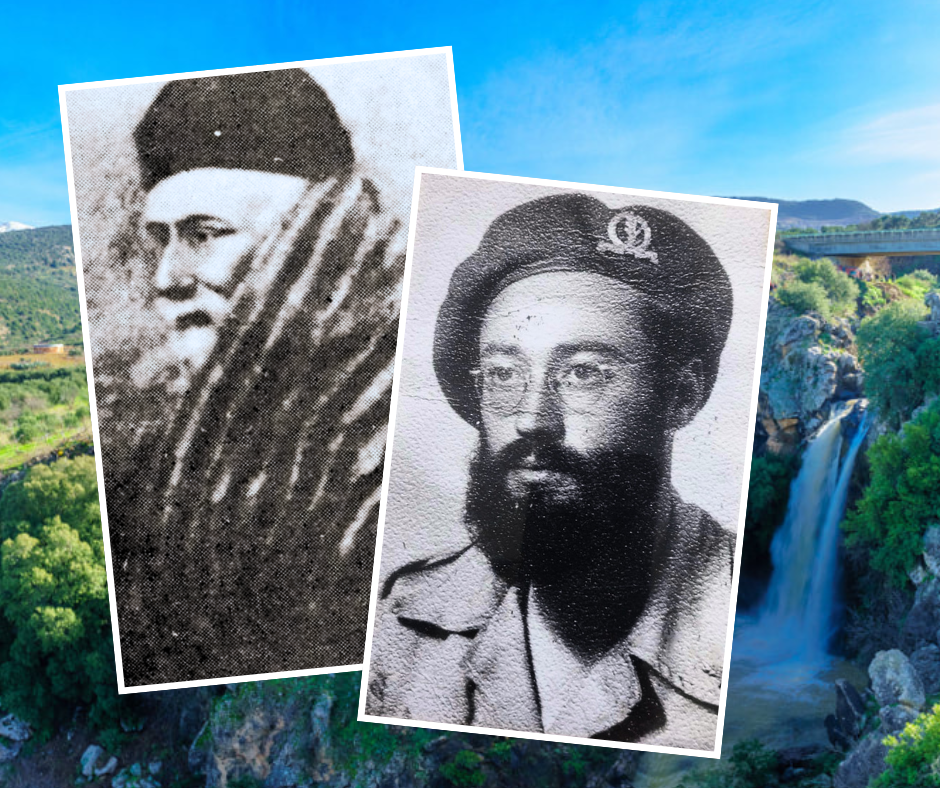
Today (9 Adar) is an important day for the Klein Family – my parents, siblings, and I – but it’s a day that holds a few timely messages for this unique moment in Jewish history, which is why I want to share it with you.
9 Adar is the yahrtzeit of both my paternal ancestor and patriarch of the Klein family (from whom my siblings are seven generations removed, “ben achar ben”), Rav Shmuel Shmelke Klein zy”a, as well as my maternal grandfather, R’ Yitzchak Eliezer (“Itzu”) Wurtzberger z”tl, who passed away when my mother was a little girl.
I think I can speak for my siblings when I say that so much of our identity is founded upon these two figures.
We grew up on the legendary tales about Rav Shmelke Selisher’s wonders: his mischievous pranks on the cruel peasants in his village that precipitated his being sent off to yeshivah at a young age, his Torah study taming a wild pack of wolves who had attacked him in the forest as a budding Talmud Chacham, his acceptance to the yeshivah of the Chasam Sofer on account of his sensitivity toward mitzvos in stepping around, instead of treading on, a bundle of s’chach, his brilliance in learning and leadership, the miracles he wrought for the people who sought him out, and so much more. To descend from such greatness was an honor. More so, perhaps, it was a responsibility.
My mother’s father, R’ Yitzchak Eliezer, was no less an influence on our lives. Throughout my childhood, kindly, pure eyes shone forth from his picture on the breakfront: a Holocaust survivor who had settled with fellow Satmar Chassidim in Toronto along with my grandmother a”h, he became a legendary 6th grade rebbe in Eitz Chayim – a passion inherited by my dear mother and duly passed on to her own children, the majority of whom are teachers as well.
His legacy was quieter, gentler. We heard about his love, about his warmth, about how much he cared for his students and how they adored him in return – so much so that until Covid, his former students from 6th grade (now men in their 60s and 70s) would gather each year to make a siyum on his yahrtzeit. We heard about how much his children, my aunts, missed him, and saw our mother’s longing when she looked at the pictures which she continues to cherish among her dearest possessions. We never got the chance to call him “Zeidy.” But he was our zeidy – palpably present even in his absence – and our zeidy he will always be.
Next to his picture on the breakfront (a tender image of him holding my mother as a toddler) was a fuzzy shot of a row of Israeli soldiers marching. Only one of them was bearded: our zeidy, R’ Yitzchak Eliezer. A few short years after the war, my grandfather was drafted into the nascent Israeli army. A fully observant Satmar Chassid, fighting for the IDF! My aunt filled in some of the details:
“Daddy was enlisted in his early 20s. I don’t think he was forced. I do know that he loved serving in the army. Daddy never let anyone criticize Israel. He and his brother Sendy were very Zionistic. How could they not be after what they went through in the camps?”
“And what about his relationship with the Satmar Rebbe,” I wondered.
“I never thought to ask Daddy if the Satmar Rebbe approved of Daddy’s being in the army. I have a feeling he didn’t. But times were different then. I just remember Daddy telling me: ‘We have to fight our enemies!'”
Some things are simple.
Putting his ideology aside, my grandfather, who had witnessed the horrors of the Holocaust, knew that he needed to participate in protecting his brothers and sisters. When he finished his draft requirement, he wanted to become a professional. This was already too much for his brother Zalmy, who said, “Did you forget we are Satmar chassidim?” Having fulfilled his military duty, my zeidy continued to devote himself to his beloved Am Yisrael in a different way, by nurturing the next generation of the sparks Hitler sought to extinguish.
The fact that these two neshamos, my paternal ancestor and my maternal grandfather, would have left the world on the same Hebrew date is remarkable enough. But there is much yet concealed beneath the surface.
I made reference earlier to Rav Shmelke’s miracles. He was not a “Chassidishe Rebbe” (although he had a close relationship with many of the admorim of his time and at one point came to the defense of the Divrei Chaim of Sanz in a letter of support), and yet he was renowned far and wide as a “baal mofes,” who was deeply in touch with the spiritual realm beyond. The following is one of the most remarkable accounts highlighting his sacred clairvoyance:
Rav Shmelke was once traveling through a forest with his student, Rav Moshe Jungreis of Kashoi. The tzaddik was usually extremely careful about causing pain to animals and would not allow horses to be struck by the wagon driver. He was so careful that if the horses were pulling the wagon uphill, he would descend from the wagon and walk so as not to burden them with his weight. Yet on this occasion, while passing through a particular forest, he instructed the wagon driver to whip the horses and travel as quickly as possible.
When they exited the forest, the Rav was breathing heavily.
His student asked: “Why is the Rav breathing so deeply? The horses ran fast, but the Rav was sitting in the wagon.”
Rav Shmelke replied: “Do you know what was in that place we just passed through?”
The student said he had seen nothing unusual.
The Rav then explained that the forest was filled with the souls of the “biryonim” (zealots) from the time of the destruction of the Second Beis HaMikdash – those who refused to heed Chazal’s call to compromise with the Romans and whose actions contributed to the churban and exile. Their souls had not yet found rectification, and the place was spiritually impure.
He added that as they passed through the forest, he heard a bas kol, a heavenly echo: those souls were pleading to be reincarnated so that they could repair their deeds. The response: although it was known they might not repent, since free will exists, they would indeed be given another chance. They would return to this world with the task of redeeming Eretz Yisrael from foreign rule and making it possible for Jews to return to our ancestral homeland. However, they were warned that if they followed the guidance of Torah sages, they would succeed, but if they acted independently of Torah, they would cause even greater harm.
Rav Shmelke then told his student: “In forty years, these souls will return to the world, and you will then be serving as a Rav.”
When they arrived at their destination, Rav Moshe Jungreis recorded this story in his notebook.
Fast forward to when Rav Jungreis was serving as the Rav of Kashoi. One day, activists came around raising funds to purchase land in Eretz Yisrael from the Turks, and wanted to replace the traditional tzedakah boxes of Rav Meir Baal HaNes with those of the Zionist’s newly formed Jewish National Fund. Remembering his Rebbe’s words, Rav Jungreis checked his old notes and turned white.
Exactly forty years had passed.
In the year 1930, Rav Shmelke’s grandson, Rav Yaakov Shalom Klein zy”a (my namesake), would eventually sit on the Beis Din that would grant the position of Chief Rabbi of Satmar to Rav Yoel Teitelbaum zy”a, perhaps the fiercest opponent of Zionism and Rebbe of my maternal grandfather.
Another of Rav Shmelke’s descendants was a man named Dovid Klein. He eventually changed his name to Giladi, and his daughter Shulamit married a Yugoslavian Jew by the name of Tomislav Lampel, who had by then changed his last name to Lapid. Together, they had a son named Yair. Today, Yair Lapid is Israel’s current leader of the opposition.
The story of Rav Shmelke’s vision in the Hungarian forest is a remarkable one, because it implies that those involved in the early Zionist efforts were “tasked,” min haShomayim, with the mission to begin the process of Yidden returning to Eretz Yisrael. This was, to say the least, not the mainstream view in the Hungarian Rabbinate at the time. And yet, Rav Shmelke’s ruach hakodesh confirmed that a group of souls would be returned to life to begin the process of rebuilding the Land, rectifying the destruction in which they had participated.
The story presents the possible eventualities as a binary: the Zionists would either build their enterprise on Torah values and succeed, or they would remain in opposition to the Torah and fail.
With the blessing of retrospect, I think it’s safe to say that the reality is a bit more complex.
Israel is an in-between place at an in-between time. The return to our Land is perhaps the primary lane on the long and narrow bridge between Galus and Geulah and reflects, moment by moment, the full catastrophe of a world in labor – the uncertain passage from the 6th Millennium to the 7th, from the suffocating birth canal of our present circumstances to the deep breath of new life. In such a fluid state of transition, challenged in so many ways, there will be pain. There will be danger. There will be confusion, and bitterness, and frustration. There will be “biryonim” who don’t listen to the words of the Sages on both sides of every issue.
And yet, there will also be people like the man whose daughter another descendant of Rav Shmelke Selisher – my father – would marry: a man named Itchu Wurtzberger, a Satmar chassid who saw his service in the IDF as part of his Chassidic religious duty, to defend what was left of the Am Yisrael whose destruction he witnessed against her enemies yet intent on finishing the job.
I couldn’t be prouder that I, too, in my own way, will soon have the privilege of joining my older brother in taking our place in this unfolding story with our upcoming move to Eretz Yisrael. Our family has heard the still, silent sound of Hashem calling us home, beckoning us to participate in the onging construction of a glorious edifice upon the hallowed foundation of hope, dreams, blood, tears, and the countless anguished prayers of both “biryonim” and saints alike.
May the neshamos of Rav Shmuel Shmelke ben Yosef and R’ Yitzchak Eliezer ben Mordechai have an aliyah, and may their merit support our family’s aliyah of a different kind, as we return to the Land where we are born and reborn again.