French-Israeli Visual Artist and Writer
Naming Ourselves: From Exile Labels to Indigenous Clarity
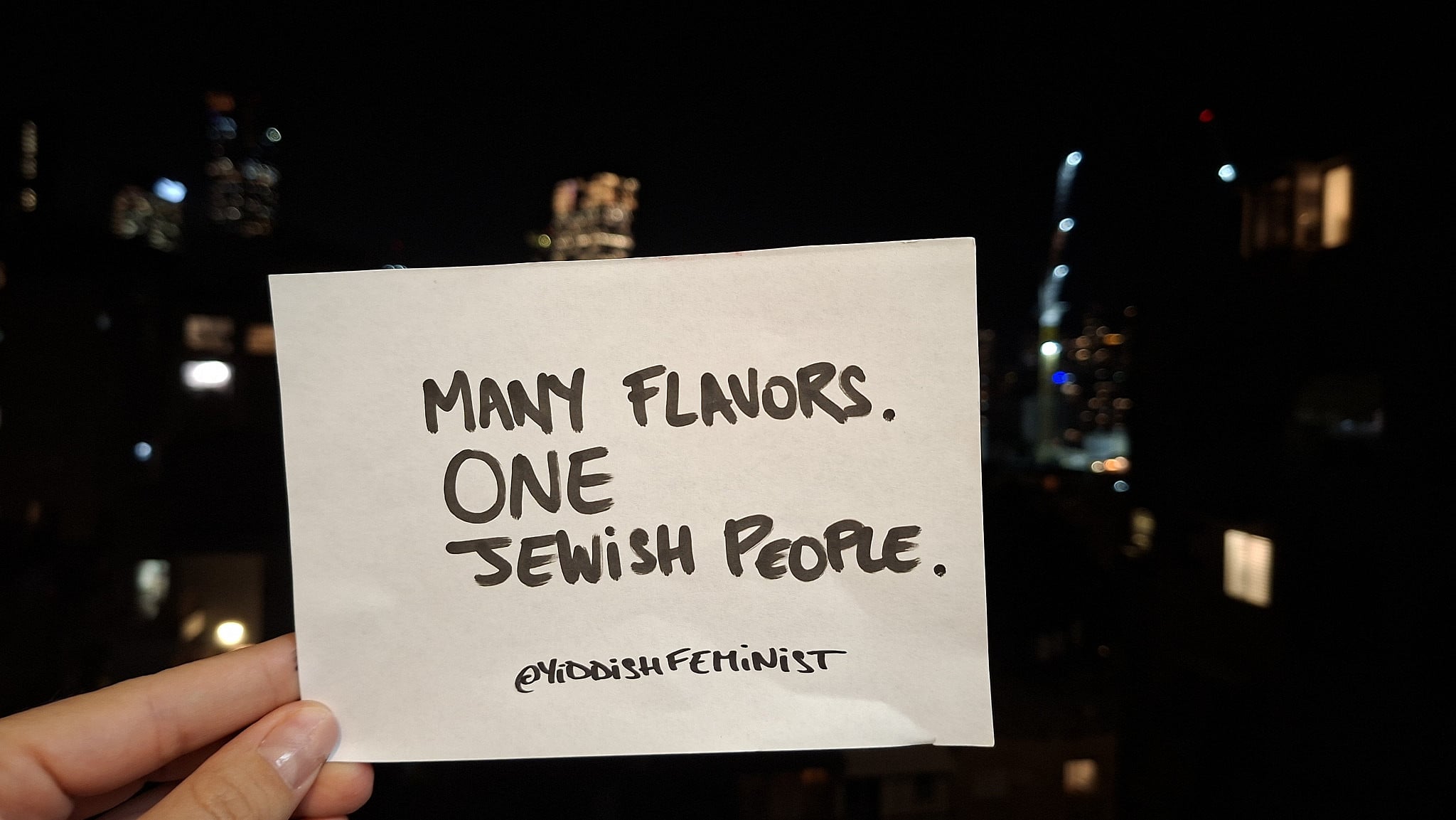
Credit: @YiddishFeminist/ Morgane Koresh
For a people with a history as old and as dispersed as ours, language has never been just communication. It has always been identity management, historical framing, and at times, survival. And much of today’s confusion around who Jews are, be it our origins, our diversity, our relationship to the Land of Israel… comes from the fact that we have been speaking about ourselves in categories that were never designed for us.
Over time, we inherited vocabulary shaped by European racial hierarchies, Arab nationalist ideologies, and colonial assumptions about geography and belonging. These frameworks were built for other peoples and other histories, yet they seeped into our own self-description.
They blur our story, dilute our continuity, and sometimes pit us against one another.
If we want clarity, unity, and confidence, especially in an era of rising antisemitism, we need to audit our vocabulary and rebuild it from the ground up.
The shift begins with a simple but profound reframing:
Diaspora is not who we are; it is where our ancestors spent their exile.
Useful as they are, the diasporic descriptions only tell part of the story. They describe where our families lived, not who we are. They speak about geography, not continuity. They reflect local adaptation, not indigeneity. And in a moment when many Jews feel unmoored or fragmented, recovering that distinction is not semantics. It is clarity, coherence, and grounding.
Because the truth is straightforward and steady:
Our diversity reflects the many places our ancestors passed through during exile, but all Jews share one origin and are part of one peoplehood.
And once we see that clearly, everything else falls into place.
Diversity is the Map of Our Journey
Jewish diversity is often explained defensively, as if it needs to be justified. But the reality is far more empowering: Jewish diversity is the record of our journey across continents.
Our families carried the same story into dramatically different climates and cultures. Over two thousand years, local environments shaped the way some of us looked, cooked, sang, and spoke. Cuisine absorbed the spices of each region; melodies echoed the instruments of local musicians; dialects mixed with surrounding languages.
But the thread that runs through all of these communities is the same.
A Jew from Vilna and a Jew from Sana’a are not two different kinds of people.
They are two different chapters of the Jewish Story.
Skin tone or features may reflect local context, but indigeneity reflects origin. And that origin is shared.
When understood this way, our diversity ceases to be a question of authenticity or legitimacy. It becomes proof that we carried a shared identity through every landscape, every empire, every border we crossed.
Reclaiming the Vocabulary of our Peoplehood
If language shapes perception, then it matters deeply how we describe ourselves.
When we rely only on diaspora labels, we unintentionally shift the story from origin to destination. We define ourselves by the stops on the road, not by the place we come from and came back to.
A simple reframing changes that:
Instead of “Polish Jew,” “a Jew whose ancestors spent their exile in Poland.”
instead of “Iraqi Jew,” “a Jew of Iraqi Diaspora heritage.”
Rather than “Ethiopian Jew,” “a Jew whose family preserved its identity in Ethiopia for centuries.”
These formulations make it clear: geography shaped expression, but not peoplehood.
These are not cosmetic changes. They re-anchor identity in history, not geography. They highlight continuity rather than displacement. And they give younger generations a language that reflects the truth instead of inherited confusion.
Why This Reframing Matters Now
We live at a moment when global narratives around identity are more polarized, more rigid, and more politicized than ever. Young Jews, especially those in multicultural societies, are searching for clarity about who they are and where they come from. Many feel pressure to fit themselves into categories that do not fit our history, worldview, or lived experience.
A vocabulary built on origin rather than diaspora offers a clear alternative.
It tells Jews:
You are not defined by the lands your ancestors passed through.
You come from a story older than exile.
You belong to a people whose beginnings are rooted, not borrowed.
Your family’s journey is part of a larger whole.
And crucially: your indigeneity is not contingent on appearance, proximity to the Middle East, or resemblance to neighboring populations.
That clarity is urgently needed. When language aligns with history, identity strengthens. When identity strengthens, unity is unquestionable.
A Shared Story, Told in Many Accents
Jewish history stretches across continents, but it begins in one place. Our ancestors carried that origin with them through Babylon, through North Africa, through Southern Europe, through Eastern Europe, through Yemen, Persia, India, Ethiopia, Spain, the Caucasus, and beyond.
Every community added its own colors, flavors, and melodies to the tapestry. But the fabric underneath remained the same.
And when we speak about ourselves with this clarity, we reclaim the narrative. We remind ourselves and the world that we are one people shaped by many journeys, not many people loosely connected by coincidence.
We are not defined by exile.
We are defined by origin and continuity.
Our families traveled far, adapted, survived, and preserved an ancient identity through every turn.
Our diversity is not the dilution of indigeneity, it is the record of that journey.
And our vocabulary should honor it.
Related Topics
Related Posts