
From Kibbutz to the global stage
NASA Watch as EU (ESA) Moves First in the 3I/ATLAS Planetary Defense Drill
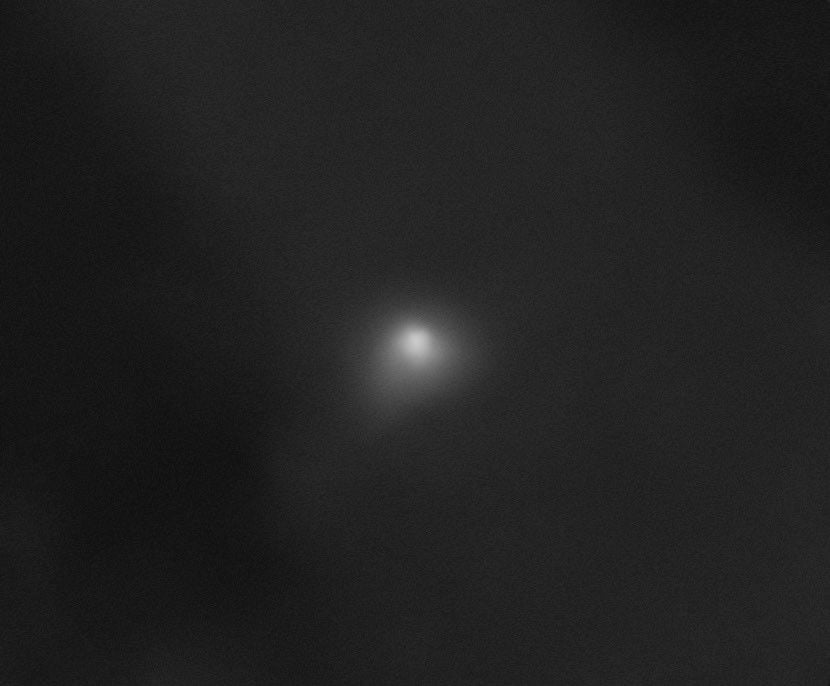
Image: captured by NASA’s HiRISE camera aboard the Mars Reconnaissance Orbiter. The frame shows the interstellar object 3I/ATLAS passing above Mars in early October, appearing as a blurred white sphere due to extreme motion during exposure. Credit: NASA/JPL/University of Arizona (Public Domain).
In early October, NASA’s HiRISE camera aboard the Mars Reconnaissance Orbiter captured a rare and puzzling sight: the interstellar object 3I/ATLAS passing above Mars. The raw frame shows a heavily blurred “white sphere,” distorted by extreme motion during exposure — a reminder of how difficult it is to image fast, unpredictable objects entering the Solar System from interstellar space.
Yet the real story emerging in the last 48 hours is no longer about the blur.
It is about geopolitics — and the fact that Europe has quietly moved ahead while NASA is still watching.
Europe Moves First:
Just days after NASA held a cautious and carefully framed press briefing, the European Space Agency released an unusual public update. Within it, almost hidden as a technical reference, was a politically significant line:
ESA confirmed that the 3I/ATLAS encounter was used as a planetary-defense rehearsal, conducted under the European Space Safety Programme and in accordance with the 2025 Ministerial Council resolution of 5 August 2025.
That resolution requires:
- enhanced transparency
- timely public updates
- and cross-agency communication
during planetary-defense events.
In other words, Europe did not merely observe 3I/ATLAS.
Europe operationalized it.
While NASA was still shaping its public message, ESA had already activated its legally mandated response framework.
This is a strategic shift — and a public one.
A Rehearsal Hidden in Plain Sight:
ESA’s statement also revealed something scientifically meaningful:
they used observations not only from Earth-based systems, but also from NASA’s own Mars Reconnaissance Orbiter. This dual-perspective triangulation sharpened orbit estimates and provided a practical test of European-led coordination between assets around different worlds.
ESA described the exercise as valuable because it:
1. Leveraged spacecraft not designed for asteroid detection:
HiRISE and MRO were built for Mars geology, not for tracking fast interstellar objects.
Using them as ad-hoc detectors is itself a test of flexibility.
2. Implemented Europe’s new space-governance obligations:
The Ministerial Council’s August 2025 resolution was not symbolic.
It created binding requirements for transparency and communication when planetary-defense events occur.
The 3I/ATLAS rehearsal appears to be the first real-world test of that mandate.
3. Signaled Europe’s intent to be an independent strategic actor:
Planetary defense has long been dominated by NASA-led processes.
ESA’s move — public, coordinated, and framed by law — signals a new European posture.
NASA’s Slower, More Cautious Messaging:
NASA remains the world’s premier scientific agency. Its teams continue analyzing all available 3I/ATLAS data, and the agency has promised further releases after intake, processing, and cross-validation with “strategic partners.”
But NASA’s communication style has been markedly careful:
- delayed images
- shifting explanations
- repeated emphasis on caution and uncertainty
Meanwhile, ESA referenced rehearsal, governance frameworks, and cross-agency communication — concepts absent from NASA’s briefing.
The contrast is becoming impossible to miss.
NASA is watching.
Europe is acting.
Why This Matters: Planetary Defense Is Becoming Geopolitical:
3I/ATLAS is only the third known interstellar object detected in our Solar System. Every observation is scientifically precious.
But this encounter has revealed something larger:
Planetary defense is no longer just a scientific discipline.
It is now a geopolitical arena.
As China expands its deep-space monitoring capabilities, India asserts itself as a global space power, and the UAE invests in interplanetary exploration, Europe’s statement places it firmly on the map as an independent actor — not merely a collaborator.
And 3I/ATLAS has become the test case.
What the Rehearsal Likely Practiced:
Although ESA was succinct, we can infer key elements of the drill:
• Timing and downlink coordination.
How fast can data from Mars reach Earth, be stabilized, and be compared with ground-based observations?
• Handling trajectory uncertainty.
Interstellar objects often show non-standard motion.
Teams likely trained on uncertainty modeling and response.
• Public communication under legal obligations.
By releasing the update explicitly under the Ministerial Council mandate, ESA tested how governance systems function in a real scenario.
Whether intended or not, ESA has set a precedent:
the next planetary-defense event will be judged by these new European standards.
A Turning Point:
3I/ATLAS is still being studied, and much remains unknown. The scientific story will continue to unfold.
But the geopolitical story is already here.
Europe moved first.
NASA is watching.
Other agencies are quietly taking notes.
A blurry white object above Mars has unexpectedly reshaped the politics of space.
Image: captured by NASA’s HiRISE camera aboard the Mars Reconnaissance Orbiter. The frame shows the interstellar object 3I/ATLAS passing above Mars in early October, appearing as a blurred white sphere due to extreme motion during exposure.
Credit: NASA/JPL/University of Arizona (Public Domain).
Related Topics