The views expressed herein are solely mine.
NATO Failed the Iran Test
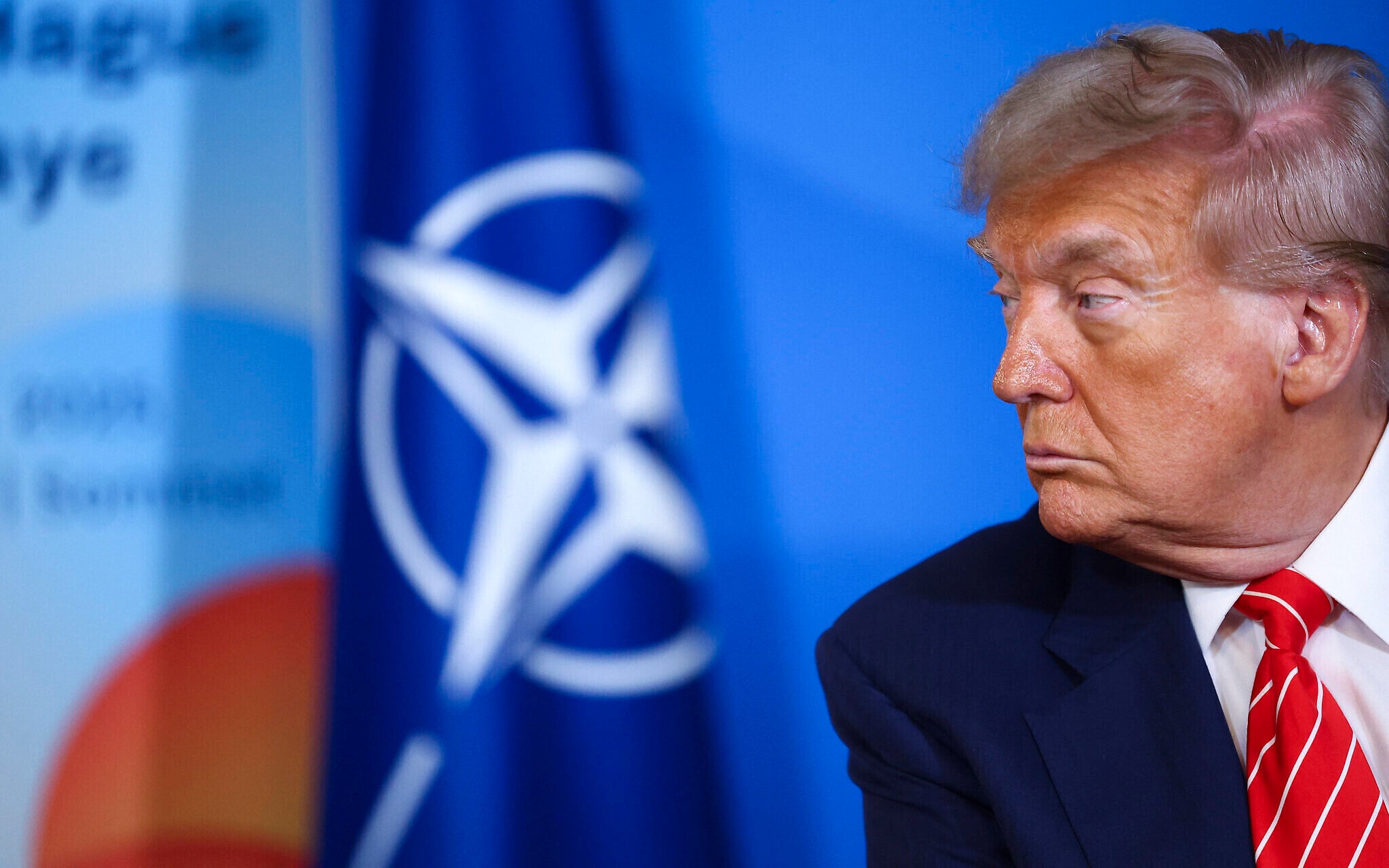
US President Donald Trump at the NATO summit of heads of state and government in The Hague on June 25, 2025. (Piroschka Van De Wouw / POOL / AFP).
The North Atlantic Treaty Organization (NATO) has not failed in the Iran war because it is confused. It has failed because, when American power is tested outside Europe, the alliance no longer behaves like an allied military bloc. Washington faced a conflict tied to deterrence, maritime security, and the security of one of the most important energy chokepoints on earth. Most of NATO did not rally behind the state that underwrites its defense. It stalled, hedged, and hid behind procedure. Thus, the Iran war has not exposed a passing disagreement. It has exposed the real structure of the alliance: America carries the weight, and much of Europe reserves the right to step aside.
That matters because the Strait of Hormuz is not a side theater. The U.S. Energy Information Administration describes it as one of the world’s most important oil chokepoints. In 2025, roughly 20 million barrels per day moved through it, equal to about 20 percent of global petroleum liquids consumption, and major volumes of liquefied natural gas also passed through the corridor. A bloc that calls itself the core of the Atlantic order should not need this explained. A crisis touching Hormuz is not a local Gulf quarrel. It is a stress test for global trade, energy security, and Western credibility.
In tandem, the usual legal defense of NATO misses the point. Yes, Article 5 was not triggered. No treaty clause required every ally to march into the Gulf. But that is a lawyer’s answer to a geopolitical problem. The real question is simpler: when the United States provides the bulk of the alliance’s military power, do its allies act like a strategic coalition when a crisis erupts that affects the wider balance of power? In Iran, the answer was no. European governments did what they increasingly do whenever the map extends beyond their preferred perimeter: they demanded clarity, stressed limits, and searched for ways not to act.
The financial imbalance leaves Europe with nowhere to hide. In 2025, U.S. defense spending was estimated at $845.3 billion out of NATO’s $1.4046 trillion in total allied expenditure, roughly 60.2 percent of the whole. Beyond the money, Washington supplies many of the capabilities that make the alliance operational: intelligence, surveillance, air-to-air refueling, ballistic missile defense, and airborne electromagnetic warfare. America is not just another ally. It is NATO’s arsenal, command core, and strategic backbone.
Then came the roll call—and the collapse. Britain ducked reality but now it is trying to be a “little bit flexible”. Germany hid behind procedure. France hedged. Canada opted out. Poland offered bureaucracy instead of backing. Italy, Greece, the Netherlands, and Spain lingered in the realm of hypotheticals. Estonia asked for clarity. Turkey said no. Even Brussels admitted there was no appetite to widen Europe’s Gulf role. This was not an alliance sharing burdens. It was an alliance that consumed American protection while refusing American fights. Across 32 members, Washington still could not build a serious coalition once the crisis left Europe’s backyard.
That is the geopolitical lesson. NATO still works as a Europe-first insurance mechanism. Eastern members want American power aimed at Russia. Western Europe wants American protection without American expectations. Much of the alliance wants the U.S. deterrent, the U.S. logistics network, the U.S. treasury, and the U.S. risk tolerance, while preserving maximum freedom to moralize and abstain whenever Washington fights outside the continent. This is not solidarity. It is dependent subsidized for so long that it now passes for virtue.
Plainly, Washington cannot dissolve NATO by decree. But it can stop pretending the old bargain still exists. It can narrow its commitments, cut the subsidy, and force Europe to pay for Europe, arm Europe, and defend Europe. That would not destroy an alliance worth preserving. It would expose whether one still exists. The Iran war did not merely embarrass NATO. It revealed that beneath the speeches and ceremonies lies a harder truth: America has allies for Europe, but clients everywhere else.
Related Topics
Related Posts