Teaching the Holocaust through stories of Jewish Resilience
Navigating the role of bystander: What can we do?
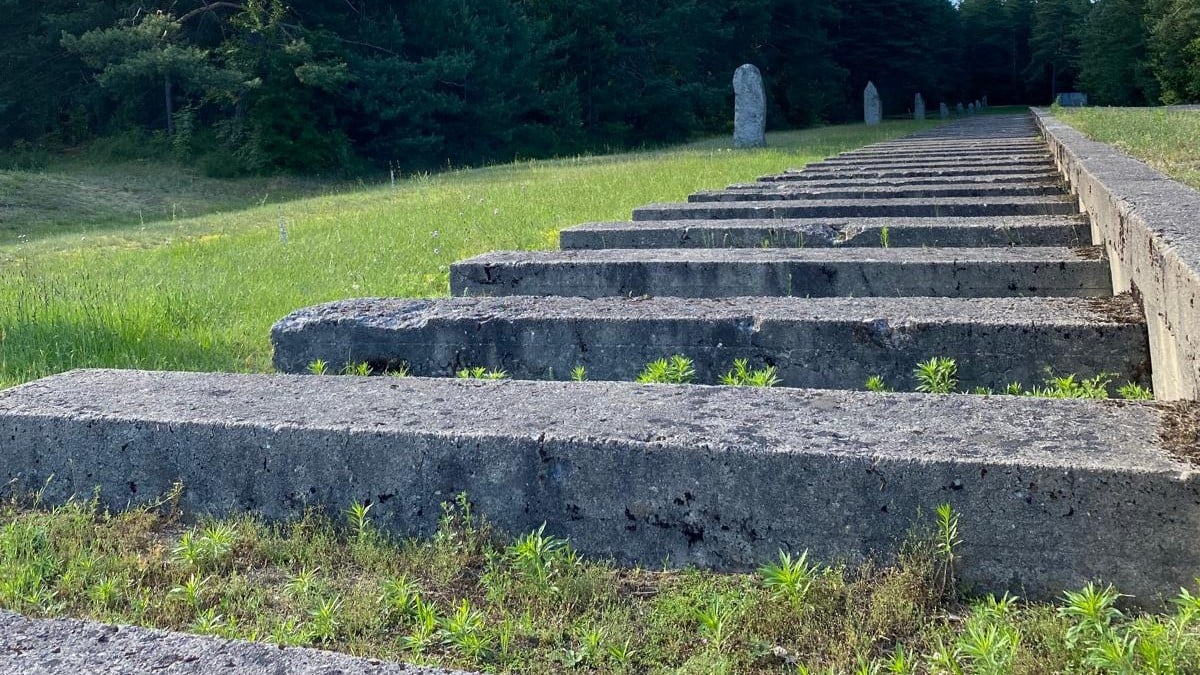
The train tracks monument in Treblinka (Source: Lynne Feldman with permission)
I am beginning to sympathize with the people of the 1930s – the people we describe as indifferent bystanders. I am also beginning to recognize that their stories are much too complicated for us to use the word indifferent.
We are all seeing things happening in the world right now which do not feel right. Your concerns may not match mine, but I think that we are all united in wanting but failing to find a safer and saner world. I also think that we are all united in feeling like bystanders to events that we would change if we could.
I may feel like a bystander but I certainly am not indifferent. In fact, I am appalled. But what I can do that would actually make a difference? Are my actions making things worse? I do not know about you, but I am struggling to figure out how to navigate the choices that come with being a bystander.
As a Holocaust educator, I look to the stories from the Holocaust for insight. The vast majority of the people in the Holocaust were, or at least started out as, bystanders. Reading their stories, I have come to understand that much depends on the community in which we are operating.
Stefan
Stefan Kucharek was 18 when the Germans took over his hometown of Małkinia, 6 km from a small, rural train station called Treblinka. At the time, he was working at a saw mill. After Poland’s defeat, he took a job at the railway, because he believed that was the only way to ensure that he would not be sent to a forced labor camp.
He started as a railroad mechanic but soon learned to drive the train. He eventually found himself driving trains filled with exhausted, terrified people to the small Treblinka station. And returning to Małkinia with empty cars.
In interviews after the war, Stefan says he did not have anything against Jews and that he tried to help them when he could. But, he says, his job was to drive the train where the Germans told him to drive it, so that is what he did.
Stefan did not apply to be an accomplice to mass murder. He was protecting himself. I do not think he knew or expected that driving people to their death would be part of his duties when he took the railway job.
Once he started driving the route to Treblinka, he was stuck. He was a witness to the Nazi war crimes and as such, would have been shot had he tried to quit.
However, he could have quit his job and refused to take the route when the order first came down. He knew what was going to happen to the people on his train even before he took the first transport – it was common knowledge around town.
Stefan believed that quitting his job would put him at risk of being sent to forced labor. He believed that quitting would risk his life. We have to ask, what is reasonable to expect from someone like Stefan? Is it reasonable to expect the average person to put themselves at risk for a stranger – or even hundreds of them? Should he have risked his life in order to not be an accomplice to murder?
We would like to think that we would have made a different choice – that we would have refused to drive that train. It is easy to make such choices in hindsight, though, when it is not your immediate reality. The prevailing culture of Stefan’s community was that your job is to protect yourself and your community. In that climate, it can be hard to make the risky choice.
Le Chambon
In Le Chambon-sur-Lignon, France, the prevailing culture was different. Led by Pastor André Trocmé, Le Chambon became a place of refuge, a place where Jews could come and know they would be hidden. In Le Chambon, if you had a barn or an attic or a basement where people could be hidden, the expectation was that you would use it to hide people.[1]
A community’s expectation is a powerful force. It can be a force for evil, such as when reluctant members of the Einsatzgruppen were subtly encouraged to participate in the murder at the killing pits. It can also be a force for good, as in places like Le Chambon where societal expectations meant that you should be helping the victims, not the perpetrators.[2]
There were other examples of this. In Albania, the expectation was that if you had the opportunity to help people, you took it. In this way, Albania became the only country in Europe where the Jewish population increased during the Holocaust.[3]
Choices are illuminated by the light of your community. In an affirmative community, it is easier to make the right choice. Your neighbors expect you to help. Risks remain, but you can expect help from your neighbors or, at a minimum, you can expect not to be incriminated by your neighbors. Your community, for the most part, has agreed to share the risk with you.
Building Affirmative Communities
I find that these two stories give me some insight into what I can do to make a difference.
Stefan lived in a community where the expectation was that you protect yourself. In such a situation, the task of resisting evil rests entirely on the individual. Each person has to make their own choice to take the harder path.
On the other hand, Le Chambon was a community where the expectation was that you helped where you could. In this situation, the task of resisting evil is shared. The choice to help becomes the easier path. In such a community, it becomes easier for an individual to make the choice to help the victims and to refuse to be complicit with the perpetrators.
So, what can we do? How do we shift from bystander into meaningful action?
We start by building communities in which doing the right thing is the expectation. We support the people and organizations that are standing up for what we believe is right. The stories from the Holocaust show us that if we leverage the power of community, we can effect a positive difference. Pastor Trocmé was the fulcrum that lifted Le Chambon, yet he relied upon the power of his community to effect the life-saving results.
In our own troubled times, we can leverage the individual stories of the Holocaust to inspire our communities. Better yet, we can learn to tell the stories of victims and helpers in order to build understanding in our communities. Teach The Shoah, as well as other organizations, are looking for volunteers to hear, to learn, and to tell true stories of the Holocaust. Some of our storytellers speak in schools, rallies, and Holocaust remembrances. Others do not publicly speak and are simply living repositories of memory that they will pass on later. All of these volunteers help to shift our communities towards tolerance and a world that is safer and saner for everyone. All of these volunteers avoid being bystanders.
Alone, I am not certain that there is a lot that I can do. Together, we can rebuild the world.
————
[1] Over the five years of occupation, the people of Le Chambon saved more than 5,000 Jews.
[2] It is worth noting that a community where everyone hid Jews may have been easier to accomplish in France than it would have been in Poland. Not because the Poles were necessarily more antisemitic than the French, but because the Nazis had a different view of the Poles than they did of the French. In Poland, one family hiding Jews might well have been risking the entire town being massacred if they were caught.
[3] The Jewish population of Albania increased from 200 in 1939 to 2,000 in 1945.
Related Topics
Related Posts