


From Kibbutz to the global stage
Navy Whaleboat: From Port Jefferson and New Bedford to Israel’s Exodus Legacy
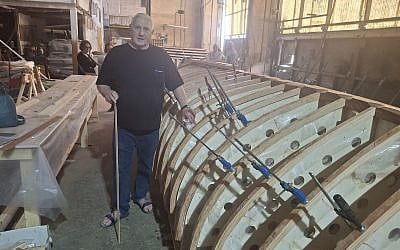
From the Palyam to Hadassah Neurim: The Whaleboat Returns to Israel.
Quietly, inside the Hadassah Neurim youth village along Israel’s coastal highway, an unusual maritime project is taking shape these days: the first authentic historical whaleboat ever to be built in Israel.
Behind the initiative stand Israeli Navy veterans — some between 75 and 90 years old — who are volunteering their time in order to preserve an important chapter in Israel’s maritime history.
The whaleboat, a large rowing boat originally developed in the world of whale hunting, is known in Israel mainly for its role during the Palyam and the Aliyah Bet immigration operations. In the years following World War II, when the British blocked Jewish immigration to Mandatory Palestine, these boats were used to transfer Jewish immigrants from clandestine immigration ships to the shore in daring operations carried out by the Haganah and the Palyam naval force.
But the story of the whaleboat began much earlier — in the whaling world of the 18th and 19th centuries.
From the United States to Israel: A Maritime Heritage Struggling to Survive.
In Port Jefferson, New York, around 25 volunteers have spent the last three and a half years building a historical whaleboat that will be displayed during the celebrations marking 250 years of American independence. The boat was built as a tribute to the bay boats that assisted American settlers during the Revolutionary War against the British.
At the same time, in New Bedford, Massachusetts — one of the world’s most important historical centers of whaling — an old whaleboat that had been forgotten for decades in a local warehouse was recently rediscovered. Efforts are now being considered to restore it ahead of the “Sails of Portugal” festival scheduled to take place in the city in 2027.
The restored boat is expected to join three other historical whaleboats commemorating the Portuguese and regional whaling heritage that shaped the area for generations.
During a “Sails of Portugal” event, Portugal’s consul in New Bedford, Tiago Sousa, praised the preservation efforts of the local AMHS organization.
“The whaleboat is much more than a wooden vessel with sails; it is a symbol of resilience, courage, and the deep connection between the Portuguese people and the sea,” he said.
“These boats are not merely museum artifacts — they are vessels of memory and identity.”
From Moby-Dick to Historical Preservation:
The world immortalized in books and films such as Moby-Dick looks very different today.
When whales moved from land to the oceans millions of years ago, they could hardly have “imagined” that in the modern era humanity itself would become the greatest threat to their survival. Over the past centuries, whale hunting led to the dramatic decline of many whale populations around the world, until broad international bans on whaling were introduced in the second half of the 20th century.
At the same time, modern research revealed the complexity of whale societies: community life, communication, family bonds, and high intelligence.
Thus, what once symbolized humanity’s dominance at sea has gradually also become a symbol of preservation, memory, and heritage.
The Israeli Whaleboat Returns to the Sea:
Over the years, several old whaleboats have been preserved in Israel, some within Sea Scout groups and kibbutzim. At Kibbutz HaHotrim, south of Haifa, an old whaleboat sometimes referred to as “Moby Dick” still exists alongside additional rowing boats used for training.
However, experts argue that many of the surviving boats underwent major modifications and repairs over the years, raising doubts about their historical authenticity.
Against this backdrop, Israeli Navy veterans, led by Ra’anan (“Zulo”) Shapira, recently launched a new project aimed at building an authentic historical whaleboat in Israel — as closely as possible to the original historical models.
The project is taking place at the Hadassah Neurim youth village, with the support of the Israeli Navy Association and assistance from the Israel Sea Scouts Association.
Most of the work is being carried out entirely on a voluntary basis, driven by a sense of mission and a desire to pass Israel’s maritime heritage on to future generations.
The volunteers hope that by this coming summer, the first authentic whaleboat ever built in Israel will be launched — not merely as a boat, but as a living symbol of maritime history, illegal Jewish immigration, the Palyam, and the spirit of volunteerism that helped shape the founding of the State of Israel.
About the Author
Rafi Glick is a writer, lecturer, farmer, and business executive with decades of experience at the intersection of academia, technology, agriculture, and international trade.
• He has served as a Senior Teaching Associate at Ben-Gurion University of the Negev, Ono Academic College, Ariel University, Ruppin Academic Center, and as a guest lecturer at Sofia University’s Faculty of Economics and Business Administration (FEBA). At Ben-Gurion University he also advised the BGU–NHSA Accelerator in the Faculty of Science.
• In business, Rafi was CEO of Bidsnet Ltd., a pioneer in deploying fiber-optic cables through unconventional infrastructure (in partnership with CableRunner), delivering high-speed connectivity to homes, enterprises, institutions, and cellular networks. Earlier he held senior roles at ECI Telecom and served on the board of RLF Venture Capital, working with partners such as Intel, Teva, and the Jerusalem Development Authority.
• He contributed extensively to Israel’s trade and investment ecosystem: he directed industrial and agricultural technology divisions at the Israel Export Institute, founded Israel’s AGRITECH as international exhibition, and served on the board of the Israeli Investment Center at the Ministry of Industry and Trade.
• In his early career, Rafi established and served as the first director of the Cargo and Aircraft Supply Security Department in the Security Division at Ben-Gurion Airport (1972–1976). He lived in Kibbutz Parod until 1974.
• Rafi has also been recognized for his writing: in 2008 he was named Best Economic Blogger by TheMarker, Israel’s leading business daily.
• Today he continues to publish essays and commentary—with a special passion for astrophysics, space exploration, technology, economics, and social issues.
From Kibbutz Parod to the global stage, Rafi Glick’s career reflects a lifelong commitment to building connections—between people, industries, and ideas.
Email: rafi.glick@gmail.com
Related Topics
Related Posts


Rafi Glick