


Rabbi, Special Operations Police Officer, Award Winning Filmmaker
Nearly 50,000 Views and Growing: What a Mother and Son Revealed About the Jewish Soul
When we launched the Shabbat Nachamu Unity Initiative, our goal was beautifully simple.
We were not trying to start a political movement. We were not asking Jews to agree on religious observance, ideology, or public policy. We were not trying to erase our differences.
We were asking something much simpler.
Set one more place at your Shabbat table.
Invite another Jew. A neighbor. A friend. Someone you haven’t spoken to in years. Someone from a different background. Someone who may vote differently than you, pray differently than you—or perhaps not pray at all.
For one Shabbat, let us remember that before we are anything else, we are one Jewish family.
The initiative was born during the days between Tisha B’Av and Shabbat Nachamu.

Tisha B’Av reminds us of the devastating consequences of internal division. Our Sages teach that the Second Temple was destroyed because of sinat chinam—baseless hatred among Jews. Immediately afterward comes Shabbat Nachamu, the Shabbat of Comfort, reminding us that healing begins when we choose a different path.
Rather than simply speaking about unity, we wanted Jews to experience it.
So we invited people to do something profoundly Jewish.
Open your home.
Open your heart.
Set one more place.
We hoped people would respond.
We believed in the idea.
But we never imagined the response would be so immediate, so heartfelt, and so widespread.
Within days, the initiative spread across Israel and beyond. Rabbis, educators, soldiers, journalists, entrepreneurs, community leaders, and ordinary Jewish families embraced the message. Videos began appearing from people representing every segment of the Jewish world, each encouraging others to welcome one more person to their Shabbat table.
Then came one particularly moving moment.
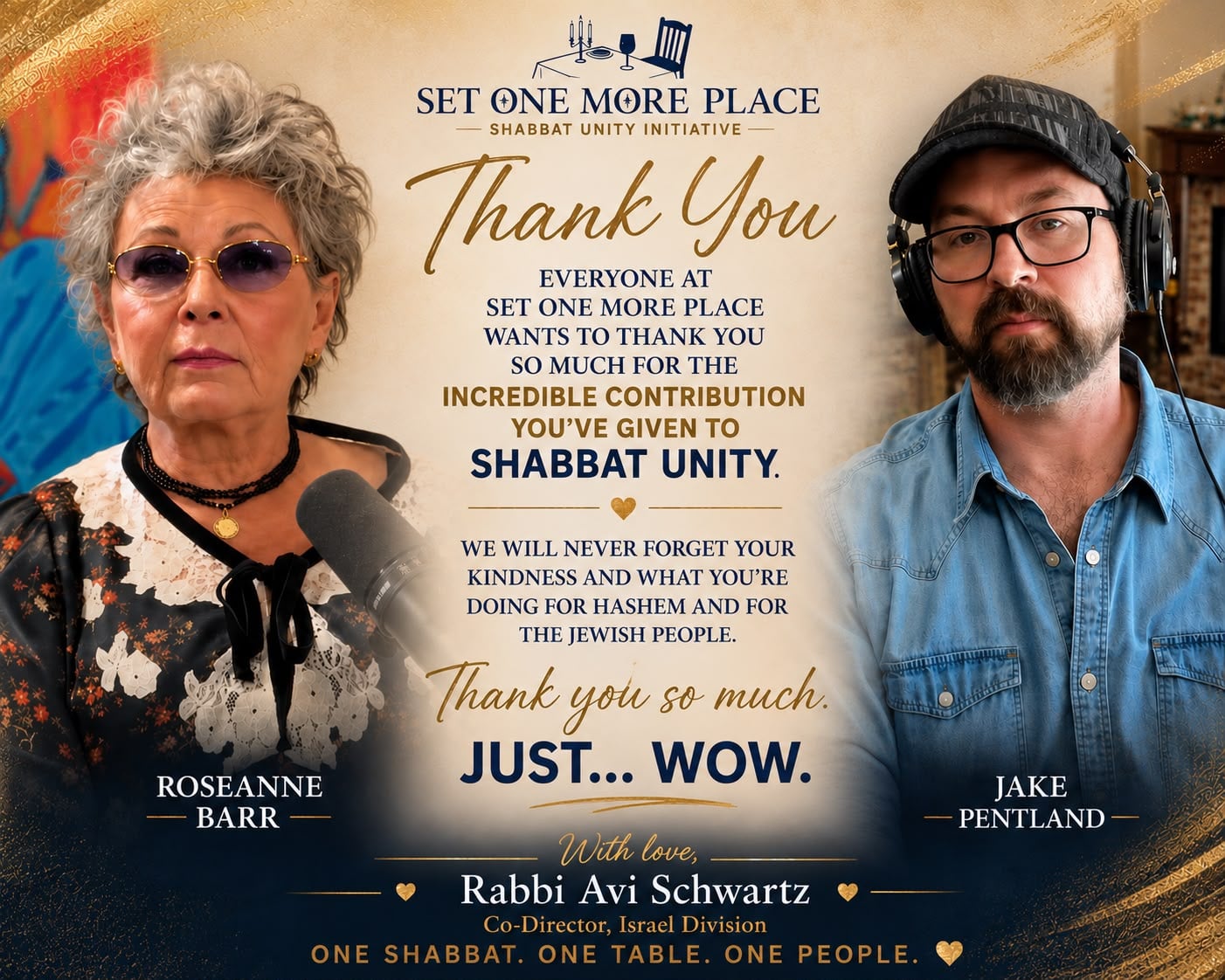
Legendary actress and comedian Roseanne Barr, together with her son, Jake Pentland, joined the initiative. Together they recorded a heartfelt message encouraging Jews everywhere to strengthen the bonds that unite us through Shabbat.
The response was extraordinary.
Their video has now generated nearly 50,000 views, including more than 47,000 views on Facebook alone, along with almost 6,000 positive engagements. Thousands have watched it (click here to watch), shared it with family and friends, commented on its message, and encouraged others to participate. Other campaign videos featuring respected public figures and community leaders have likewise inspired thousands more, demonstrating the growing desire among Jews to reconnect through the simple, timeless act of sharing a Shabbat table.
Of course, social media numbers are gratifying.
But they are not the real story.
The real story is what those numbers revealed.
They revealed something many of us had almost forgotten.
The Jewish people are longing for one another.
After years of political tension, social division, the trauma of October 7, the ongoing war, rising antisemitism around the world, and endless arguments within our own communities, something remarkable became clear.
People want to reconnect.
They want to sit around the same Shabbat table.
They want to talk.
They want to listen.
They want to laugh together.
They want to sing together.
They want to rediscover that before we are religious or secular, left or right, Ashkenazi or Sephardi, Israeli or American, we are first and foremost members of one extraordinary family.
Perhaps that is why the campaign resonated so deeply.
It did not ask anyone to change their beliefs.
It did not ask anyone to compromise their principles.
It simply invited Jews to share a meal.
Sometimes the simplest invitation reaches the deepest part of the human soul.
Roseanne Barr and Jake Pentland became instruments for delivering that invitation to tens of thousands of people. Their participation mattered not merely because they are well-known personalities, but because they helped carry a message whose time had come. They became messengers for a longing that already existed within the Jewish people.
The campaign did not create the desire for unity.
It uncovered it.
Every encouraging comment, every share, every invitation extended to another Jew suggested the same truth: beneath the noise of public debate lies a deep yearning to reconnect with one another.
That may be the greatest lesson of the Shabbat Nachamu Unity Initiative.
The Jewish people have never lacked passion.
We have never lacked conviction.
What we sometimes lack are opportunities to encounter one another as family instead of as opponents.
A Shabbat table changes that.
Around challah, wine, and conversation, labels begin to fade.
Strangers become guests.
Guests become friends.
Friends become family.
For thousands of years, the Jewish home has been the place where our people renewed themselves, one generation after another. Long before there were governments, political parties, or social media, there was the Shabbat table.
Perhaps that is where our healing begins once again.
If nearly 50,000 people were inspired by a simple invitation to Jewish unity, imagine what could happen if tens of thousands of Jewish families each set one more place at their Shabbat table.
The future of the Jewish people will not be built only in the Knesset, on television, or on social media.
It will also be built in our homes.
One invitation.
One extra chair.
One Shabbat.
One Jewish people.
As we discovered during this initiative, the longing has always been there.
All that was missing was someone willing to say:
“Come join us for Shabbat.”
And perhaps that is the greatest lesson of all.
Shabbat Nachamu should not remain only one special Shabbat each year. If opening one more place at the table can touch tens of thousands of hearts, imagine what could happen if we made it part of our lives—not once a year, but once a month, or even more often.
The Jewish people are waiting to reconnect.
All it takes is one more invitation, one more chair, and one more Shabbat together.
To learn more about the initiative, visit www.SetOneMorePlace.com.
While you’re there, listen to the movement’s two official theme songs—one in English and one in Hebrew—and consider making your next Shabbat table the place where one more connection begins.