
Middle East Analyst
Netanyahu, Eisenkot and the Question of Striking Iran Now
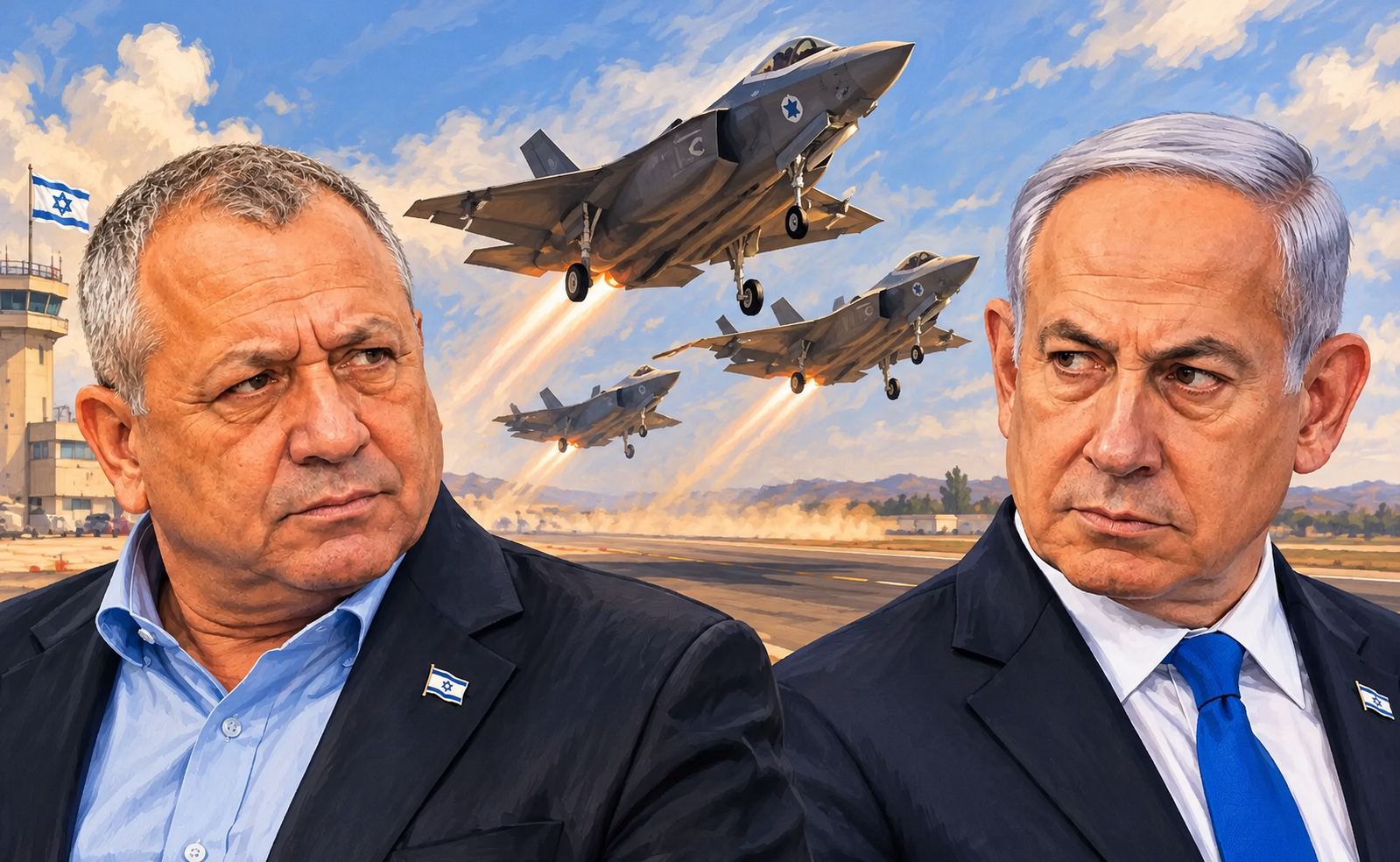
by author (AI)
Israel’s political debate over another military confrontation with Iran is about more than the country’s continuing security concerns. It is also about timing, military readiness, American political support, regional stability and the economic consequences of another escalation. Those considerations are increasingly important as Gadi Eisenkot attempts to form a government and Benjamin Netanyahu continues to advocate a more aggressive approach toward Tehran.
The disagreement is often presented as a choice between Netanyahu’s determination to eliminate the Iranian threat and Eisenkot’s more cautious approach. That is an incomplete characterization. Eisenkot does not dismiss the Iranian nuclear threat, nor does he argue that Israel should abandon its efforts to prevent Iran from acquiring nuclear weapons. His argument is essentially about whether another military operation is necessary now, what it would accomplish and whether its consequences could outweigh its benefits.
The distinction matters because Israel is not making this decision in isolation. The United States, which provided essential military support during the previous conflict, faces significant constraints of its own. Those constraints could make another campaign substantially more difficult to sustain.
The Continuing Iranian Nuclear Threat
There is little disagreement that Iran’s nuclear capabilities have not been eliminated. Following Operation Midnight Hammer in June 2025, President Donald Trump, Defense Secretary Pete Hegseth and Netanyahu publicly described Iran’s principal nuclear facilities as obliterated. The administration subsequently characterized the operation as having effectively eliminated Iran’s nuclear program.
The military strikes inflicted substantial damage, but subsequent assessments were considerably more complicated. A preliminary Defense Intelligence Agency assessment reportedly estimated that Iran’s nuclear program had been set back by several months. Other American and Israeli assessments described more extensive damage and a longer setback. None established that Iran’s nuclear expertise, capabilities and ambitions had disappeared.
One particularly important unresolved issue is Iran’s approximately 400 kilograms of uranium enriched to 60 percent. The International Atomic Energy Agency has been unable to verify the stockpile’s present location and condition. Trump previously insisted that the uranium had not been moved before the American strikes and was buried beneath thousands of tons of rock and rubble. He suggested that recovering it would be extremely difficult. That explanation now presents the administration with a credibility problem. If the uranium remains buried and inaccessible, what has changed to make it an immediate threat? If Iran has recovered access to it, or has begun moving or processing it, what intelligence supports that conclusion? The administration needs to distinguish between the continuing existence of a dangerous nuclear stockpile and evidence that Iran is preparing to use it or rapidly resume enrichment.
Eisenkot has identified the unaccounted-for uranium as a major concern. His position is not that the problem can be ignored. It is that the existence of the stockpile does not automatically establish the need for another immediate military campaign.
The Unanswered Questions About Operation Epic Fury
There is another question the Trump administration has not adequately addressed. When Operation Epic Fury began on February 28, 2026, the opening attacks concentrated on Iranian leadership, conventional military capabilities and missile infrastructure. Iran’s principal enrichment facilities were not the focus of the initial strikes.
Subsequent attacks affected some nuclear-related infrastructure, including entrances to facilities at Natanz. There may have been legitimate operational reasons for not immediately attacking the principal enrichment sites. They may have been inaccessible, already severely damaged or considered less urgent than eliminating Iran’s ability to retaliate. But the administration has not provided a sufficiently clear public explanation.
If Iran represented an imminent nuclear threat requiring another major military operation, why were its principal surviving enrichment facilities not the priority during the opening phase? There is an important distinction between preventing Iran from eventually rebuilding its nuclear capabilities and responding to an imminent nuclear emergency. The administration has not convincingly explained where the situation falls on that spectrum. That distinction is central to the argument Trump would have to make to justify another escalation.
Israel’s Own Military Intelligence Concerns
The disagreement is not confined to politicians. According to November 22 reporting by Israel’s Channel 12, military intelligence officials warned Netanyahu that another attack on Iran could trigger a wider regional conflict involving Lebanon, Syria and Gaza. The reported assessment challenged expectations that another operation could be limited to three to five days. Military intelligence reportedly warned that the consequences could be considerably more extensive. This is important because the assumption that Israel can conduct another short, relatively contained operation without triggering a broader confrontation is far from assured.
Former Mossad director David Barnea has publicly advocated preparing for another war, arguing that Iran’s nuclear ambitions remain unchanged and that the regime cannot be trusted to abandon them. His position provides support for Netanyahu’s strategic concerns. But Barnea’s argument that Israel must remain prepared to resume military action is not necessarily an endorsement of an immediate offensive campaign.
Eisenkot’s position is different. He recognizes the continuing threat but places greater emphasis on the operational consequences, the remaining nuclear material and the need to consider whether military action now would improve Israel’s long-term security. The distinction between these positions is not whether Iran is dangerous. It is whether another war, at this particular moment, is the appropriate response.
The American Military Constraint
One of the most important considerations is the condition of American military inventories. The United States has expended substantial quantities of high-demand munitions during the Iran conflict. These include long-range precision weapons, cruise missiles and missile-defense interceptors. The concern is not simply whether the United States retains enough weapons to conduct another initial strike. It is whether it can sustain a prolonged campaign while maintaining sufficient inventories for other contingencies, particularly in the Indo-Pacific.
There is also a defensive dimension. A shortage of THAAD, Patriot and naval missile-defense interceptors could increase the vulnerability of American forces, Israeli population centers and Gulf Arab allies to Iranian retaliation. An extended conflict would require Washington to balance offensive operations against the need to protect its regional partners and preserve military readiness elsewhere. Netanyahu may believe Israel can undertake another campaign, but Israel’s ability to sustain it would be affected by the availability of American military support. The United States might still provide intelligence, logistical assistance and defensive weapons without being prepared to participate in another extended offensive campaign. Those are very different commitments.
The Congressional Clock Is Running
Trump faces another problem that will become increasingly important in January. The November midterm elections have put Democrats in control of both chambers of Congress beginning in January. Democratic lawmakers have already signaled that they intend to use congressional funding authority to constrain further military operations against Iran. But the problem is not limited to the incoming Congress. The current Republican-controlled Congress is already facing disagreements over additional funding.
The November 23 Washington Post reporting on Senate discussions illustrates the problem. Some lawmakers are considering replenishing depleted Pentagon munitions while withholding funding specifically for continuing offensive operations against Iran. Senator Tim Kaine and other Democrats have also proposed restrictions on offensive military operations without congressional authorization, while preserving funding for the defense of American forces. The distinction is important. Congress could support restoring American military readiness while opposing another offensive campaign.
The president retains substantial authority over military operations, and a new Democratic majority would not automatically be able to terminate a conflict. But congressional control over appropriations provides considerable leverage. Trump therefore cannot assume that he will receive whatever additional funding he requests, particularly after January.
This creates an unusual strategic window. If he delays another offensive campaign, he will face a Congress more inclined to restrict it. If he acts before January, he still must contend with a Republican-controlled Congress that has not demonstrated that it can readily agree on additional war funding.
The Gulf Arab Allies and the Global Economy
Another military campaign would also place America’s Gulf Arab partners at greater risk. Iran has already demonstrated its ability to threaten energy infrastructure and commercial shipping beyond its immediate military targets. During the previous conflict, Saudi and Emirati oil exports suffered substantial disruptions. Kuwait and Iraq experienced even more severe interruptions, while Qatar’s LNG exports were affected.
The Strait of Hormuz remains particularly vulnerable. Approximately one-fifth of global petroleum consumption normally passes through it. Another escalation could threaten Saudi oil production and export facilities, Emirati infrastructure, Qatari LNG production and shipping throughout the Persian Gulf and Gulf of Oman. The economic consequences would extend well beyond the Middle East.
A renewed disruption could increase crude oil, gasoline and diesel prices. Higher diesel and transportation costs would affect agriculture, fertilizer distribution, food production and virtually every sector dependent on commercial transportation. Shipping insurance premiums and supply-chain costs could also increase. The resulting inflationary pressures would be particularly unwelcome for an American administration already facing domestic concerns about affordability. Iran does not have to defeat the United States or Israel militarily to impose significant strategic costs. Its ability to threaten shipping and energy infrastructure gives it leverage that cannot be measured simply by the number of Iranian military targets destroyed.
The American Public-Opinion Problem
Perhaps the most consequential political issue is whether Americans would support another military campaign if they perceived it as being driven primarily by Netanyahu. American support for Israel and American support for another war against Iran are not interchangeable. There is already evidence of increasing public dissatisfaction with the level of American support for Israel. Pew Research Center’s April 2026 survey found that 60 percent of Americans held an unfavorable view of Israel, while a Quinnipiac poll found that 55 percent of independents believed the United States was too supportive of Israel. These figures do not directly measure support for another war. They do, however, indicate a more difficult political environment in which to justify another major American military commitment.
The November 10 Reuters/Ipsos survey found that 71 percent of Americans wanted the new Congress to pass legislation ending Trump’s Iran war. Even among Republicans, 51 percent supported congressional action to end the conflict. That is a significant political warning. If Americans conclude that Netanyahu is pressing Trump to resume bombing while the United States absorbs the military costs, risks to American forces and economic consequences, the resulting backlash could further erode support for Israel.
Trump would need to make a compelling case that another escalation serves an identifiable American national security interest. So far, he has not adequately done so. His own previous statements have made that task more difficult. He, Hegseth and Netanyahu declared Iran’s nuclear program obliterated following Midnight Hammer. Trump subsequently described the enriched uranium as buried beneath rubble and effectively inaccessible. Now Americans are being asked to accept that Iran once again represents a sufficiently urgent nuclear threat to justify another major military commitment. The administration needs to explain what has changed.
It must also explain why the principal surviving nuclear facilities were not the priority during the opening phase of Operation Epic Fury if an imminent nuclear threat was the justification.Without credible answers, the argument that another campaign is necessary could become increasingly difficult to sell.
Eisenkot’s Political Challenge
All of these considerations intersect with Israel’s government-formation process. Eisenkot received the mandate to form a government on November 8. His initial period runs until December 6, with a possible two-week extension. If he cannot assemble a conventional majority, he has indicated that he is prepared to consider a minority government. That is not an uncomplicated alternative.
The opposition parties have 48 seats, while the Arab parties hold another 19. A minority government could potentially take office with outside support or abstentions, but its ability to govern and sustain parliamentary confidence would remain uncertain. The disagreements over military conscription, Arab-party participation and the inclusion of Likud make coalition negotiations difficult. A unity government under Eisenkot could provide broader political support, but Netanyahu’s insistence on remaining prime minister complicates that possibility.
The irony is that Netanyahu argues that Israel needs unity to confront Iran, while his own political demands have complicated the formation of such a government. There is also a question of national security governance. Should a caretaker prime minister without a parliamentary majority initiate another major military campaign while his successor is attempting to form a government? That is not simply a partisan question. It concerns the political authority and national consensus required for a decision that could have consequences lasting years.
The Strategic Question Is No Longer Simply Whether Iran Remains Dangerous
There is a legitimate argument that Iran’s nuclear ambitions remain a fundamental threat to Israel and potentially to the wider region. Neither Eisenkot nor the American administration should dismiss that reality. But recognizing a threat does not automatically determine the appropriate response, the timing of military action or the resources required to sustain it. Netanyahu’s strategic objective may be understandable, but the circumstances surrounding another military campaign are substantially more complicated.
The United States faces depleted military inventories, congressional funding constraints, the prospect of renewed threats to Gulf Arab infrastructure and an increasingly skeptical American public. Israel’s own military intelligence establishment has reportedly warned that another operation could produce a wider regional conflict than its political leadership anticipates.
Trump also faces a credibility problem created by his own declarations that Iran’s nuclear program was obliterated and its enriched uranium effectively buried.
If Netanyahu wants another American-supported campaign, the burden is on both leaders to explain what has changed, what another operation would accomplish and why the United States should accept the additional military, economic and political risks.
The central question is not whether Iran remains a threat. It is whether another war, initiated under these circumstances, would leave Israel, the United States and their regional partners more secure than they are today.
That is the question Eisenkot’s position raises, and it deserves an answer that goes beyond Netanyahu’s determination to finish the job.
Related Topics
Related Posts