
Netanyahu Is Not Putin and Israel’s War Is Not Russia’s
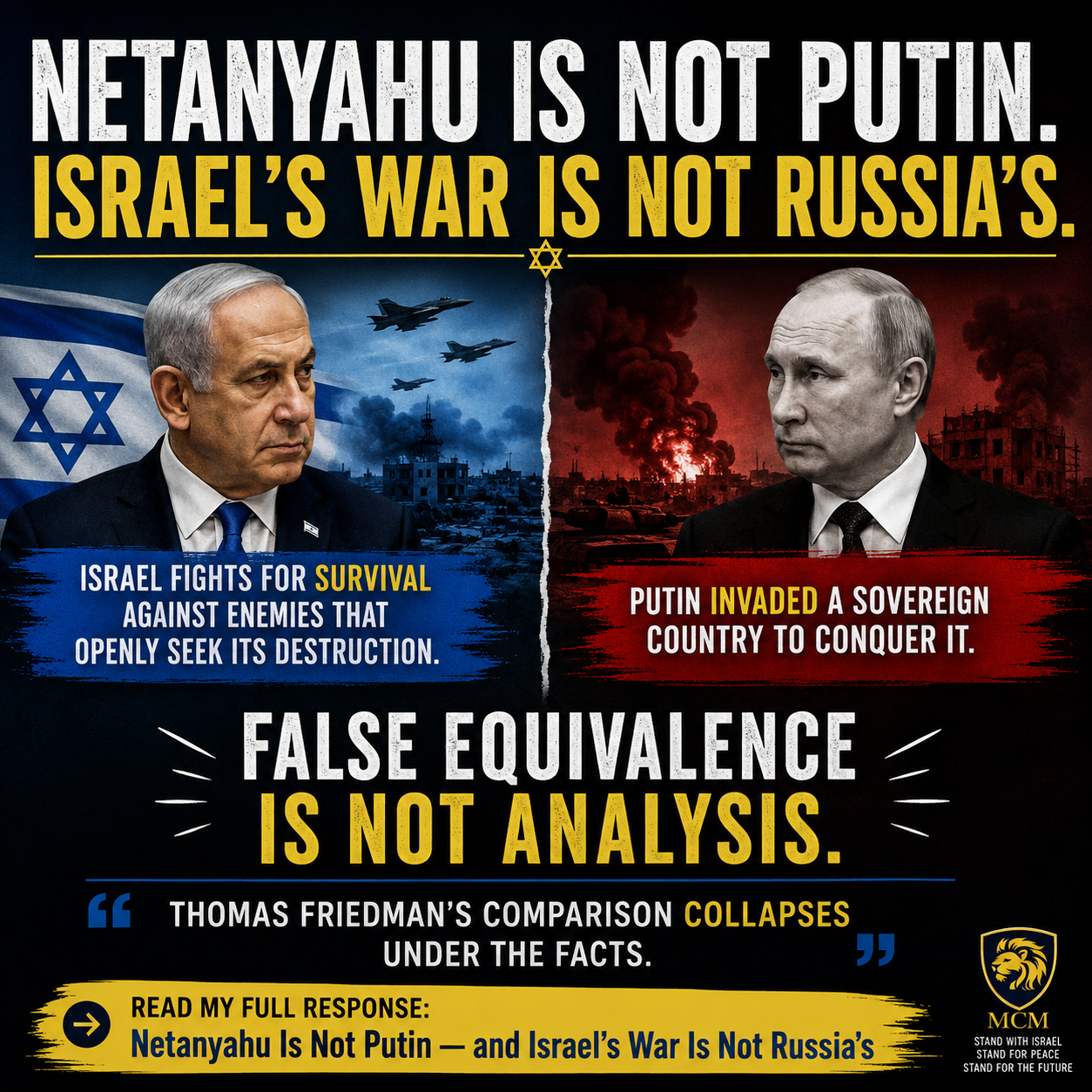
Thomas Friedman’s New York Times column comparing Benjamin Netanyahu, Donald Trump, and Vladimir Putin is forcefully written, but it is built around a false equivalence and a series of assumptions presented as established fact — especially when it comes to Israel’s prime minister.
Friedman places Netanyahu, Trump, and Putin in the same moral and strategic category. That may make for a dramatic opening, but it ignores the most important distinction. Putin invaded an independent country in an effort to conquer it. Israel has been confronting enemies that openly call for its destruction, arm terrorist organizations on its borders, and repeatedly attack Israeli civilians.
Whatever criticism one may have of Netanyahu, these are not comparable situations.
The column portrays Netanyahu as reckless, delusional, and intoxicated with power while treating Friedman’s interpretation of Israeli strategy as though it were proven fact. He assumes that Netanyahu believed one air campaign could neatly topple the Iranian regime and that Israel could simply choose Iran’s next leader. That is an extraordinary claim, and the public has not been shown enough evidence to treat Friedman’s version of events as settled history.
Even if Israeli officials discussed regime change, that does not mean it was Israel’s only objective or even its primary objective. Iran has spent decades building missiles, developing nuclear capabilities, financing Hamas and Hezbollah, and threatening Israel. Weakening those capabilities is a legitimate Israeli security goal whether or not the Iranian government collapses.
Friedman also gives Netanyahu little credit for the strategic environment he inherited. Israel did not invent Hamas, Hezbollah, Iran’s nuclear ambitions, or October 7. Netanyahu can be criticized for decisions made before and after the massacre, but it is dishonest to discuss his military strategy as though it emerged entirely from personal vanity rather than from genuine threats to the survival of the country he leads.
The comparison with Putin is especially misleading. Putin attacked Ukraine because he denied its right to exist independently. Netanyahu did not wake up one morning and decide to invade peaceful neighbors. Israel was attacked by Hamas, faced Hezbollah fire from Lebanon, and has lived under direct Iranian threats and proxy warfare for years.
Friedman argues that Netanyahu has won tactical victories but created no strategic change. That is his conclusion, not an established fact. Weakening Hamas, Hezbollah, Iran’s missile capacity, and Iran’s regional military network can alter the balance of power even if it does not immediately produce a peace agreement.
Strategic change does not always arrive in a neat package with a ceremony and a signed document.
Friedman also accuses Netanyahu of sacrificing normalization with Saudi Arabia, support among young Americans, relations with Democrats, and Israel’s judiciary in order to pursue annexation. That is a sweeping indictment, but the column treats motive as proof. Friedman assumes annexation explains Netanyahu’s actions and then uses that assumption to condemn him. He does not demonstrate that every Israeli military action in Gaza, Lebanon, or Iran was designed to advance annexation.
The discussion of Mossad has the same weakness. Friedman tells an engaging story about Israeli intelligence being good at assassination but poor at understanding societies. There may be value in that warning. Intelligence services can misread political realities. But one historical failure in Lebanon does not prove that every Israeli assessment of Iran is foolish. Nor does it prove that Netanyahu is incapable of understanding the consequences of military action.
The reported idea that Israel might support Mahmoud Ahmadinejad as part of a future Iranian transition is certainly startling. But reported discussions, anonymous accounts, and contingency planning are not the same as an adopted policy. Governments and intelligence agencies examine many possibilities, including bad ones. Friedman takes one reported scenario and turns it into a sweeping judgment about Netanyahu’s sanity and competence.
The article is also selective in how it assigns responsibility. Netanyahu is portrayed as the central source of instability, while Iran’s leaders, Hamas, Hezbollah, and other terrorist organizations appear largely as background characters until the end.
Iran has spent decades funding attacks on Israel, supporting armed proxies, repressing its own people, and threatening the destruction of the Jewish state. Hamas launched October 7. Hezbollah opened another front. Those facts are not side notes. They are the context in which Netanyahu — and every Israeli prime minister — must make decisions.
That does not mean every decision Netanyahu makes is correct. He should be challenged. His conduct should be scrutinized. Israelis themselves have fiercely debated his leadership, his coalition, the hostage crisis, the judiciary, and the war.
But scrutiny is not the same as caricature.
Friedman reduces Netanyahu to a vain man surrounded by sycophants who is now trapped in a war of his own making. That description leaves out the attacks Israel endured, the enemies surrounding it, the hostages, and the possibility that some of Israel’s military actions prevented even greater threats.
The column’s central image is that Netanyahu, Trump, and Putin must all eventually eat a “plate of crow.” It is clever writing.
But clever writing is not proof.
Netanyahu may have made mistakes. He may have miscalculated. But Friedman does not establish that Israel’s war against Hamas, Hezbollah, or Iran is equivalent to Putin’s war of conquest. He does not prove that Netanyahu’s strategy was based only on arrogance. And he does not adequately confront the possibility that Israel’s enemies — not Netanyahu alone — created the wars Israel is now fighting.
This is a powerful opinion column, but it is still an opinion column. It presents speculation as certainty, motive as evidence, and false equivalence as analysis.
I do not accept that framing of Prime Minister Netanyahu, and I do not accept the attempt to place Israel’s defense against enemies seeking its destruction in the same category as Russia’s invasion of Ukraine.