


Netanyahu Refuses To Take Yes for an Answer
Following the June 1967 war and Israel’s capture of the West Bank, Gaza Strip, and Golan Heights, Foreign Minister Abba Eban stated that “everything is negotiable,” and Defense Minister Moshe Dayan announced that “Israel is waiting for a phone call from the Arabs.” Instead of placing a phone call to Prime Minister Levi Eshkol, however, eight Arab heads of state convened an Arab League summit in Khartoum which ended with the passage of a resolution that said no to peace with Israel, no to recognition of Israel, and no to negotiations with Israel. A handful of analysts struggled to find a silver lining and claimed that the beginnings of a willingness to engage in some form of political process could be found in what the declaration did not say, but overall the Khartoum resolution came to be known as “the 3 noes.”
Unsurprisingly, the Israeli leadership at the time reacted by digging in its heels, accusing the League of acting irresponsibly and vowing to stand up to Israel’s enemies who seek “to undermine her security and act against her sovereignty and her very existence.”
On September 12, the UN General Assembly (UNGA) adopted a resolution endorsing the New York Declaration, which calls for “a just, peaceful and lasting settlement of the Israeli-Palestinian conflict based on the effective implementation of the Two-State solution.” Almost 60 years after Khartoum, 142 countries, including the entire Arab League, said yes to peace with Israel, yes to recognition of Israel, and yes to negotiations with Israel. Based on the Israeli Foreign Ministry reaction, however, which called the UNGA “a political circus detached from reality,” one might think that the applause that reverberated from the Assembly Hall marked a resounding nay rather than an exuberant yay.
Plan for a New Middle East
Before examining the broader aspects of the Declaration, one should note that it contains those same objectives that the Israeli Government claims to be pursuing in its war on Gaza: the release of all living hostages and return of all remains and an end to Hamas rule in Gaza and its disarmament. But it goes much further, laying out a plan for a new Middle East into which Israel would be fully integrated. It outlines a “comprehensive and actionable framework” for a peaceful resolution of the Israel-Palestine conflict with proposals that address its “political, security, humanitarian, economic, legal, and strategic narrative dimensions.” It speaks of programs to combat radicalization, international security guarantees, and a regional security architecture. It speaks of resolving all final-status issues and of ending all claims, a sticking point in previous negotiations. It speaks of a regional and international framework that would provide appropriate support to resolve the refugee question. These are just a few of the highlights. What, then, brought Finance Minister Bezalel Smotrich to call it “a diplomatic attack on Israel?”
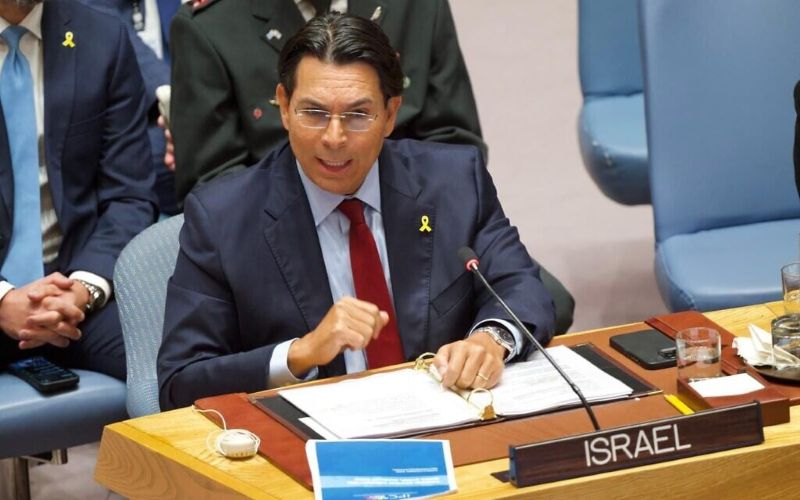
The answer is simple. Instead of being a “one-sided Declaration [that] will not be remembered as a step toward peace,” as described by Danny Danon, Israeli ambassador to the UN, it is precisely the opposite. The Declaration is as even-handed as it can be, demanding an end to violence against civilians on both sides, noting the need to guarantee the security of both peoples, calling for the creation of a culture of peace on both sides, calling for both sides to ensure that their respective political parties adhere to the principles of nonviolence and mutual recognition, and committing the signatories to take tangible steps to promote mutual recognition, peaceful coexistence, and cooperation among all the regional states.
Earlier Tolerance for a Quasi-State
The balance demonstrated by the international community in invoking the rights of both sides and holding both accountable was enough to get the Israeli leadership’s knickers in a twist. After all, they see putting the mighty and righteous State of Israel on a par with “Hamastan” and “Fatahstan” (Prime Minister Netanyahu’s epithets for the Gaza Strip and West Bank) as evidence that the signatories “turn a blind eye” to terrorists or try to appease them, as Danon said when the Declaration was published in July.
Nonetheless, Netanyahu might have been able to stomach the notions of mutuality, reciprocity, cooperation, and coexistence had they rested on the establishment of a quasi-Palestinian state as proposed in the first Trump administration’s Peace to Prosperity plan in 2020. That plan envisioned a Palestinian “state” consisting of fragmented areas of land overseen by a government that would be under Israel’s thumb. The notion of sovereignty was described as flexible, and the aim was said to be to maximize rather than realize self-determination for the Palestinians. No wonder Netanyahu applauded Trump for charting “a brilliant future” by presenting “a realistic path to a durable peace.” Of course, that was long before October 7.
Netanyahu delivered a very different message to French President Emmanuel Macron who, together with Saudi Crown Prince Mohammed bin Salman, was responsible for initiating the process that led to the New York Declaration. In a letter to Macron on August 19, Netanyahu accused him of nothing less than fueling the fire of antisemitism and had the audacity to demand that he “replace weakness with action” by September 23, which marks the Jewish New Year.
Peaceful Settlement for Jews Only
So what is it about the New York Declaration that has Netanyahu berating the French president and Smotrich calling for immediate annexation of the West Bank? Anyone who keeps up with current affairs knows that I’ve buried the lead. The Declaration adopted by the UNGA announces its commitment “to achieve, through concrete actions, as rapidly as possible, the realization of an independent, sovereign, economically viable and democratic State of Palestine.” As far as the Israeli Government is concerned, that sentence, which ends with the phrase “living side by side, in peace and security with Israel, thus enabling full regional integration and mutual recognition,” might as well have ended with the phrase “living by the sword until the last surviving Jew is driven into the sea.”
It is worth noting that the full name of the document is “New York Declaration on the Peaceful Settlement (author’s emphasis) of the Question of Palestine and the Implementation of the Two-State Solution.” After two years of flattening Gaza and striking at anything that moves, after two years in which the cover of the war on Gaza has been exploited by extremist settlers to advance ethnic cleansing of the West Bank, after two years of Netanyahu torpedoing every ceasefire arrangement that had a chance of success, there is no doubt that the peaceful settlement he’s looking for is one in which the Jewish people have exercised their “exclusive and indisputable right to all parts of the Land of Israel,” as stated in the coalition government’s guiding principles.
Recognition Will Be Hollow Without Action
On September 22, the world will witness what could be one of the most dramatic moments in the history of the Israel-Palestine conflict when approximately a dozen countries will announce their recognition of the State of Palestine. “Could be,” because the announcement will prove to be hollow if it is not quickly followed by the concrete actions the world Assembly vowed to take.
It remains to be seen what Draconian measures the Israeli Government will take in response, but it is likely that Netanyahu’s recent call to the Israeli people to prepare to be super-Sparta in the face of growing international economic isolation will be equally applicable to Israel’s diplomatic standing. My heart constricts at the thought of how many lives will be lost as a result of… corruption? greed? megalomania? messianism? I also ask myself how much longer the government will be in the hands of self-seeking politicians to whom the yeses of New York are no different from the noes of Khartoum.