
Writing on Jewish life, relationships, trauma, and resilience
Netanyahu, Trump, and the Shadow of Munich
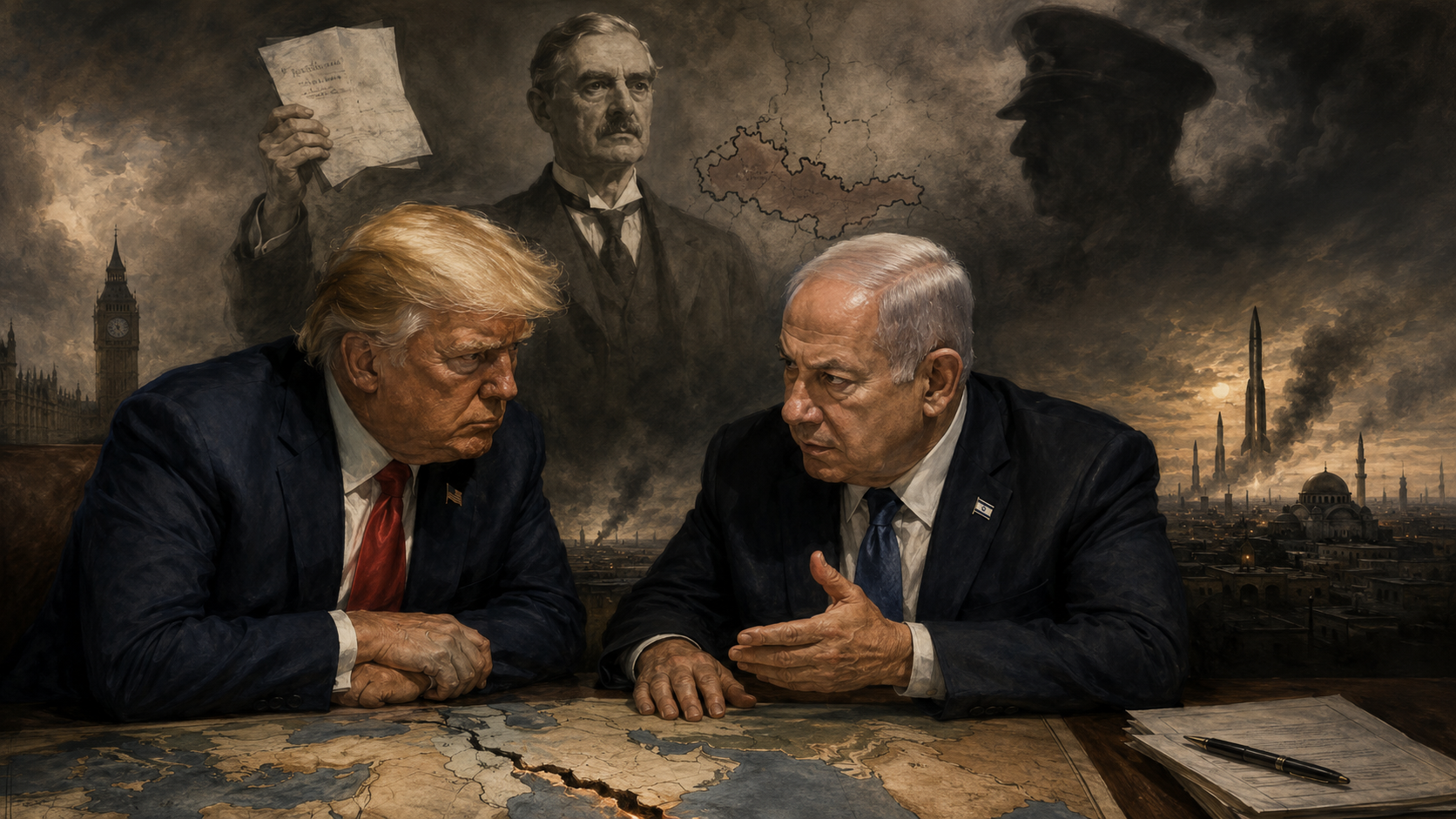
Illustrative: AI image created by the author.
There are moments in history when diplomacy is not the opposite of war, but the prelude to something worse.
That is the fear many Israelis now feel as President Donald Trump presses toward an agreement with Iran while warning Prime Minister Benjamin Netanyahu not to take actions that could derail it. Recent reporting from Washington, Jerusalem, and the region has sharpened those fears, particularly accounts that Trump warned Netanyahu against escalation and that US pressure affected Israeli operational planning. The concern is not merely a personal clash between two leaders. It is a strategic gap between American political urgency and Israeli security reality.
For Trump, a deal with Iran could mean reopening the Strait of Hormuz, easing pressure on energy prices, calming financial markets, and claiming a foreign policy victory at home.
For Israel, the question is more existential: Will such a deal actually prevent Iran from becoming a nuclear power, or will it purchase a pause while Tehran regroups, refills its coffers, rebuilds its proxies, and waits?
That is why Munich is being invoked in Israel — not as a perfect historical parallel, but as a warning about what happens when aggressive regimes read concessions as weakness.
The lesson of Munich
No historical comparison is exact. Iran is not Nazi Germany. Trump is not Neville Chamberlain. Netanyahu is not Winston Churchill. History does not repeat itself so neatly, and used carelessly, Munich becomes a cliché. Used carefully, it remains a warning.
The lesson of Munich is not that every negotiation is appeasement. That would be foolish. Diplomacy, when backed by strength, verification, and consequences, can prevent war. But the lesson is that when aggressive regimes interpret concessions as weakness, the cost of postponed peace can become catastrophic.
In 1938, Chamberlain accepted Hitler’s demand for the Sudetenland in the belief that sacrificing part of Czechoslovakia would satisfy Germany’s ambitions and preserve peace. It did neither. The agreement did not moderate Hitler. It emboldened him. The price was not paid only by Czechoslovakia, but eventually by Europe and the world.
The point is not that Iran is Hitler’s Germany. The point is that a signed document is not the same thing as a changed strategic reality.
That is the anxiety many Israelis feel today when they hear that an emerging Iran deal may be sold as a diplomatic breakthrough while leaving Iran’s regime intact, its proxy network active, and its long-term nuclear ambitions only partially restrained.
America’s interests and Israel’s reality
Vice President JD Vance described the emerging Iran deal in a Fox News interview as a “home run for the American people,” adding that Israel “may like that, they may not like that,” but that Washington would act in America’s interest.
That is a legitimate statement of American sovereignty. But Israelis are entitled to hear it clearly: the United States and Israel have overlapping interests, not identical ones.
America can decide that a temporary deal is good enough. Israel has to live next door to the consequences.
That is the heart of Netanyahu’s dilemma. He cannot afford to break with the American president. The United States remains Israel’s indispensable ally, its diplomatic shield, and its most important strategic partner. But Netanyahu also cannot allow Israel to become a passive spectator while Washington negotiates terms with Tehran that could define Israel’s security environment for a generation.
Netanyahu’s challenge is not merely to oppose a bad deal. It is to keep Trump close without allowing Israel’s security to be subordinated to Trump’s domestic political needs.
That is a narrow bridge, and there is no handrail.
The Washington Post has framed the political bind sharply: Netanyahu once found ways to maneuver around US pressure by exploiting divisions in Washington. But Trump’s hold on the Republican Party leaves him with few places to turn, while Democrats have little sympathy for him.
In plain English, the old playbook is gone.
Netanyahu cannot go around Trump. He has to go through him.
The case for serious diplomacy
The case for diplomacy is not foolish. A verifiable agreement that halts high-level enrichment, restores intrusive inspections, imposes automatic penalties for violations, reduces regional escalation, and prevents a wider war would serve both American and Israeli interests.
Supporters of a deal can fairly argue that military action may only delay Iran’s program while triggering a regional war. That argument deserves to be taken seriously. No Israeli leader should treat war as a first resort, and no American president should be mocked for trying to avoid one.
But that argument only holds if the agreement imposes delays, inspections, and penalties strong enough to change Iran’s cost-benefit calculation.
The danger lies not in negotiation itself, but in mistaking a signed document for a changed reality.
A serious agreement would dismantle, not merely pause, Iran’s path to a bomb. It would include intrusive inspections, strict limits on enrichment, clear restrictions on weaponization research, and meaningful penalties for violations. It would tie economic relief to verified performance, not promises. It would restore free navigation through the Strait of Hormuz without ransom, “fees,” or Iranian veto power over global commerce.
And it would recognize that Iran’s nuclear program and its proxy warfare are not separate problems. They are parts of one strategy. Tehran uses Hezbollah, the Houthis, militias in Iraq, and other armed extensions to pressure Israel, threaten US interests, destabilize Arab states, and raise the cost of confronting Iran directly.
Any serious agreement must therefore account not only for centrifuges, but also for rockets, drones, funding, training, and command networks.
An agreement that addresses centrifuges while ignoring rockets is not a strategy.
It is a loophole with a press release.
What Netanyahu should say to Trump
Netanyahu’s message to Trump should be clear, private, and disciplined:
Mr. President, Israel welcomes diplomacy that removes the threat. We cannot accept diplomacy that repackages the threat.
That sentence should be the center of Israel’s approach.
It means no front-loaded sanctions relief. No inspection gaps. No tolerance for covert weaponization work. No access to frozen funds without verified compliance. No side understanding that restrains Israeli self-defense against Iranian proxies.
Netanyahu should not humiliate Trump. That would be reckless. Nor should he appear to manipulate him. With Trump, policy and pride are never far apart. The relationship is not only about interests; it is also about optics, loyalty, dominance, and ego. Any analysis that ignores those personal dynamics misunderstands how this relationship functions.
But Netanyahu also cannot allow Trump to believe that Israel will accept any agreement simply because Washington needs one.
The proper posture is neither defiance for its own sake nor obedience dressed up as friendship. It is sober coordination with unmistakable red lines.
No surprises. No public ego contest. No empty threats. No theatrical brinkmanship.
Israel should make clear in advance what it cannot live with: an Iran allowed to retain a rapid path to nuclear breakout; sanctions relief before verified compliance; frozen assets released without dismantling terror infrastructure; and any agreement that effectively shields Hezbollah by making Israeli self-defense in Lebanon a violation of a broader US-Iran understanding.
These are not Israeli preferences. They are survival concerns.
The danger of a Chamberlain-like deal
A Chamberlain-like agreement would have several warning signs: vague promises from Iran, delayed inspections, weak enforcement, sanctions relief up front, access to frozen funds, and no serious restraint on Hezbollah, the Houthis, or Iran’s other armed extensions.
Such a deal would not end the conflict.
It would finance the next phase.
It would tell Iran that pressure works. Close the Strait of Hormuz, fire through proxies, threaten escalation, wait for oil prices and election calendars to do their work, and eventually the West will call retreat “de-escalation.”
That is not peace. That is bargaining with a stopwatch held by the aggressor.
A serious agreement would send the opposite message: benefits follow verified change. Sanctions relief follows compliance. International legitimacy follows altered behavior. Iran does not get paid in advance for promises it has every incentive to reinterpret later.
Negotiation says: prove you have changed, and benefits will follow.
Appeasement says: take the benefits now, and we will hope you change later.
The Jewish people have some experience with the cost of “later.”
Speaking honestly to Israelis
Netanyahu also needs to speak differently to Israelis. He should not pretend there is no tension with Washington. Israelis can read. They do not need bedtime stories about perfect harmony between allies.
They need sober leadership that says: America is our closest friend; friends sometimes disagree; Israel will coordinate whenever possible and act alone only when necessary.
That is not weakness. That is adulthood.
Nor should Netanyahu allow his coalition partners to define sovereignty as the loudest possible insult to Washington. Sovereignty is not a performance. It is judgment. Sometimes standing firm means striking. Sometimes it means waiting. Sometimes it means absorbing a public insult from an ally while quietly preserving the freedom to act tomorrow.
Trump’s domestic incentives are not the only political danger. Netanyahu, too, may face pressure to appear defiant, decisive, or indispensable. Serious Israeli strategy requires resisting both American impatience and Israeli theatrics.
That makes this moment dangerous. Not because diplomacy is bad, but because bad diplomacy can be worse than no diplomacy if it teaches Tehran that pressure works, patience pays, and the West can be worn down by oil prices, elections, and exhaustion.
The question Munich leaves us
The Munich analogy should not be used as a slogan to shut down debate. It should be used as a warning to sharpen it.
The question is not whether America and Iran can produce a signed document. Chamberlain produced a signed document. The question is whether the agreement changes the behavior and capabilities of the aggressive regime, or merely changes the headlines.
Israel cannot demand that America adopt every Israeli preference. But neither should America demand that Israel outsource its survival to wishful thinking.
Netanyahu’s task now is to keep Trump close without becoming subordinate to him, to support diplomacy without surrendering deterrence, and to remind Washington that peace is not made by giving dangerous regimes time, money, and legitimacy in exchange for temporary quiet.
Israel should not be reckless. It should not seek war. It should not humiliate its closest ally. But it must be clear-eyed.
If a deal with Iran prevents a nuclear threat and weakens Tehran’s war machine, Israel should welcome it.
If it merely gives the regime breathing room while tying Israel’s hands, then it is not peace.
It would not be Munich in every detail.
But it would repeat Munich’s fatal illusion: that an aggressive regime has changed because a document says so.
And Israel cannot afford to mistake the document for the lesson.
Related Topics