
Strategic Intelligence Consultant & Insights Advisor
Netanyahu’s Iran War: The Strategic Paradox of Victory Without Resolution
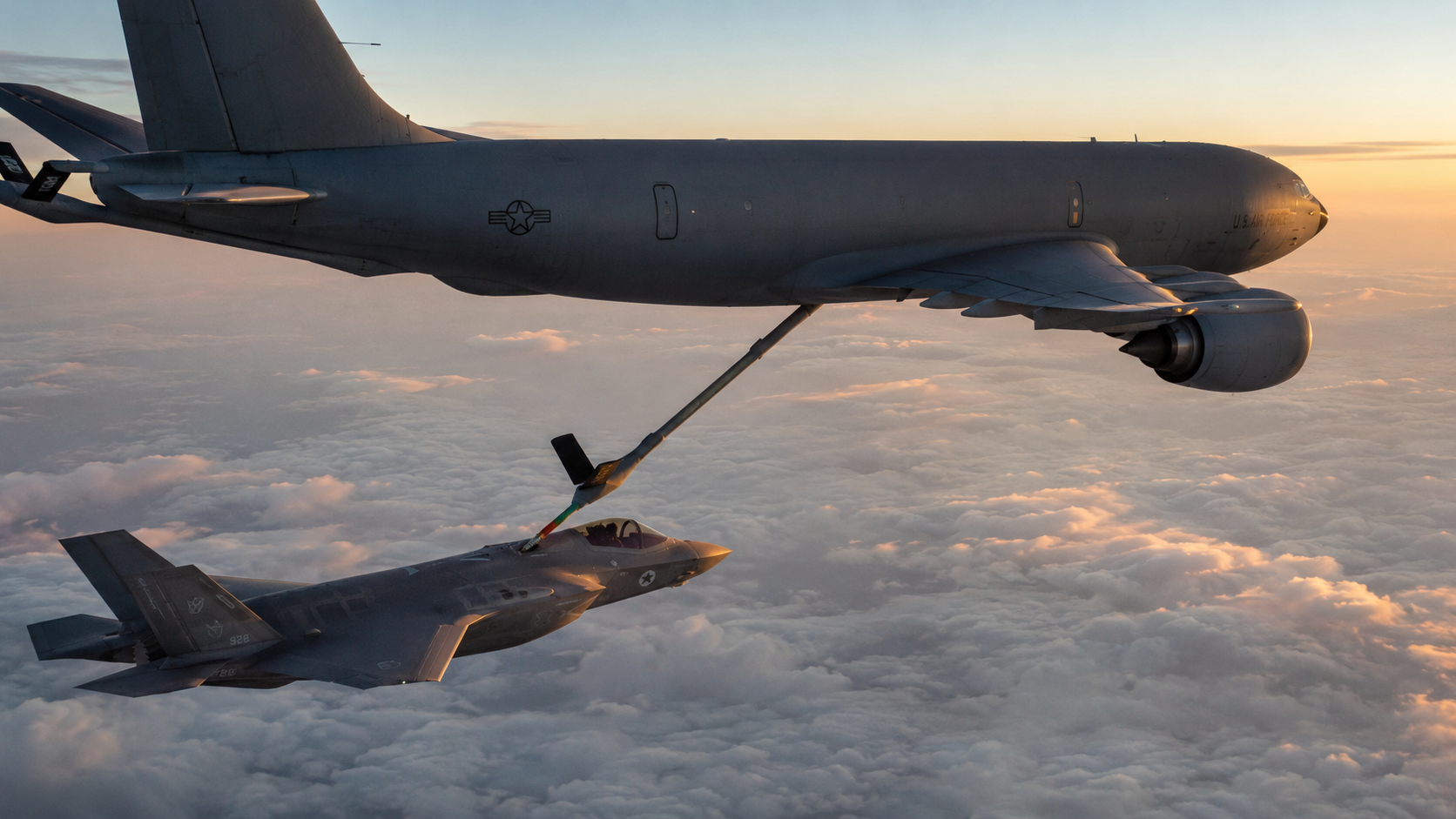
Israeli f 35 refueling (free for use - source AI)
Israel has shown extraordinary military reach. But the harder question is whether operational success has produced a durable strategic outcome — in Iran, Lebanon, or at home.
For nearly three decades, Benjamin Netanyahu has organized his political identity around a single conviction: that Iran represents the central threat to Israel’s existence, and that confronting it is the defining task of his generation. From his first term in 1996, through years of warnings at the United Nations and in Washington, the Iranian nuclear program and its network of regional proxies formed the spine of his strategic worldview. He has now, in a sense, achieved what he long sought — a direct confrontation with Tehran, conducted in unprecedented operational partnership with the United States.
And yet the outcome appears strikingly ambiguous. Israel may have demonstrated military reach and operational excellence of a kind few thought possible. But demonstration is not the same as resolution. Across each front — Iran, Hezbollah, the United States, and Israel’s own fractured politics — the same paradox recurs: tactical success has not translated automatically into strategic victory.
A military achievement that is real
It would be a mistake to underplay what Israel has accomplished. The campaign against Iran saw American and Israeli aircraft flying together, refueling one another, dividing targets and coordinating intelligence in ways that, only a short time ago, seemed implausible. This was not the posture of a weak or isolated state. It was the projection of formidable capability, reach, and political alignment with the world’s pre-eminent power.
The record against Hezbollah is similarly substantial. Israel has eliminated Hassan Nasrallah, his successor, and that successor’s successor, along with thousands of operatives. It has destroyed significant infrastructure across southern Lebanon, the Bekaa Valley, and the Dahiyah quarter of Beirut. The pager and walkie-talkie operations of late 2024 stand as case studies in intelligence penetration and operational daring. Whatever else may be said, Israel has shown it can strike deep and impose extraordinary costs.
The question the achievement does not answer
The difficulty is that none of this settles the strategic question. Did the war permanently degrade Iran’s nuclear and military capability, or merely set it back? Did it alter Tehran’s regional behavior, or simply interrupt it? Did it reduce the long-term threat from Hezbollah, or buy a pause? Did it restore Israel’s freedom of action, or constrain it in new ways?
These questions are genuinely open, and the honest position is to treat them as such. Military achievement raises the strategic bar; it does not clear it. The most consequential outcomes of a war are frequently invisible at its conclusion, becoming clear only in the political order — or disorder — that follows.
Hezbollah and Lebanon: the test case
Nowhere is the paradox sharper than in Lebanon. Israel has degraded Hezbollah, killed its leadership, and pushed deeper into the south than at any point in a generation, retaking even the iconic Beaufort ridge — a site held from 1982 until the withdrawal of 2000. The recapture was celebrated domestically as a landmark. Seen more soberly, it looks largely symbolic. The high ground offers tactical advantages, but Beaufort long ago ceased to be an emblem of triumph; for many Israelis it is a reminder of the Lebanese quagmire and the difficulty of leaving it.
The deeper point is that Hezbollah has survived nearly three years of war. It can still fire rockets into northern Israel. It can still deploy first-person-view drones with lethal effect against Israeli soldiers. These are cheap, often assembled from commercial components, flown low with negligible radar signature, and increasingly guided by fibre-optic cable that renders electronic jamming useless. Israel was slow to grasp the severity of a threat already proven in Ukraine, and is now improvising layered countermeasures — fishing nets, barbed wire, shotguns, AI-assisted fire-control optics. The casualties remain small in number, but their societal impact is disproportionate. A tactical weapon has become a strategic problem, eroding public understanding of why Israeli soldiers are in southern Lebanon at all.
The reason Hezbollah endures is not principally military. It is embedded in Lebanese society, represented in parliament and government — far more than a guerrilla faction. Short of occupying the whole country, which Israel neither wants nor can sustain, there is no military path to its elimination. The experience of Gaza, where full territorial control did not destroy a smaller and weaker organization, is instructive. Defeating Hezbollah is ultimately a political problem, and the actor best placed to address it — the Lebanese state — has been allowed, in effect, a pass. No one with leverage is telling Beirut to take responsibility, and a society scarred by civil war shows little appetite to confront the group itself.
Iran’s strategic linkage
This is where Tehran’s design becomes visible. Iran appears to have linked the Lebanon front to its wider confrontation with Washington, conditioning any extension of its own ceasefire with the United States on a parallel halt in Lebanon. Reading Donald Trump’s evident desire for a deal, Iran was able to convert that desire into pressure on Israel to stop — and Israel, in effect, stopped.
If accurate, this represents a considerable success for Tehran, and arguably for Hezbollah, achieved not through battlefield victory but through survival, leverage, and the manipulation of time. A ceasefire shaped by Iran allows Hezbollah to rebuild, rearm, and resupply — potentially funded by the very billions a future US–Iran agreement might release. Iran’s strategic logic does not require defeating Israel militarily. It requires enduring, linking fronts, and outlasting the political will of its adversaries.
The American factor
The United States is therefore both enabler and constraint. American partnership gave Israel reach into Iran it could not have achieved alone. But the same partnership now narrows Israel’s room for maneuver. If Washington prioritizes a broader settlement with Tehran, Israel may find itself pressed to moderate or suspend operations in Lebanon. Reports of tense exchanges between Trump and Netanyahu — including pointed reminders of Israel’s dependence — suggest how quickly enablement can become leverage.
This is the dilemma in its starkest form: the relationship that extends Israel’s strategic reach may also foreclose its strategic endgame. Israel’s operational freedom in Lebanon, once exercised almost at will, now appears to require American permission — a direct consequence of folding the Lebanon front into the Iran dynamic.
The Netanyahu paradox
Here lies the irony at the heart of the matter. Netanyahu obtained the war he had wanted for thirty years, fought alongside the United States in a manner once thought impossible. But the war against Iran has not ended as Israel hoped, and the battle with Hezbollah has not ended as Netanyahu envisioned. His entire doctrine rested on preventing Iran from becoming an unmanageable regional power. If Iran emerges damaged but politically intact, if Hezbollah survives and rebuilds, and if Israel now depends on American consent for further escalation, then Netanyahu’s defining project remains conspicuously incomplete. There is something close to a historical injustice in it — the long-sought confrontation arriving without the resolution that was its entire purpose.
What does victory mean?
The episode forces a hard question about the meaning of victory. Is it the destruction of facilities? The killing of commanders? A temporary ceasefire? The restoration of deterrence? The return of evacuated northern communities? The disarmament of Hezbollah? A new regional balance? Deterrence in particular resists measurement — it holds only for as long as an adversary chooses to be deterred, and must be continuously maintained. The post-2024 deterrence Israel had established, with operational freedom and quiet on the northern border, appears to have been undermined less by any single battlefield reversal than by the linkage to the Iran confrontation. Without a defined political end-state, tactical victories risk becoming pauses before the next round.
The view from home
This strategic ambiguity will shape Israel’s next political contest, even if it does not dominate it. Netanyahu’s supporters may present the Iran war as historic proof of leadership; his critics may argue that operational brilliance has not resolved a multi-front crisis. The anti-Netanyahu camp, meanwhile, remains fragmented and leaderless — Bennett, Lapid, Eisenkot, Lieberman, and Golan bound by little beyond opposition to the prime minister. Naftali Bennett’s merger with Yair Lapid, intended to crown him the undisputed challenger, has so far failed to produce a decisive polling shift, while Gadi Eisenkot rises independently and declines to join. The result is a standoff with no clear alternative to Netanyahu’s dominance — which itself helps explain the durability of his position.
Israel has demonstrated strength. But strength alone is not strategy. Netanyahu’s Iran war may be remembered as a turning point that reshaped the region — or as one more instance of the Middle East’s recurring pattern, in which dramatic military success is followed by unresolved political reality. The decisive question is not only what Israel destroyed, but what order, if any, comes after the destruction. On present evidence, that question remains open.
Disclaimer: This article draws on insights discussed during a BICOM briefing with Israeli journalist and author Yaakov Katz. The analysis, interpretation and conclusions are the author’s own and do not necessarily represent the views of BICOM or the briefing participants.
Related Topics