
Never Again
Throughout history, Jewish women have been hunted down, raped, beaten, and murdered. Through the Inquisitions, the pogroms, the Holocaust, and October 7, 2023, the degradation and murder of Jewish women became a sadistic sport.
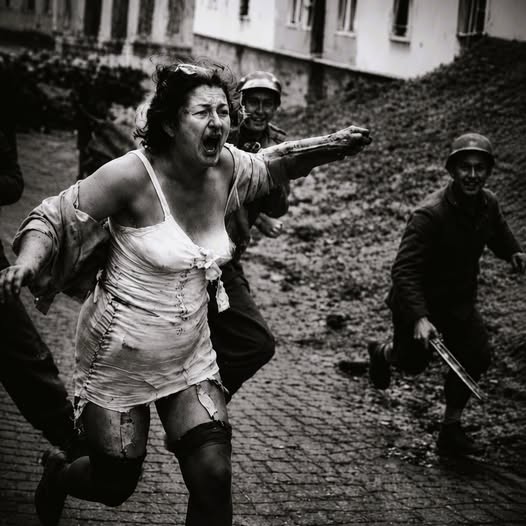
In July 1941, during the Lviv pogrom, a German photographer captured the terror on the face of a middle-aged Jewish woman, bloodied and fleeing from club-wielding tormentors. Stripped of her dignity, she runs down the street in torn white undergarments covered in red blood, screaming in terror. She knows that the people pursuing her are not strangers from some distant land. They are her neighbors. They are among those participating in the slaughter of thousands of Jews.
Her screams do not ask, Why are my neighbors trying to kill me? There is no time for that question. Her body has only one command: Run. Run faster. Do not fall. Falling means: beating, rape, and death.
Yes, the Nazis encouraged the violence. But the perpetrators included Ukrainian nationalists, local residents, and boys who joined the bloodshed with sticks in their hands, bloodlust in their hearts, and smiles on their faces.
Yes, a German camera crew recorded her humiliation, transforming her terror into a spectacle for those who take pleasure in the suffering of the Jews.
And we sit before that photograph, horrified. We study the contortions of her bloodied face. We search her eyes for the pain we can scarcely bear to imagine. We try to feel what she felt, to understand what we cannot understand.
And we murmur the familiar words: Never Again.
But somewhere inside us, we know the terrible truth: it will happen again.
And it will be photographed again.
That photograph has been burned into our collective psyche. It is no longer merely a record of one woman’s terror in one street in one city in 1941. It has become an image of Jewish vulnerability, of the hatred that can turn neighbors into executioners, and of the thin, treacherous line separating civilization from barbarism.
On October 7, we saw that line disappear again.
We saw Jewish women brutalized, raped, abducted, and murdered. We saw the old hatred wearing new faces. And once again, we were forced to confront the question that has haunted Jewish history for centuries: How many times must we watch this happen?
And yes, we recognize ourselves in that fleeing woman. We see her terror, her helplessness, her desperate struggle to survive. We see the Jewish people running through history, pursued from one generation to the next, searching for a place where we can live without fear of the next pogrom, the next Holocaust, the next October 7.
And yes, we insist that those who committed the atrocities of October 7, along with those who knowingly participated in them, must die. Those responsible must be held accountable. Jewish blood cannot be spilled cheaply.
And yes, justice must be done.
Because Never Again cannot remain a whispered prayer over the photographs of hunted down, raped, beaten, and murdered Jewish women.
It must be a promise to the living.