
Never Again Means Recognizing the Sparks: The Sparks on Lexington Avenue
A woman I went to high school with posted something to Facebook last week. We were never close. She was a face in a hallway and she is a name in a feed now, which is how most of us know most people.
What she posted was a screenshot of an editor’s note from New York Magazine, explaining why the magazine had decided the word genocide was an accurate description of Israel’s actions in Gaza. She added one word of her own.
“Yep.”
Gaza is a horror. I am not going to say otherwise, and I am not asking anyone to defend a government.
But I am not writing about Gaza, and I am not writing about whether the word fits. I am writing about what happens when an argument about the actions of a state migrates into something larger and more dangerous.
Whatever its stated purpose, I have watched this argument do something else. It has helped make the collective indictment of Jews respectable.
There is a difference between an inquiry and a campaign. An inquiry has an outcome that could disappoint the people conducting it. A campaign has a conclusion it was built to reach and a fresh occasion every few weeks to reach it again.
Watch one for long enough and the shape becomes unmistakable. The finding never changes. What changes is the number of people who have now heard, from a source they respect, that the boundaries of acceptable speech about Jews have moved.
At some point, scholarship stops functioning as inquiry when its conclusion becomes a slogan, endlessly repeated and increasingly detached from the distinctions scholarship is supposed to preserve.
Look at where the damage falls.
An argument about Israeli policy should remain an argument about Israeli policy. It should land on ministries and ministers and the machinery of a state.
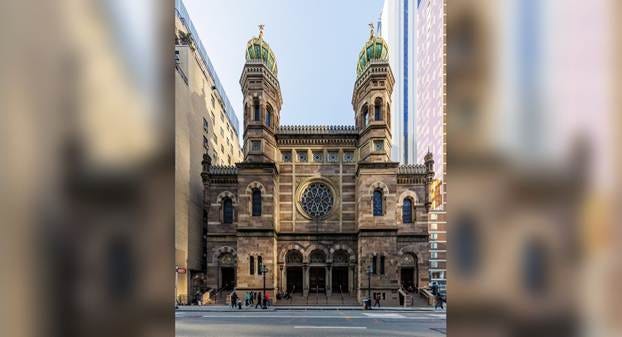
Instead, on a Friday night this month, a man walked into Shabbat services at Central Synagogue on Lexington Avenue, struck a 63-year-old congregant, damaged the sanctuary, and spat at and headbutted a member of the security team before an officer took him down. He now faces state and federal hate crime charges.
New York City’s police commissioner grew up in that congregation. She was married in that building.
In July, a Jewish man who had stepped outside a synagogue on the Upper West Side was stabbed in the chest with a screwdriver. In January, swastikas were painted across a Brooklyn playground.
Through the first seven months of this year, confirmed hate crimes in New York City rose 9.4 percent. Anti-Jewish crimes accounted for nearly 57 percent of them: 205 confirmed incidents in seven months.
Jews are roughly 10 percent of this city. Yet nearly 57 percent of its confirmed hate crimes this year have been anti-Jewish.
This is my city. I grew up here.
Lexington Avenue is not Gaza. The Upper West Side is not a settlement. The woman who was hit at Shabbat did not order an airstrike. Neither did the man who was stabbed in July. Neither did the children whose playground got the swastikas.
That is the danger. A political argument about the actions of a state has migrated thousands of miles and attached itself to Jews who have no power over that state at all.
The line between Israel and Jews was not erased by us. We spent decades insisting on it. Yet Jews here increasingly absorb the consequences of a distinction other people have stopped making.
Here is why I am the one saying this.
For five years I sat with my mother-in-law, Edna, and wrote her Holocaust memoir. I knew her for 37.
She was born at 18 Miła Street in Warsaw, the very address where the ŻOB command bunker would later be located and where Mordechai Anielewicz and dozens of other Jewish fighters made their last stand during the Warsaw Ghetto Uprising.
At 7, she was slipping through gaps in the ghetto wall to smuggle food back to her family.
At 9, having remade herself into a Polish Catholic orphan, she served in the Warsaw Uprising as a courier in the Polish Home Army, one of its youngest decorated fighters.
Pope Pius XII later put a medal around her neck and honored her as a Catholic war hero.
He did not know she was Jewish.
Nobody did.
That was the point.
She remained Catholic in a convent in England until she was 16, when her brother Yakov came for her.
She did not recognize him.
She had no idea who the man in front of her was until he sang her a Yiddish lullaby from their childhood, and something surfaced that had been buried so deep and so deliberately that her own brother’s face could not reach it.
And in her Shoah Foundation testimony, Edna says that Hitler made her hate her parents for being born a Jew.
Sit with that.
It is not a sentence about fear, and it is not a sentence about hiding.
A child was taught, by a world working at full capacity, to resent the two people who had given her the thing that was going to kill her.
The hatred got inside her and turned around and pointed at her own family.
She was 7.
That is what sustained hatred does at its deepest setting. It does not only put Jews in danger. It can teach Jewish children to be ashamed of who they are, long before anyone lays a hand on them.
It did not require Hitler personally standing in front of one little girl. It required saturation. It required that everywhere a child turned, the same message was waiting for her.
Something is saturating again: the idea that Jews may legitimately be made answerable, collectively, for the actions of a government thousands of miles away.
I am watching Jewish students take their Hebrew names off their doors. I am watching people tuck a chai inside a collar on the 1 train. I am watching congregants at Central Synagogue file past armed guards to pray on a Friday night in Manhattan.
And I am watching young Jews run an arithmetic that frightens me: How visibly Jewish is it safe to be?
Some apologize for being Jewish at the very moment they are attacked for being Jewish.
When I hear it, I hear Edna on that tape.
I never expected to recognize the shape of her story from my own window, in the city where I was born.
Jew-hatred did not begin with Hitler, and it did not end with him.
It is one of the oldest sustained hatreds in the West. It does not require a Reich. It goes quiet and it comes back, and when it comes back it dresses itself in whatever the era considers respectable.
It was theology once. Then blood libel. Then race science, complete with journals, professors and institutions. Each supplied its own respectable vocabulary for an ancient prejudice. Many of the people repeating those ideas would have been insulted to be called haters.
That is the part of “Never Again” we have taught wrong.
We taught it as a vow about camps, and so we trained generations to watch for cattle cars.
Nobody in 1932 saw a cattle car.
They saw arguments. Caricatures. Exclusions. They saw respectable people explaining why Jews were the problem. The endpoint was not visible from the beginning.
That is precisely why remembering only the endpoint teaches us so little about prevention.
Never Again cannot mean recognizing the fire. By the time there is a fire, everything after that is counting the dead. It has to mean recognizing sparks.
It has to mean having the willingness to look at something small, respectable and socially acceptable and ask where it leads. It means putting out hatred while it is still small enough to put out, and while saying so costs you nothing worse than an argument at a party.
That is all I am doing here.
I am telling you where the sparks are landing.
So here is what would not fit in a Facebook comment box.
I am not calling anyone a bigot. I am not asking anyone to defend Israel. I am not asking anyone to soften one word about the suffering in Gaza.
I am asking several hundred people I grew up with to understand that they are not observing this from outside it. When you repost a sweeping accusation with one word of agreement, your credibility travels with it. Your friends do not receive it from an institution. They receive it from you.
You become the respectable source.
I am saying this to the people I went to school with because they are the ones I can picture. But I am not only saying it to them.
I am saying it to anyone who read that editor’s note and felt something click into place, and who has not yet asked what else might have clicked into place along with it.
I spent thirty-seven years listening to a Jewish Holocaust survivor describe what happened when hatred became the atmosphere she breathed.
By seven, she had learned to hate the fact that her own parents were Jews.
I know what came later in her world.
None of us knows what comes later in ours.
That is why we do not have the luxury of waiting for fire before we recognize what burns.
The sparks are already landing on Lexington Avenue.
–
Janet Bond Brill, PhD, is the author of Little Edna’s War, based on her mother-in-law’s Holocaust testimony, published on January 27, 2026, on International Holocaust Remembrance Day.